Epitalon Sounds Like the Ultimate Longevity Peptide. So Why Isn’t Everyone Taking It?
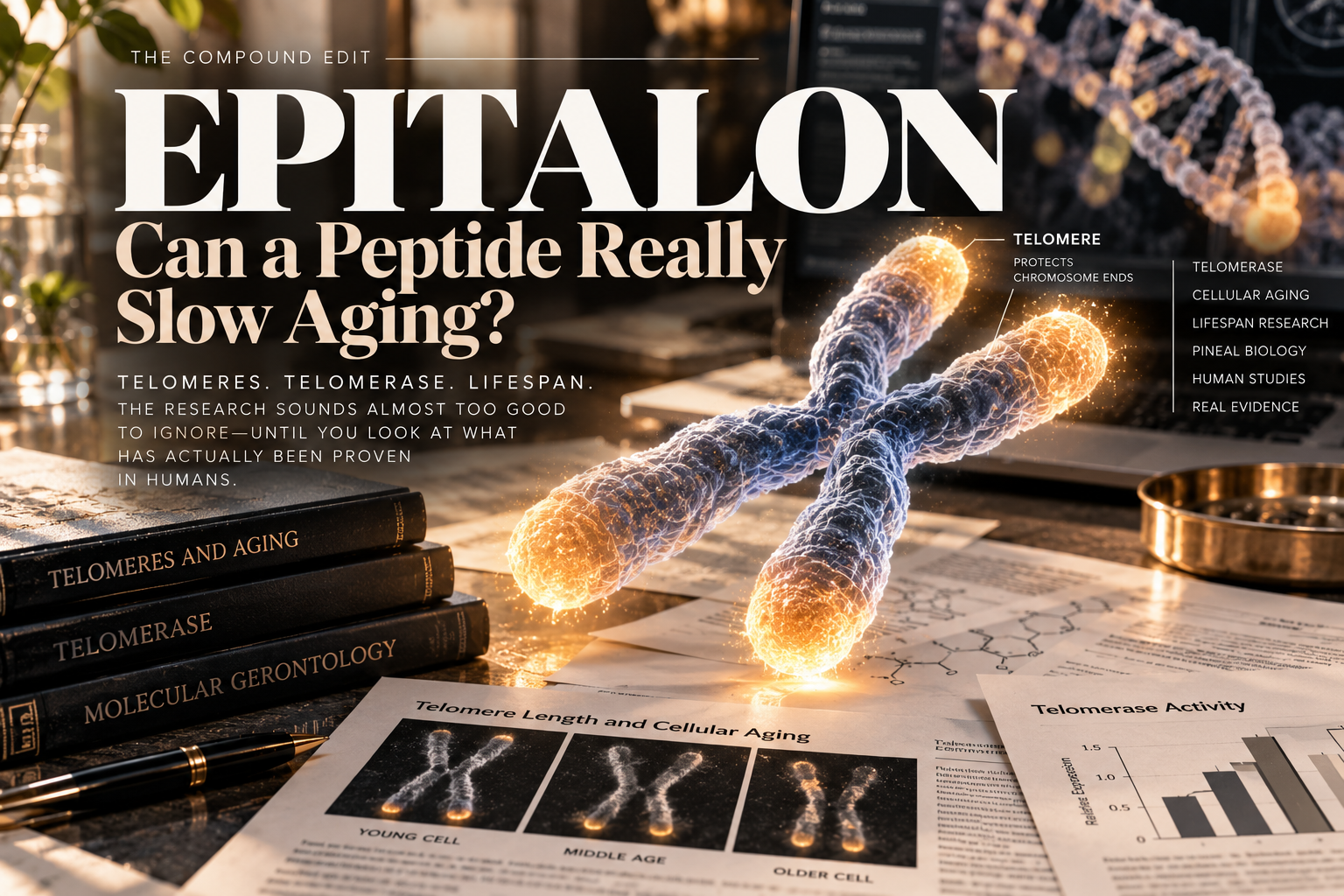
Telomeres. Telomerase. Lifespan. Epitalon has some of the boldest claims in the peptide world—and surprisingly, some of them trace back to real research.
There are peptide claims.
And then there are Epitalon claims.
Spend five minutes researching Epitalon—or Epithalon, as you’ll also see it spelled—and you’ll run into words that sound almost too good to be true:
Telomeres.
Telomerase.
Anti-aging.
Cellular lifespan.
Longevity.
Some corners of the internet talk about Epitalon as though periodically taking a short cycle is basically routine maintenance for the human aging process.
And honestly?
Once you hear the pitch, it’s easy to understand the excitement.
If aging is associated with shortening telomeres…
and Epitalon can activate telomerase…
and telomerase can rebuild telomeres…
then why wouldn’t everyone periodically use Epitalon?
Because biology gets considerably more complicated after that sentence.
The fascinating part is that the Epitalon story wasn’t simply invented by peptide marketing.
Researchers really have reported effects involving telomerase, telomere length, cell division and lifespan in experimental models. More recent laboratory work has continued investigating those effects. PubMed
But there’s a very large distance between:
“A peptide changed telomeres in cells.”
and
“Taking this peptide once or twice a year will make a healthy human live longer.”
Let’s talk about that gap.
First: Epitalon or Epithalon?
You’ll see several spellings online:
Epitalon
Epithalon
and sometimes Epithalone.
They’re generally being used to refer to the tetrapeptide with the amino-acid sequence:
Ala-Glu-Asp-Gly — AEDG
A tetrapeptide is simply a peptide made from four amino acids.
Epitalon’s history is closely connected to Epithalamin, a peptide preparation derived from pineal tissue that was investigated by researchers in Russia and Eastern Europe.
Epitalon was subsequently synthesized based on work involving that pineal peptide preparation. A recent scientific review describes Epitalon/Epithalon as the AEDG tetrapeptide developed from research involving Epithalamin. PubMed
This distinction becomes important later.
Because some of the human longevity claims you’ll see attributed to Epitalon actually come from studies involving Epithalamin.
Those aren’t automatically interchangeable.
And Yes, the Pineal Gland Is Involved
The pineal gland is a tiny endocrine structure in the brain best known for its role in producing:
melatonin.
Melatonin helps regulate circadian rhythms and the sleep-wake cycle.
Researchers studying pineal aging became interested in whether peptide preparations could influence age-related changes in pineal function.
Older research involving Epithalamin in elderly subjects reported changes in nighttime melatonin production, while animal work with Epitalon also investigated age-related pineal and metabolic changes. PubMed
That alone would make Epitalon interesting.
But melatonin isn’t why it became famous.
Telomeres are.
First, What the Hell Is a Telomere?
Imagine your chromosomes are shoelaces.
At the end of a shoelace is that little plastic cap preventing it from fraying.
Telomeres are often described similarly.
They’re repetitive DNA sequences located at the ends of chromosomes that help protect chromosome integrity.
Every time many normal cells divide, telomeres generally become shorter.
Eventually, sufficiently shortened telomeres can contribute to a cell entering senescence or reaching its replicative limit.
Because telomere shortening is associated with aging and numerous age-related processes, telomeres became one of the most recognizable biomarkers in aging research.
Which naturally created a very seductive idea:
If shortening telomeres is associated with aging, wouldn’t making them longer reverse aging?
Not necessarily.
But we’ll come back to that.
Enter Telomerase
Telomerase is an enzyme complex capable of adding telomeric DNA sequences back onto chromosome ends.
Most normal adult somatic cells have relatively low telomerase activity.
Some cells—including certain stem and germ cells—maintain greater activity.
And then there are cancer cells.
Many cancers find ways to maintain their telomeres, frequently through activation of telomerase, allowing continued cellular proliferation.
Already you can see why this biology isn’t simply:
Short telomeres = bad.
Long telomeres = good.
Aging biology almost never gives us something that easy.
So Where Did the Epitalon Telomerase Claim Come From?
This is where the story gets legitimately fascinating.
In early laboratory experiments, researchers treated human fibroblast cells with Epithalon.
They reported induction of the catalytic component of telomerase, increased telomerase activity and elongation of telomeres. PubMed
Another experiment examined aging human fetal fibroblasts that had approached their normal division limit.
After Epithalon treatment, researchers reported telomere elongation and approximately 10 additional passages of cell division compared with untreated cells. PubMed
Read that casually and it sounds enormous.
A peptide made old cells divide longer.
And that’s basically where the internet version of the story begins.
But remember what we just described.
These were:
cells growing in a laboratory.
Not people.
Not people taking a yearly cycle.
Not people living twenty years longer.
Cells.
That’s a very important distinction.
Then Something Interesting Happened in 2025
More than two decades after those early experiments, researchers published another study examining Epitalon and telomere biology in human cell lines.
They reported dose-dependent telomere lengthening in normal epithelial and fibroblast cells alongside increased hTERT expression and telomerase activity. PubMed
So the telomere story hasn’t simply disappeared.
Researchers are still investigating it.
But the study also illustrates exactly why this topic deserves more nuance.
Because the researchers didn’t only study normal cells.
They studied cancer cell lines too.
The Cancer Question Gets Complicated Fast
Before anybody reads the next section as:
Epitalon causes cancer
that’s not what this research established.
But telomerase biology and cancer are deeply connected.
Cancer cells need a way to keep dividing.
If their telomeres continually shortened like those of many normal somatic cells, eventually that would become a major limitation.
Many cancers solve that problem by activating telomere-maintenance mechanisms.
The 2025 Epitalon experiment found telomere-lengthening effects in the cancer cell lines they studied as well, although the researchers reported evidence pointing toward an alternative telomere-lengthening mechanism rather than the same telomerase response observed in normal cells. PubMed
Again:
This does not demonstrate that Epitalon causes cancer in humans.
But it does demonstrate why saying:
“Telomerase is anti-aging, therefore more telomerase is good.”
is biologically naive.
The same cellular machinery can have very different implications depending on context.
Did Epitalon Actually Extend Lifespan?
Here’s another reason the longevity reputation exists.
Researchers have investigated Epitalon in multiple animal models.
One early experiment studied lifespan effects in Drosophila melanogaster—fruit flies. PubMed
Another study followed female mice receiving Epitalon and examined lifespan, aging biomarkers and spontaneous tumor development. PubMed
So when someone says:
“Epitalon has been studied for longevity.”
That’s true.
But the next question should always be:
Longevity in what?
Fruit flies?
Mice?
Cells?
Humans?
Those aren’t interchangeable levels of evidence.
A compound extending lifespan in an animal model is exciting.
It’s also a very long way from proving that it extends human lifespan.
But Haven’t There Been Human Studies?
This is where Epitalon’s story becomes particularly confusing.
Yes, there are human studies associated with the broader pineal-peptide research program.
For example, researchers reported long-term findings involving elderly people treated with Epithalamin, the pineal peptide preparation we mentioned earlier.
One published study described 266 older adults followed for six to eight years and reported lower mortality among groups receiving pineal and/or thymic peptide preparations compared with controls. PubMed
Another randomized study involving elderly coronary-disease patients reported lower mortality during long-term follow-up among participants treated with Epithalamin in addition to basic therapy. PubMed
Those results are certainly interesting.
But here’s the crucial detail:
Epithalamin isn’t the same thing as synthetic Epitalon.
Epithalamin is a peptide preparation derived from pineal tissue.
Epitalon is the specific four-amino-acid synthetic peptide AEDG.
So you can’t simply take a mortality result from an Epithalamin trial and rewrite the conclusion as:
“Epitalon makes humans live longer.”
That’s exactly the type of evidence inflation that happens online.
This Is How the Longevity Story Gets Built
Watch what happens when we remove context.
Research says:
Epitalon affected telomerase and telomere length in cultured human cells. PubMed
Research also says:
Epitalon has been investigated in animal longevity models. PubMed
And separate research says:
Epithalamin was associated with interesting long-term outcomes in some elderly human populations. PubMed
The internet combines those three sentences and produces:
“Epitalon lengthens telomeres and makes humans live longer.”
See what happened?
Every individual ingredient had some basis in research.
The final conclusion still outran the evidence.
That’s why reading the actual study matters.
What About the Famous Epitalon “Cycle”?
This is probably one of the most interesting parts of peptide culture.
Search Epitalon online and you’ll find incredibly specific protocols.
Take it for a certain number of days.
Stop.
Repeat months later.
Some people describe doing a cycle once or twice per year as though this is the established clinical method for maintaining telomeres.
But we don’t have large modern randomized clinical trials demonstrating that an annual Epitalon cycle in healthy adults:
lengthens lifespan
reduces biological age
prevents age-related disease
or
provides a favorable long-term risk-benefit profile.
That’s the part that gets lost.
A protocol being repeated thousands of times online doesn’t transform it into a clinically validated protocol.
And We Don’t Know the Ideal Human Dose
This follows naturally from the previous problem.
If we haven’t established a clinical indication through robust human trials, then we also haven’t established an FDA-approved therapeutic dosing regimen for longevity.
That means claims such as:
“This is the optimal amount.”
or:
“Everyone should do this once a year.”
are much more confident than the evidence allows.
There’s a difference between describing what people in peptide communities do and knowing what humans should do.
The first is an observation.
The second requires considerably better evidence.
The FDA Recently Looked at Epitalon
This is particularly relevant because the regulatory picture is current.
In 2026, FDA reviewed Epitalon-related bulk drug substances as part of its pharmacy-compounding process.
FDA stated that Epitalon isn’t a component of an FDA-approved drug and raised concerns about insufficient human safety information, as well as potential immunogenicity risks associated with aggregation and peptide-related impurities for certain routes of administration. U.S. Food and Drug Administration
FDA’s review materials specifically concluded that it had not identified clinical data supporting Epitalon’s safety for the proposed use and route it evaluated. U.S. Food and Drug Administration
That’s an important counterweight to the way Epitalon is discussed online.
The scientific question isn’t simply:
Could this peptide do something interesting?
It’s also:
Do we know enough about what happens when humans repeatedly take it?
Right now, those aren’t the same question.
What About Side Effects?
This is where the lack of robust clinical development becomes a problem.
When a drug has been tested in thousands of participants across controlled clinical trials, researchers can begin estimating:
common adverse effects,
uncommon adverse effects,
dose-response relationships,
drug interactions,
and longer-term risks.
With Epitalon, we don’t have that type of safety database.
And if the product comes from an unapproved or research market, another layer gets added:
Is the vial actually what the label says it is?
Identity.
Purity.
Potency.
Sterility.
Peptide-related impurities.
Those aren’t philosophical concerns.
They’re part of determining whether an injectable product is safe.
Does Longer Telomere Mean Younger?
This is another longevity-industry shortcut worth challenging.
Telomere length is associated with aging.
But aging isn’t controlled by one measurement.
Biological aging involves enormously complicated interactions among:
genomic stability
epigenetic changes
mitochondrial function
cellular senescence
immune function
protein homeostasis
metabolism
and countless other processes.
You can’t reduce all of that to:
longer telomere = younger person.
Even if an intervention reliably lengthened telomeres in humans, we’d still need to demonstrate that doing so actually improves meaningful outcomes.
Does it reduce disease?
Improve function?
Extend healthy lifespan?
Extend lifespan at all?
Those are the outcomes people actually care about.
This Is Why Epitalon Is So Damn Interesting
Normally when we investigate an overhyped compound, the conclusion is fairly straightforward.
Interesting mouse research.
Internet got excited.
Human evidence isn’t there yet.
Epitalon is a little stranger.
There’s research stretching back decades.
There’s cell biology involving telomerase.
There’s animal longevity work.
There’s pineal biology.
There’s melatonin research.
There’s a body of older Eastern European work involving related peptide preparations.
And now we’re seeing newer molecular research revisit some of those old telomere claims. PubMed
That’s genuinely fascinating.
But fascinating isn’t synonymous with proven.
And maybe Epitalon is the perfect example of why those two words need to stay separate.
So Why Isn’t Everyone Taking It?
We’re finally back to our original question.
If Epitalon might influence telomeres…
and aging…
and pineal function…
and perhaps longevity…
why wouldn’t everyone take a cycle once a year?
Because we don’t yet know whether doing that produces a meaningful longevity benefit in healthy humans.
We don’t know the optimal exposure.
We don’t have a large modern human safety database.
We don’t know the consequences of repeatedly manipulating these pathways over decades.
And we don’t have evidence demonstrating that the annual cycles promoted online actually extend healthy human lifespan.
That’s not proof that Epitalon doesn’t work.
It’s an acknowledgement that the most important experiment hasn’t been done convincingly yet.
The Compound Edit Takeaway
Epitalon deserves a more nuanced conversation than either extreme gives it.
Calling it:
“an anti-aging scam”
ignores some genuinely interesting experimental research.
Calling it:
“a peptide that lengthens your life”
goes much further than that research allows.
Epitalon has been investigated in cells and animals for effects involving telomerase, telomeres, pineal biology and longevity. Laboratory studies have reported telomerase activation and telomere elongation in certain normal human cells. PubMed
But we do not currently have compelling evidence that taking an annual Epitalon cycle makes healthy humans live longer.
And some of the human longevity evidence frequently associated with the name actually involved the related pineal preparation Epithalamin, not synthetic Epitalon itself. PubMed
That’s a distinction worth remembering.
Because perhaps the most exciting thing about Epitalon isn’t that we’ve discovered how to slow human aging.
It’s that a four-amino-acid peptide may interact with some extraordinarily interesting pieces of aging biology.
Whether we can turn that biology into a safe, effective human longevity intervention?
That’s the part of the story researchers still need to prove.
Continue Exploring
The Compound Edit follows the evolving science around peptides, metabolic health, recovery, performance and longevity—while separating what research actually shows from what’s gaining traction online.
The Compound Edit is affiliated with Chuk BioWorks. You can read more about that connection and how we approach editorial independence here.
EXPLORE CHUK BIOWORKS → www.chukbioworks.com
The Compound Edit is for educational and informational purposes only and does not provide medical advice. Epitalon is not an FDA-approved longevity treatment, and discussion of investigational compounds or protocols should not be interpreted as a recommendation for human use.