
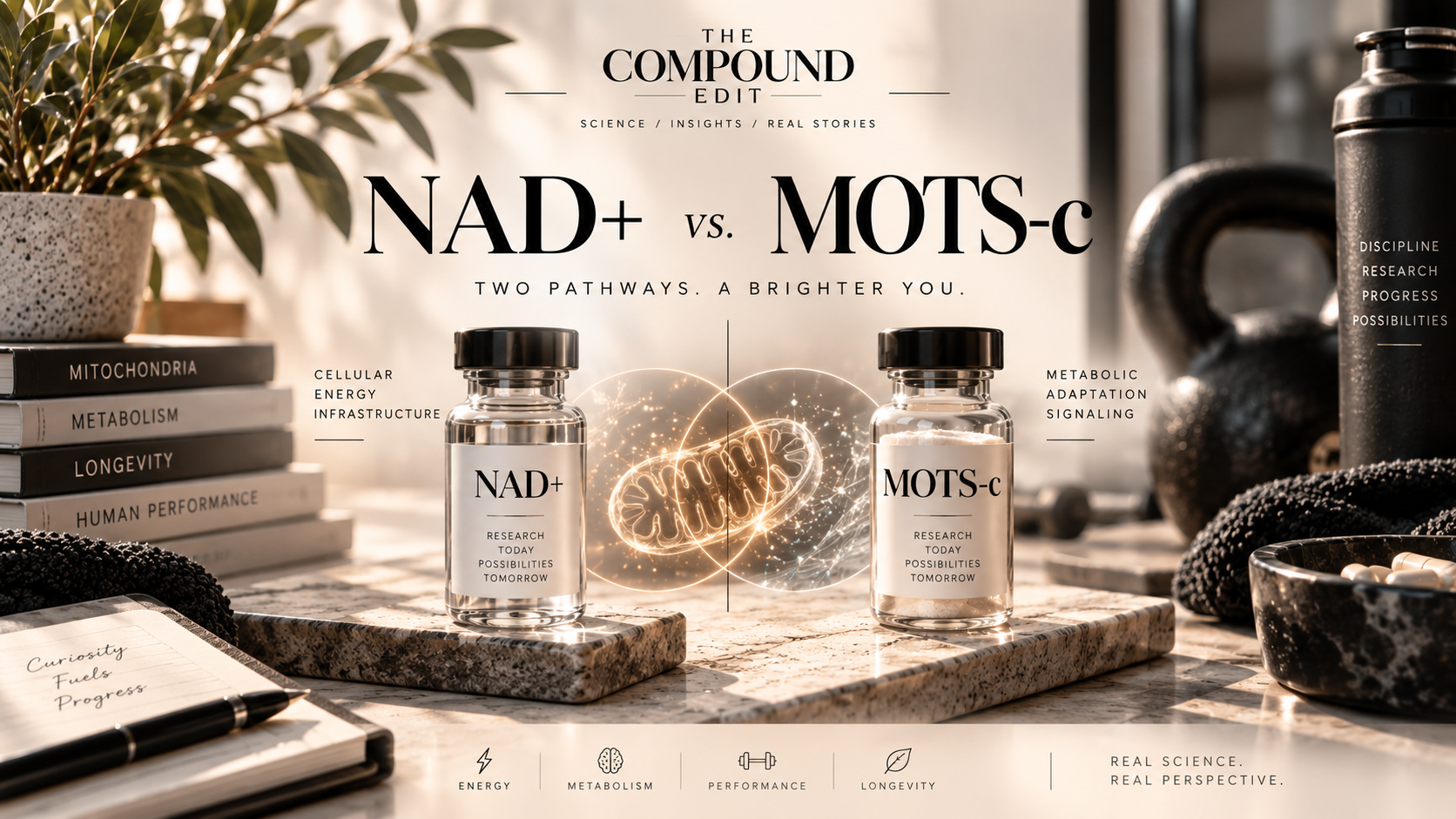
NAD+ vs. MOTS-c: They’re Both Called “Energy” Compounds — But They’re Not Doing the Same Thing
One supports the machinery. The other may help tell the machinery how to adapt.
Spend enough time in the peptide and longevity world and eventually two names start showing up in the same conversation:
NAD+. MOTS-c.
Both get associated with mitochondria. Both get mentioned alongside energy, metabolism, exercise and longevity. And both have somehow earned a reputation as things people reach for when they’re tired of feeling… tired.
So naturally, the question becomes:
Which one is better for energy?
The answer is more interesting than picking a winner.
Because NAD+ and MOTS-c aren’t really two versions of the same thing.
They’re involved in cellular energy from completely different angles.
First: What Do We Actually Mean by “Energy”?
When most of us say we want more energy, we’re thinking about something very human:
Getting out of bed without feeling wrecked.
Making it through the afternoon without reaching for another coffee.
Actually wanting to go to the gym after work.
Feeling like your body can do things again.
But biologically, energy starts much deeper.
Your cells are constantly converting nutrients into usable cellular energy, much of it in structures called mitochondria. And that’s where both NAD+ and MOTS-c enter the conversation — just in very different ways.
NAD+: Part of the Energy Machinery
NAD+ — nicotinamide adenine dinucleotide — isn’t a peptide.
It’s a molecule naturally present in our cells, and it plays a fundamental role in metabolism.
One of its most important jobs is helping transfer electrons during the reactions your cells use to ultimately produce ATP, the molecule commonly described as the cell’s energy currency.
Put simply:
Your cellular energy system needs NAD+ to operate.
NAD+ is also involved in DNA repair, cellular signaling and enzymes associated with metabolic regulation and stress responses.
That’s a big reason NAD+ became such a massive topic in longevity research.
But here’s where wellness marketing sometimes gets ahead of the science.
The fact that NAD+ is essential for cellular energy production does not automatically mean that taking more NAD+ will make a person feel dramatically more energetic.
Research on NAD+-boosting strategies in humans has shown that compounds such as NR and NMN can alter NAD-related biomarkers, but improvements in functional outcomes have been inconsistent. A 2026 systematic review similarly found plenty of biological activity but concluded that clinical effectiveness for wellness and anti-aging outcomes remains uncertain.
And there’s another important distinction: much of the human research involves NAD+ precursors, not the injectable NAD+ commonly discussed in wellness circles.
There still isn’t strong clinical evidence establishing injectable NAD+ as an energy treatment in otherwise healthy people.
So NAD+ may be better thought of as part of the cellular energy infrastructure rather than a biological espresso shot.
MOTS-c: More Like a Metabolic Messenger
MOTS-c is a completely different animal.
It’s a tiny, 16-amino-acid peptide encoded within mitochondrial DNA — part of an intriguing family known as mitochondrial-derived peptides.
Rather than functioning as a basic ingredient required for ATP production, MOTS-c appears to participate in communication about metabolic stress and adaptation.
One pathway receiving considerable attention is AMPK — essentially one of the cell’s major energy-sensing systems.
Research suggests MOTS-c can influence this pathway and affect glucose metabolism, insulin sensitivity and cellular responses to metabolic stress.
And this is where things get especially interesting for anyone who trains.
MOTS-c has an unusual relationship with exercise.
Human studies have found that exercise can affect naturally occurring mitochondrial-derived peptides, including MOTS-c, although findings haven’t been completely consistent between studies.
Animal experiments go further.
In mice, externally administered MOTS-c has improved physical performance and produced some metabolic adaptations resembling those associated with physical activity. That’s why you’ll sometimes hear MOTS-c described as an “exercise mimetic.”
Which sounds incredible.
But there’s a giant asterisk attached.
Most of the exciting intervention data are still preclinical.
A recent systematic review examining mitochondrial-derived peptides and exercise concluded that the available evidence is promising but human research remains limited, with more controlled trials needed.
That distinction matters.
So Why Might NAD+ and MOTS-c Feel Different?
Conceptually, think about it this way:
NAD+ = cellular energy infrastructure
NAD+ participates directly in the biochemical reactions your cells depend on to generate energy.
MOTS-c = metabolic adaptation signaling
MOTS-c appears to help cells respond to energetic stress and adjust how fuel is handled.
That’s an oversimplification — biology always is — but it’s a useful way to understand why these two compounds shouldn’t really be treated as interchangeable.
One isn’t simply a stronger version of the other.
They’re operating at different points in an extraordinarily complicated system.
What About Gym Energy?
This might be the biggest misconception.
Neither NAD+ nor MOTS-c should be confused with a stimulant.
We’re not talking about caffeine kicking in 30 minutes before leg day.
The interesting research surrounding these compounds is happening at the level of cellular metabolism, mitochondrial signaling and metabolic adaptation.
With MOTS-c specifically, its relationship with exercise is one reason athletes and longevity enthusiasts have become fascinated by it.
Researchers have observed increases in naturally occurring MOTS-c in response to certain forms of exercise, while animal research suggests externally administered MOTS-c can influence exercise capacity and metabolic adaptation.
That’s scientifically interesting.
It’s just not the same thing as proving that someone injecting MOTS-c will walk into the gym feeling like they suddenly gained another gear.
We aren’t there yet.
Could They Work Together?
Mechanistically, it’s easy to understand why people group them together.
One sits inside fundamental cellular energy chemistry.
The other appears involved in the way mitochondria communicate metabolic stress and adaptation.
But a plausible biological story isn’t the same thing as clinical evidence.
There isn’t strong human trial evidence demonstrating that combining injectable NAD+ and MOTS-c produces better energy, athletic performance or longevity outcomes than either approach alone.
That’s an important distinction in a space where stacks often become popular much faster than the research behind them.
The Most Interesting Part Isn’t Which One “Wins”
Maybe we’re asking the wrong question.
Instead of:
NAD+ or MOTS-c?
The more interesting question might be:
How much of the way we experience energy is actually being controlled by mitochondrial health and metabolic signaling?
NAD+ research has helped scientists explore the chemistry cells require to produce and maintain energy.
MOTS-c research is opening another door — the possibility that mitochondria aren’t simply tiny power plants sitting quietly inside our cells.
They’re communicating.
They’re sensing stress.
They’re responding to exercise.
And they may even be sending tiny peptides throughout the body that help coordinate those responses.
That story is still being written.
And that’s exactly what makes it interesting.
The Compound Edit Takeaway
If you hear NAD+ and MOTS-c described as two compounds that “give you energy,” that’s probably too simple.
NAD+ is fundamental to cellular energy metabolism. MOTS-c is an experimental mitochondrial-derived peptide being studied for its role in metabolic signaling and adaptation.
Both have fascinating biology.
Neither currently has strong evidence supporting the kind of guaranteed energy transformation sometimes portrayed online — particularly when discussing injectable wellness use.
The research is exciting.
The marketing is often several chapters ahead of it.
And around here, we’re interested in knowing the difference.
Continue Exploring
The Compound Edit follows the evolving science surrounding peptides, metabolic health, recovery, performance and longevity — separating what researchers actually know from what’s simply gaining traction online.
The Compound Edit is affiliated with Chuk BioWorks. That relationship helps support this publication, but our goal here remains the same: explore the research honestly, including where evidence is promising, uncertain or simply not there yet.
EXPLORE CHUK BIOWORKS → www.chukbioworks.com
The Compound Edit is for educational and informational purposes only and is not medical advice. Compounds discussed may be experimental, investigational, or not approved for human use. Always discuss medical decisions with a qualified healthcare professional.