

Why Does Retatrutide Feel Like It Stopped Working?
When the appetite suppression isn’t as obvious as it used to be, does that actually mean the compound stopped working?
If you’ve spent any time reading conversations about retatrutide, you’ve probably seen some version of this:
“It worked amazingly at first. Now I’m hungry again. Did it stop working?”
It’s an understandable question.
Early on, some people describe the change in appetite as almost impossible to miss. Food occupies less mental space. Portions get smaller. Getting full can happen surprisingly quickly.
Then, weeks or months later, something changes.
You notice you’re hungry before dinner again. You can finish more of your meal. Maybe the scale isn’t dropping as dramatically as it did in the beginning.
And suddenly it feels like the magic disappeared.
But feeling different doesn’t necessarily mean retatrutide has stopped having an effect.
The beginning can set an unrealistic expectation
One reason the later months can feel disappointing is simply because the beginning can feel so dramatic.
Retatrutide is being studied as a triple receptor agonist, acting at GLP-1, GIP and glucagon receptors. In the published Phase 2 obesity trial, decreased appetite and early satiety were among the reported effects.
When someone experiences strong appetite suppression early on, that sensation can become their personal definition of whether the compound is “working.”
But appetite isn’t an on/off switch.
Being able to feel hunger again doesn’t automatically mean there’s no longer an effect.
Look at the trend, not just today’s hunger
This is probably the biggest distinction.
“Am I hungry?” and “Is this still affecting my weight and eating behavior?” aren’t necessarily the same question.
Instead of judging everything by appetite suppression alone, it can be more useful to look at the bigger picture.
Are portions still different than they were before? Are you getting full sooner? Is food easier to walk away from? What has happened to weight and waist measurements over the last four to eight weeks rather than the last four days?
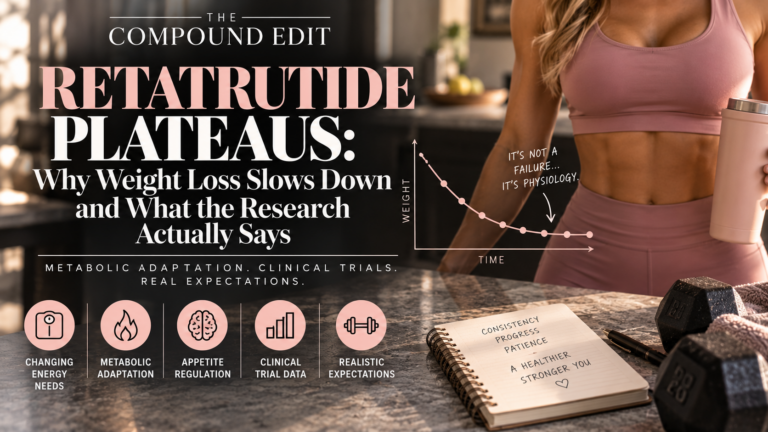
That longer view matters because weight loss isn’t normally linear.
The research gives us an interesting clue
The Phase 2 trial followed participants for 48 weeks.
At week 24, average weight reductions ranged from 7.2% to 17.5%, depending on the retatrutide group.
But weight loss didn’t simply stop there.
By week 48, average reductions ranged from 8.7% to 24.2%. In fact, investigators reported that participants receiving the higher dose continued losing weight through the end of the treatment period and that the weight-loss curves had not yet clearly reached a plateau.
That’s worth remembering.
The subjective feeling of appetite suppression isn’t the same thing researchers use to determine whether a treatment is producing an effect.
A slower scale isn’t necessarily a stalled compound
There’s another issue that’s easy to overlook.
Imagine someone starts at 250 pounds and loses 30, 40 or 50 pounds.
They’re now maintaining a considerably smaller body.
The experience at month eight shouldn’t necessarily be expected to look exactly like month one.
Changes in body size, food intake, activity, hydration and many other factors can change the rate at which someone’s weight moves.
A week—or even several weeks—of slower progress isn’t enough by itself to establish that retatrutide suddenly quit working.
And more isn’t automatically the answer
This is where online conversations can get messy.
Someone posts that they’re hungry again and inevitably receives some version of:
“Just increase the dose.”
That’s not a conclusion strangers on the internet can safely make from one symptom.
In the Phase 2 trial, gastrointestinal side effects were dose-related, and gradual dose escalation was part of the study design. Researchers also observed dose-dependent increases in heart rate that peaked around week 24 before declining later in the trial.
So chasing the strongest possible appetite suppression isn’t a particularly good way to evaluate what’s happening.
Hunger isn’t failure
This may be the most important takeaway.
Feeling appropriately hungry isn’t inherently a bad thing.
The goal shouldn’t necessarily be to reach a point where the thought of food is unpleasant or eating becomes difficult.
There’s a big difference between:
“I’m hungry for dinner.”
and
“My appetite and eating patterns are completely back to where they were before.”
Those two situations can feel similar in the moment, but they aren’t the same.
What we’d watch instead
If the effect seems weaker, zoom out.
Look at several weeks rather than several days. Look at portions, fullness, cravings, body measurements and weight trends together rather than using hunger as the only measuring stick.
And if there’s been a genuine sustained change—or significant side effects—that’s something to discuss with a qualified healthcare professional rather than automatically changing treatment based on social-media advice.
Retatrutide is an interesting compound precisely because we’re still learning about it.
And sometimes the answer to “Why doesn’t this feel like it did in the beginning?” may simply be:
Because the beginning isn’t supposed to last forever.
The Compound Edit covers emerging research, experiences and conversations surrounding health and investigational compounds. This article is for educational purposes and is not medical advice.
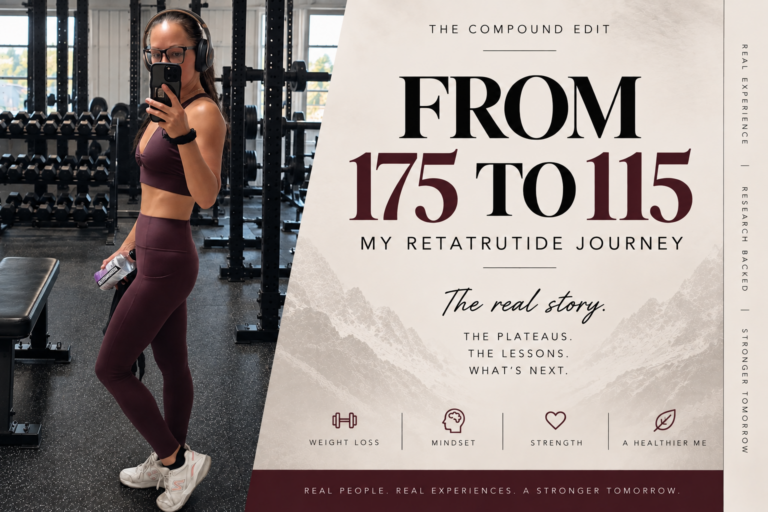
I’ve experienced the dramatic early-loss phase and the slower periods myself, which I documented in my personal 175-to-115-pound retatrutide journey.
Continue Exploring
The Compound Edit is affiliated with Chuk BioWorks, a research compound company. If you’re interested in exploring the compounds discussed throughout The Compound Edit, you can learn more through Chuk BioWorks.
EXPLORE CHUK BIOWORKS → www.ChukBioWorks.com
Disclosure: The Compound Edit is affiliated with Chuk BioWorks. Content on The Compound Edit is provided for educational purposes and does not constitute medical advice.



One Comment
Comments are closed.