I Wasn’t Expecting This After Shoulder Surgery: My Experience With BPC-157 & TB-500
Spend enough time in recovery forums, gyms, or peptide communities and eventually you’ll hear a story that sounds something like this:
Someone has shoulder surgery.
They’re told recovery will take months. There’s a sling, physical therapy, limited range of motion and the frustrating realization that healing doesn’t happen nearly as quickly as they’d like.
Then someone mentions two names:
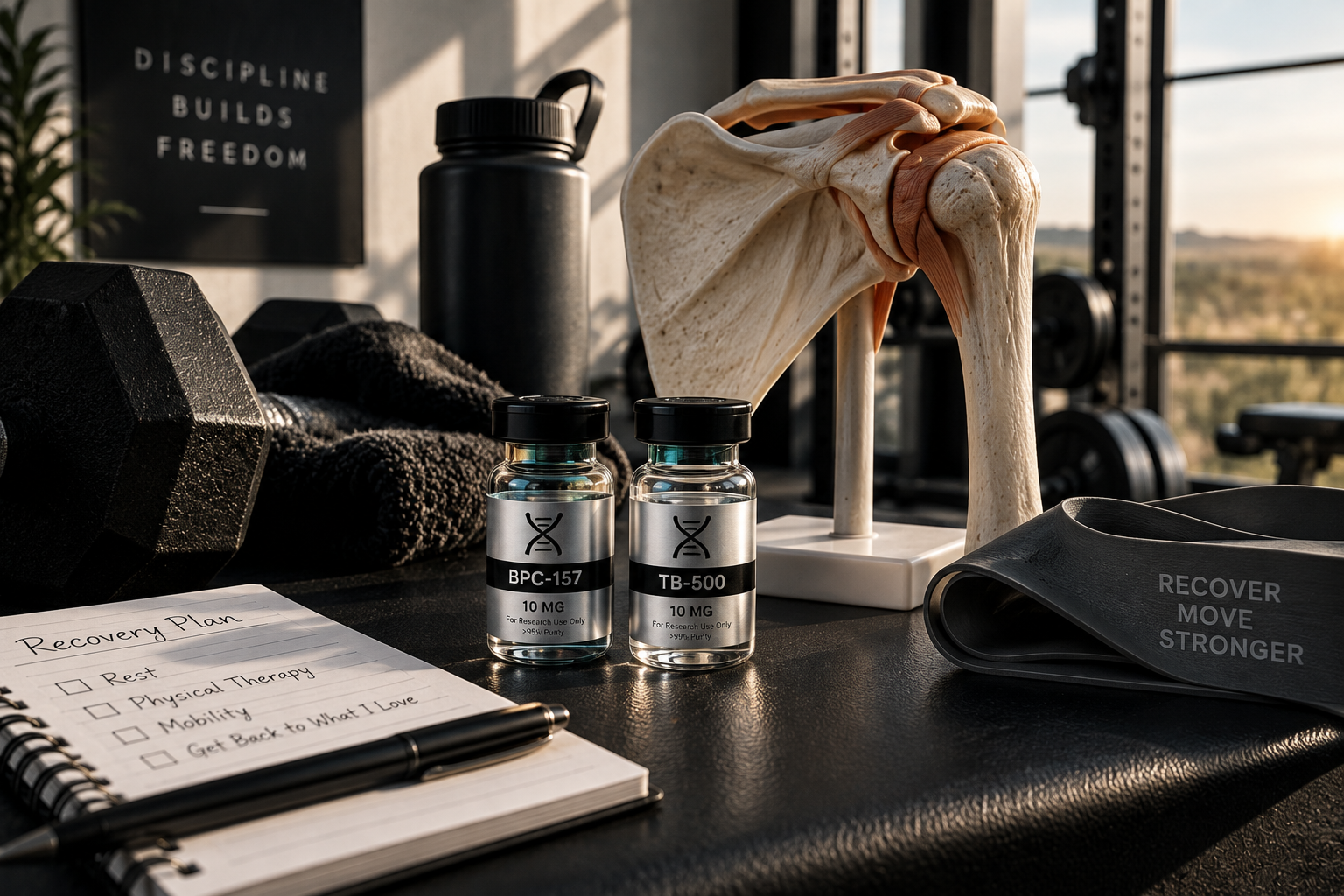
BPC-157 and TB-500.
Maybe it’s a friend at the gym. Maybe it’s someone who had a similar surgery. Maybe it’s a recovery story buried deep in an online forum.
And the claims can be pretty remarkable.
Less discomfort. Better mobility. Faster progress in physical therapy. Incisions that seem to heal beautifully. Getting back into the gym sooner than expected.
We’ve seen enough of these stories that we wanted to know:
Is there actually something here?
The shoulder-surgery stories are everywhere
One particularly interesting account came from someone documenting recovery after Latarjet shoulder surgery.
The poster described using BPC-157 and a thymosin-beta-4 product during an eight-week period following surgery.
Months later, they returned with an update.
They reported less inflammation and pain than expected, very little scar tissue, an incision that appeared to heal well and a return to light lifting relatively early in recovery.
That sounds impressive.
But what they said next may be even more important:
They couldn’t say with certainty that the peptides caused it.
They acknowledged that their age, normal healing, rehabilitation—or even placebo—could have contributed.
And that’s the problem with almost every recovery story like this.
When you’re healing, a lot is happening at once
Think about what someone recovering from shoulder surgery might be doing.
They’re resting.
They’re following a structured rehabilitation program.
They’re gradually increasing movement.
They’re doing physical therapy.
They may be prioritizing protein, sleep and nutrition more than they did before surgery.
And most importantly—the body is already healing.
If someone introduces BPC-157 or TB-500 during that same period and then improves, it’s incredibly difficult to determine how much of that improvement came from the compound versus everything else happening simultaneously.
That’s why personal experiences can be fascinating without being proof.
And not everyone reports a miracle
This is the part that often disappears when these compounds are discussed online.
For every dramatic recovery story, there are also people saying:
“I didn’t notice much.”
In one shoulder-recovery discussion, someone reported using BPC-157 and TB-500 for approximately two months and ultimately described the experience as money wasted.
Another person with a suspected labrum injury reported that they might have experienced some temporary pain relief but certainly didn’t consider themselves healed.
That’s important.
Anecdotes exist on both sides.
So why are researchers interested in these compounds at all?
The enthusiasm didn’t appear completely out of nowhere.
BPC-157 has attracted attention in experimental research involving tissue repair and healing pathways.
Thymosin beta-4 has also been investigated for biological processes involved in tissue repair, cell migration, blood-vessel formation and wound healing.
That’s scientifically interesting.
But there’s a huge distinction between:
“This mechanism looks interesting in laboratory or animal research.”
and
“This has been proven to accelerate recovery after human shoulder surgery.”
Those statements are nowhere near equivalent.
TB-500 makes the story even more complicated
TB-500 and thymosin beta-4 are frequently talked about online as though they’re interchangeable.
They aren’t necessarily the same thing.
A 2026 review examining thymosin beta-4 and TB-500 found that most of the research was actually performed on thymosin beta-4—not the TB-500 products commonly discussed online.
The researchers concluded that evidence related directly to human musculoskeletal repair remains limited and that direct evidence for TB-500 itself is particularly sparse.
That’s a pretty important distinction when someone says:
“Studies show TB-500 heals injuries.”
The actual research landscape is considerably more complicated.
What about BPC-157?
BPC-157 has a similar problem.
There’s plenty of excitement surrounding experimental findings, particularly from animal research.
What we don’t have is the kind of robust human clinical evidence we’d want before confidently saying that BPC-157 improves recovery after rotator cuff repair, labrum surgery or other orthopedic procedures.
And without controlled human trials, it’s impossible to know how much of the dramatic improvement reported online would have happened anyway.
The safety question matters too
There’s another side to this conversation that deserves more attention.
These aren’t established, FDA-approved post-surgical recovery treatments.
The FDA has specifically noted the lack of human exposure and clinical safety data for TB-500, meaning potential risks in humans aren’t well characterized.
That doesn’t automatically tell us a compound is harmful.
It tells us something different:
We don’t know enough yet.
And “we don’t know” is an important answer in emerging research.
So what should we make of all these recovery stories?
We wouldn’t dismiss them.
Anecdotes are often where interesting scientific questions begin.
When unrelated people repeatedly report similar experiences, it’s reasonable to become curious about what’s happening.
But curiosity and proof aren’t the same thing.
A surprisingly fast shoulder recovery could involve the peptide.
It could involve excellent physical therapy.
It could involve age, genetics, nutrition, sleep, the skill of the surgeon, the severity of the original injury—or some combination of all of them.
Without controlled human research, there’s simply no reliable way to separate those factors.
The part we find most interesting
Maybe the real story isn’t:
“BPC-157 and TB-500 dramatically accelerate shoulder recovery.”
We don’t currently have the human evidence to make that statement.
The more interesting story is:
Why are so many people convinced that they do?
That’s a question worth investigating.
For now, BPC-157 and TB-500 sit in that fascinating—and sometimes frustrating—space between promising experimental research and widespread real-world experimentation.
There are compelling stories.
There are disappointing stories.
There are intriguing biological mechanisms.
And there are still some very big unanswered questions.
We’ll be watching the research.
The Compound Edit explores emerging research and the experiences being discussed around investigational compounds. Experiences described in this article are anecdotal and cannot establish that a compound caused a particular outcome. BPC-157 and TB-500 are not FDA-approved treatments for post-surgical shoulder recovery. This article is for educational purposes and is not medical advice.
Continue Exploring
The Compound Edit is affiliated with Chuk BioWorks, a research compound company. If you’re interested in exploring the compounds discussed throughout The Compound Edit, you can learn more through Chuk BioWorks.
EXPLORE CHUK BIOWORKS → www.ChukBioWorks.com
Disclosure: The Compound Edit is affiliated with Chuk BioWorks. Content on The Compound Edit is provided for educational purposes and does not constitute medical advice.