
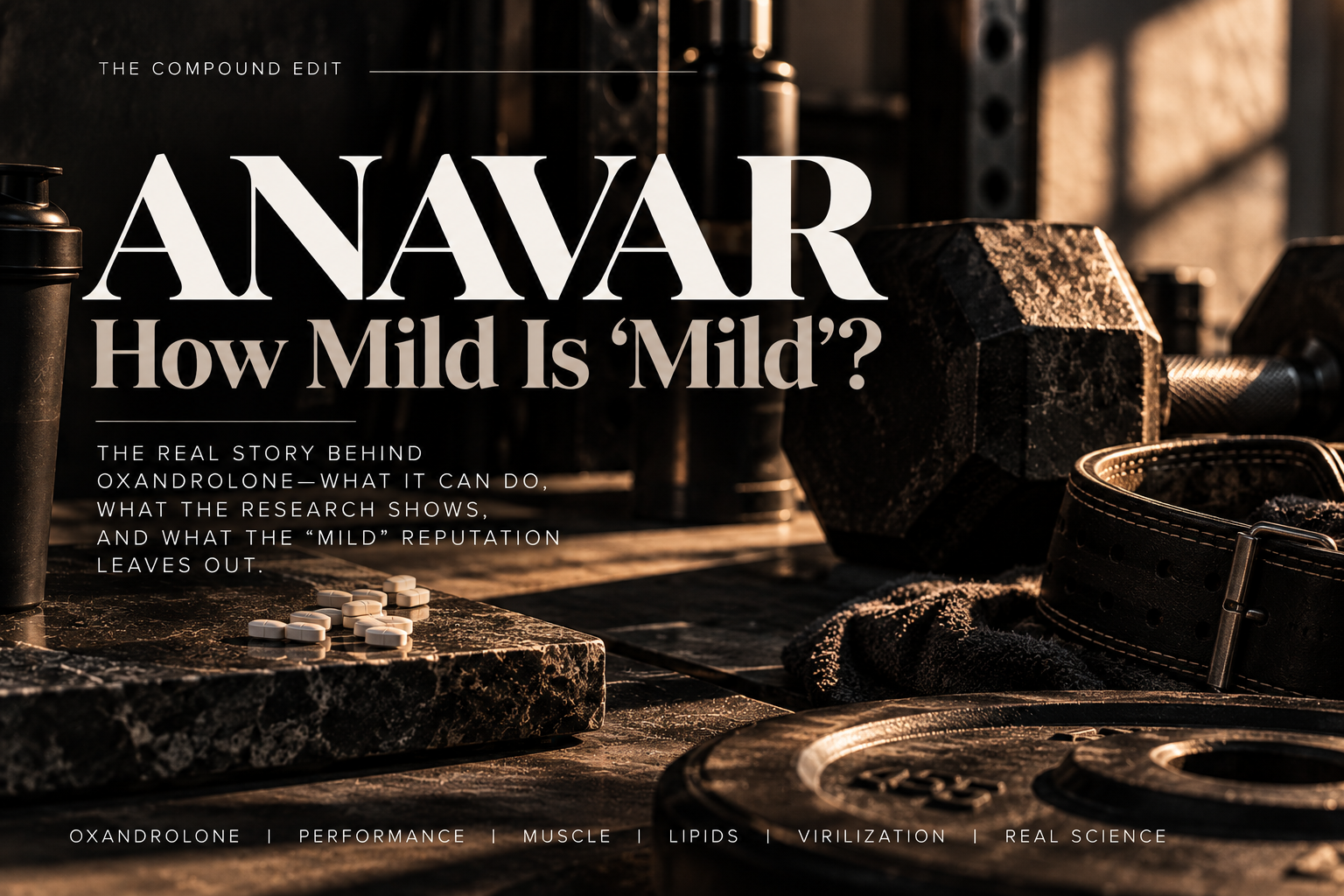
Anavar Has a Reputation as the “Mild” Steroid. Is It Actually Mild?
Oxandrolone has become especially popular among women and people who want muscle without the stereotypical “steroid look.” But mild is a relative term—and it definitely doesn’t mean harmless.
Say the word steroids and most people picture something pretty specific.
Huge bodybuilders.
Needles.
Acne.
Aggression.
Massive amounts of muscle.
Then there’s Anavar.
In bodybuilding circles, Anavar tends to be described very differently.
You’ll hear:
“It’s mild.”
“It’s one of the safest steroids.”
“It’s the steroid women use.”
“It doesn’t really have side effects.”
That reputation has made Anavar feel almost like the exception to the steroid rule.
But Anavar is still an anabolic-androgenic steroid.
Its real name is oxandrolone.
And while there are legitimate reasons it earned a reputation for being less androgenic than many other anabolic steroids, somewhere along the way:
“Less androgenic” became “safe.”
Those aren’t the same thing.
First: Anavar Wasn’t Invented for Bodybuilding
Oxandrolone was developed as a pharmaceutical drug.
It has been medically studied in situations involving severe burns, wasting and other catabolic conditions where preserving or restoring lean tissue can be important.
Clinical research has demonstrated that oxandrolone can increase or preserve lean body mass in certain patient populations. PubMed
So unlike some performance-enhancing compounds discussed online, Anavar isn’t based entirely on bodybuilding lore.
It has real anabolic activity.
That’s precisely why people became interested in using it for physique enhancement.
What Does “Anabolic” Actually Mean?
Anabolic-androgenic steroids are related to testosterone and interact with the androgen receptor.
The two words describe effects people often try to separate:
Anabolic refers broadly to tissue-building effects, particularly involving muscle.
Androgenic refers to effects associated with male sexual characteristics.
Bodybuilders would obviously love a drug that’s enormously anabolic and barely androgenic.
And oxandrolone developed a reputation for having a comparatively favorable anabolic-to-androgenic profile.
That’s where the word “mild” starts entering the conversation.
But here’s the problem:
You can’t completely separate anabolic effects from androgenic biology.
Especially in women.
Why Anavar Became So Popular With Women
This deserves its own section because Anavar occupies a strange place in women’s fitness culture.
Women who would never consider themselves “steroid users” will sometimes talk about Anavar very casually.
And oxandrolone does appear frequently among women who use anabolic steroids for physique or strength purposes. A recent clinical cohort of female amateur athletes with histories of non-prescribed androgen use found oxandrolone was by far the most commonly reported androgen. PubMed
Part of the attraction is obvious.
People want:
more muscle
more strength
better muscle retention while dieting
and a harder or leaner appearance.
But they don’t necessarily want the androgenic changes associated with more strongly masculinizing steroids.
So Anavar gets presented as the compromise.
An anabolic steroid without all the “steroid stuff.”
Except that’s not really how it works.
Let’s Talk About Virilization
This is probably the most important part of the Anavar conversation for women.
Virilization refers to the development of male-pattern characteristics from androgen exposure.
Potential signs associated with oxandrolone include:
voice deepening or hoarseness
increased facial or body hair
acne
male-pattern hair loss
menstrual changes
and clitoral enlargement.
Official oxandrolone labeling specifically warns women to watch for these changes and notes that some virilizing effects may be irreversible even after the drug is discontinued. DailyMed
That last part deserves more attention than it gets.
If you stop taking something because you’re retaining water, the water can disappear.
A permanently deepened voice is a very different situation.
“But Isn’t Anavar Less Androgenic?”
Relatively speaking, yes.
That’s part of why oxandrolone has been useful medically and why it became attractive to women.
But less androgenic doesn’t mean non-androgenic.
Think of it this way:
If one drug has a greater tendency to produce androgenic effects than another, the second drug may reasonably be described as less androgenic.
That does not mean the risk is zero.
And women generally have much lower baseline androgen exposure than men.
Changes that might be relatively unremarkable in a male hormonal environment can be much more noticeable in a woman.
A broad review of anabolic-steroid use notes that women can experience voice changes, hirsutism, clitoral enlargement and menstrual disruption with androgen exposure. PubMed Central (PMC)
The Voice Change Deserves Special Attention
This is one side effect that gets brushed off surprisingly often.
Someone notices they’re slightly hoarse.
Maybe their voice sounds rough in the morning.
They assume they’re getting sick.
Then it gets deeper.
Oxandrolone’s prescribing information specifically lists deepening of the voice among virilizing effects in women and warns that some changes may not reverse completely after stopping. DailyMed
That’s why early androgenic symptoms aren’t something to casually “push through.”
The internet tends to frame side effects as inconveniences.
Some are potentially lasting biological changes.
Anavar Doesn’t Convert to Estrogen the Way Testosterone Does
Another reason people consider Anavar “clean” is that oxandrolone isn’t aromatized into estrogen.
That means it doesn’t produce estrogen through the same aromatase pathway as testosterone.
This helps explain why Anavar isn’t particularly associated with some estrogen-mediated effects people associate with testosterone-based anabolic-steroid use.
But again:
Removing one pathway doesn’t remove every risk.
A compound can avoid aromatization and still affect the liver, lipids, reproductive hormones and androgen-sensitive tissues.
The Cholesterol Part Is Easy to Miss
If you only judge a drug by how you feel, this is where you can get fooled.
You can feel completely normal while your lipid profile changes.
Anabolic steroids can:
decrease HDL cholesterol
and
increase LDL cholesterol.
Oxandrolone labeling specifically warns about these effects and recommends periodic lipid monitoring. DailyMed
A clinical review also identified reductions in HDL as one of the commonly documented adverse effects of oxandrolone. PubMed
That’s particularly important because people often use Anavar specifically because they believe it’s the “healthier” steroid.
Feeling fine doesn’t tell you what your cholesterol is doing.
And Yes, It’s an Oral Steroid
Oxandrolone is a 17-alpha-alkylated anabolic steroid.
That chemical modification helps it survive oral administration.
It also means liver effects are part of the conversation.
Medical references warn about elevations in liver enzymes and potentially serious hepatic complications associated with this class, particularly with prolonged or high exposure. MedlinePlus
Oxandrolone may have a reputation for being better tolerated than some other oral anabolic steroids, and clinical literature has described transient liver-enzyme elevations rather than severe toxicity in many therapeutic studies. PubMed
But:
“Less hepatotoxic than another oral steroid” doesn’t mean “not hepatotoxic.”
Again, everything comes back to what we’re comparing it with.
What About Men?
Men sometimes approach Anavar differently.
Because its androgenic effects may appear less dramatic than those of some other anabolic steroids, it’s easy to think Anavar somehow leaves the male hormonal system alone.
It doesn’t.
Exogenous anabolic-androgenic steroids can suppress the hypothalamic-pituitary-gonadal axis.
Oxandrolone’s prescribing information lists inhibition of testicular function, testicular atrophy and reduced sperm production among potential effects in postpubertal males. DailyMed
That’s one reason bodybuilding discussions often place Anavar alongside testosterone.
But that doesn’t mean adding testosterone magically neutralizes Anavar’s risks.
It simply introduces another drug and another set of variables.
“Dry Gains” Aren’t a Scientific Measurement
This is another phrase you’ll hear constantly.
People describe Anavar as producing:
dry muscle
hardness
vascularity
or a more defined appearance.
Those are bodybuilding descriptions.
They aren’t clinical endpoints.
Some of the visual reputation probably relates to Anavar not aromatizing into estrogen and therefore not producing the same estrogen-related water-retention pattern associated with certain other steroids.
But someone’s appearance also depends on:
body-fat percentage
glycogen
hydration
diet
training
genetics
and whatever else they’re using.
A photograph can’t tell you what a steroid did physiologically.
Anavar Doesn’t “Burn Belly Fat”
This one deserves correcting too.
You’ll occasionally see Anavar described almost like a fat-loss medication.
It isn’t.
An anabolic steroid can influence body composition by affecting lean tissue, training capacity and muscle retention.
That is not the same mechanism as an obesity medication designed to reduce appetite or alter metabolic signaling.
If someone diets, trains hard, uses Anavar and becomes leaner, it’s very easy to conclude:
Anavar burned my fat.
But several variables changed simultaneously.
Body composition is the outcome.
That doesn’t tell us which part of the intervention produced each change.
Why People Say They Feel Stronger So Quickly
Muscle size and strength aren’t identical.
Androgens can influence muscle protein synthesis, neuromuscular function and training adaptations.
That means performance changes don’t necessarily require someone to visibly gain huge amounts of muscle first.
This is one reason anabolic steroids are attractive in strength and physique sports.
But increased capability can introduce another problem:
Your enthusiasm can outpace your connective tissue.
Feeling stronger doesn’t automatically mean every tendon and joint has adapted equally quickly to heavier loading.
That’s one more reason performance enhancement isn’t simply “more muscle faster.”
Is Anavar Actually “Mild”?
This depends entirely on what that word means.
Compared with certain anabolic steroids?
It may have a comparatively lower androgenic profile.
Compared with taking no anabolic steroid at all?
Calling it mild becomes much less useful.
Oxandrolone can affect:
lipids
liver enzymes
natural hormone production
fertility
skin
hair
and androgen-sensitive tissues.
Women additionally face the possibility of virilization, including changes that may not fully reverse. DailyMed
That’s a lot of biology packed into the word “mild.”
There’s Another Problem: Underground Anavar May Not Be Anavar
This is especially relevant in bodybuilding communities.
Clinical research on oxandrolone tells us about oxandrolone.
It doesn’t automatically tell us what’s inside a tablet purchased through an unregulated source.
Without reliable analytical testing, questions remain about:
identity
dose
purity
and contamination.
That’s particularly important with a compound whose popularity is partly based on supposedly predictable side effects.
You can’t confidently predict the effects of oxandrolone if you don’t actually know whether the tablet contains oxandrolone—or how much.
Why Bloodwork Matters More Than How You Feel
One of the biggest lessons from anabolic-steroid research is that some meaningful changes don’t necessarily announce themselves.
You don’t physically feel:
HDL falling.
You may not feel:
LDL rising.
And early liver-enzyme changes may not produce obvious symptoms.
Medical oxandrolone labeling recommends monitoring liver function and serum lipids, with hematologic monitoring in relevant circumstances. DailyMed
That’s very different from the gym approach of:
“I feel great, so everything must be fine.”
How you feel is information.
It isn’t laboratory testing.
Why Anavar’s Reputation Probably Isn’t Going Away
Anavar occupies an appealing middle ground in fitness culture.
It’s oral.
It has legitimate anabolic activity.
It doesn’t aromatize.
Its androgenic reputation is milder than that of many other anabolic steroids.
And unlike compounds associated primarily with enormous mass gain, Anavar has become associated with a lean, athletic aesthetic.
That’s basically perfect marketing.
Especially for women.
But marketing tends to flatten nuance.
Lower risk isn’t no risk.
Less androgenic isn’t non-androgenic.
Better tolerated isn’t harmless.
And:
“Mild steroid” is still a steroid.
The Compound Edit Takeaway
Anavar is the trade name most people use for oxandrolone, an anabolic-androgenic steroid with legitimate medical history and documented anabolic effects.
Its reputation as a “mild” steroid didn’t appear from nowhere.
Compared with many anabolic steroids, oxandrolone has historically been viewed as having relatively favorable anabolic activity with lower androgenic activity.
But somewhere between medicine and bodybuilding culture, relative became absolute.
Oxandrolone can still alter lipids, affect liver function, suppress endogenous reproductive hormones and produce androgenic effects. Women face the additional concern of virilization, and some virilizing changes may be irreversible. DailyMed
So maybe the better question isn’t:
“Is Anavar mild?”
It’s:
“Mild compared with what?”
Because compared with stronger anabolic steroids, that description may tell us something.
Compared with taking no anabolic steroid at all?
It tells us considerably less.
Continue Exploring
The Compound Edit follows the evolving science around peptides, metabolic health, recovery, performance and longevity—while separating what research actually shows from what’s gaining traction online.
The Compound Edit is affiliated with Chuk BioWorks. You can read more about that connection and how we approach editorial independence here.
EXPLORE CHUK BIOWORKS → www.chukbioworks.com
The Compound Edit is for educational and informational purposes only and does not provide medical advice. Oxandrolone is a prescription anabolic-androgenic steroid. Discussion of non-medical or performance-enhancing use should not be interpreted as a recommendation or protocol.




2 Comments
Comments are closed.