
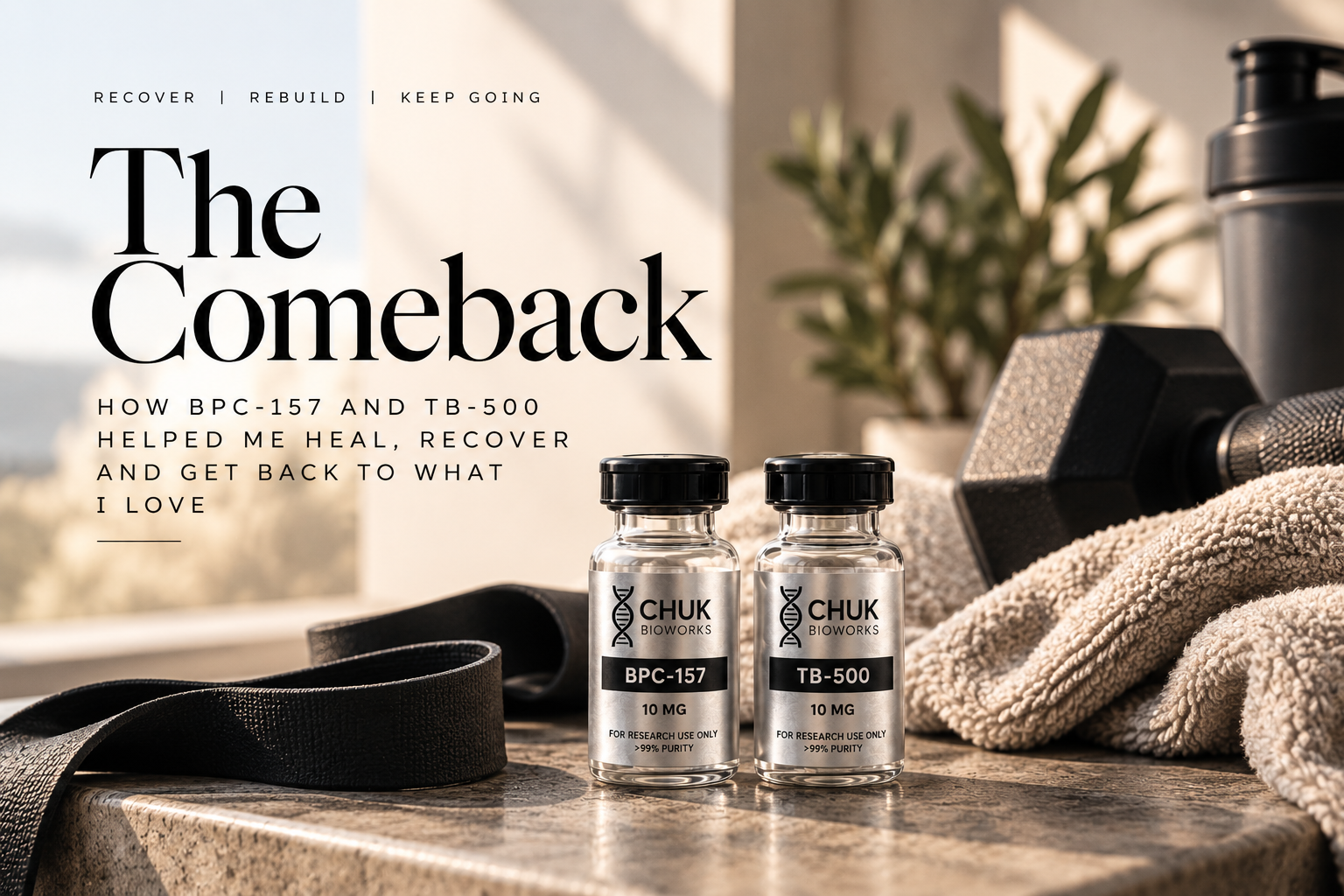
BPC-157 & TB-500 After Shoulder Surgery: The Recovery Stories People Can’t Stop Talking About
Shoulder surgery has a reputation for being a long, frustrating recovery.
Weeks in a sling. Months of physical therapy. Limited range of motion. Difficulty sleeping. And the constant question:
When is my shoulder finally going to feel normal again?
That’s one reason BPC-157 and TB-500 have become such a huge topic in online recovery communities.
And one shoulder-surgery story in particular caught our attention.
A Shoulder Surgery Recovery That Got People Talking
In an online discussion about BPC-157 and rotator-cuff recovery, one man described undergoing shoulder surgery involving partial tears of his rotator cuff, labrum and biceps.
About one to two weeks after surgery, he said he began using BPC-157 and TB-500 as part of his recovery.
His experience?
He described it as positive, reported no side effects, and said he healed well. More interestingly, he said both his doctor and physical therapist commented that his recovery seemed faster than usual.
That sounds impressive.
But there’s a detail in his story that makes it much more believable:
He openly admitted he couldn’t know whether the peptides were responsible.
He was also using collagen, omega-3s and other supplements while going through the normal post-surgical healing and rehabilitation process.
That distinction matters.
He Isn’t the Only One Talking About It
Another person documented recovery after a Latarjet shoulder surgery for instability and a labral injury. The athlete incorporated BPC-157 and TB-500 alongside a strict rehabilitation program, high-protein nutrition, collagen, creatine and several other supplements.
And these aren’t isolated conversations.
People recovering from labrum repairs, rotator-cuff repairs and other shoulder procedures continue to discuss these compounds online.
But the experiences aren’t universally positive.
In one recent post-surgical discussion, a person several months out from rotator-cuff repair said they had used BPC-157 and TB-500 on and off but genuinely couldn’t tell whether the peptides had contributed to their recovery.
Another shoulder discussion included someone who reported using the combination for two months without improvement.
That’s actually important information.
Anecdotes can tell us what people are experiencing. They can’t tell us what caused the outcome.
So Why Are BPC-157 and TB-500 Associated With Recovery?
This is where things get interesting.
BPC-157 has attracted attention because laboratory and animal research has investigated potential effects involving tendon, muscle and other tissue repair.
TB-500 is related to a fragment of thymosin beta-4, a naturally occurring peptide associated with cellular processes involved in tissue repair and wound healing.
On paper, it’s easy to understand why athletes and people recovering from injuries became interested.
But there’s a very large gap between “interesting biological mechanism” and “proven to accelerate recovery after shoulder surgery.”
Right now, that gap still exists.
What Does the Human Research Actually Show?
This is the part that tends to disappear from social-media discussions.
A 2026 sports-medicine review examining peptide supplements including BPC-157 and TB-500 found that much of the published evidence comes from preclinical animal research.
Human studies were limited, and the authors concluded that the recovery and performance claims surrounding emerging peptide supplements remain unsubstantiated by current human trials.
There currently isn’t good clinical evidence demonstrating that BPC-157 and TB-500 speed recovery following rotator-cuff, labrum or other shoulder surgery.
The FDA’s review of TB-500 similarly noted that it had not identified adequate clinical studies or human-exposure data from which its safety could be established.
So when someone says:
“BPC-157 and TB-500 healed my shoulder faster.”
The scientifically accurate translation is closer to:
“I used BPC-157 and TB-500 while my shoulder was healing, and I experienced a recovery that felt unusually good to me.”
Those are very different claims.
The Problem With Incredible Recovery Stories
Imagine two people undergo the same shoulder surgery.
One uses BPC-157 and TB-500.
The other doesn’t.
To determine whether the peptides actually accelerated recovery, we’d need to control for things like:
- age and overall health
- severity of the original injury
- surgical technique
- physical therapy
- sleep and nutrition
- protein intake
- supplements
- training history
- genetics
- adherence to rehabilitation
Then we’d need enough patients to determine whether the difference was actually caused by the treatment rather than chance.
That’s what controlled clinical trials are designed to do.
Reddit stories can’t do that.
But that doesn’t make the stories meaningless.
They can highlight questions that researchers haven’t adequately answered yet.
Why These Stories Keep Spreading
For someone staring down months of rehabilitation after shoulder surgery, it’s easy to understand the appeal.
If there were something capable of improving recovery, most people would at least want to know about it.
And when someone says:
“My surgeon couldn’t believe how quickly I was progressing,”
people pay attention.
The problem comes when an interesting observation becomes a guaranteed outcome.
Right now, BPC-157 and TB-500 sit in an unusual place where public interest has moved much faster than human clinical research.
There are intriguing mechanisms.
There are animal studies.
There are plenty of personal experiences.
But there still isn’t strong human evidence proving that either compound—or the combination—accelerates shoulder-surgery recovery.
The Most Interesting Part of the Story
Maybe the takeaway isn’t that BPC-157 and TB-500 definitely work.
And it isn’t that every recovery story should be dismissed either.
It’s that thousands of people are asking a question researchers still haven’t adequately answered:
Could these compounds meaningfully influence human tissue recovery?
For now, the responsible answer is:
We don’t know yet.
And until better human trials are completed, stories like these should be viewed for exactly what they are—interesting experiences, not clinical proof.
Continue Exploring
The Compound Edit is affiliated with Chuk BioWorks, a research compound company. If you’re interested in exploring the compounds discussed throughout The Compound Edit, you can learn more about our connection or explore the research products available through Chuk BioWorks.
EXPLORE CHUK BIOWORKS → www.ChukBioWorks.com
Disclosure: The Compound Edit is affiliated with Chuk BioWorks. Content published by The Compound Edit is provided for educational purposes only and does not constitute medical advice. BPC-157 and TB-500 are not FDA-approved treatments for post-surgical shoulder recovery. References to individual experiences should not be interpreted as evidence of safety or effectiveness.

One Comment
Comments are closed.