

Retatrutide Isn’t Approved Yet. So Why Is Everyone Already Talking About It?
The triple-agonist weight-loss drug is still investigational—but remarkable clinical-trial results have made it famous long before it can be routinely prescribed.
There’s something unusual happening with retatrutide.
Ask a doctor for an FDA-approved prescription for retatrutide today and there’s a problem:
There isn’t one.
Retatrutide is still an investigational drug being developed by Eli Lilly. It has not been approved by the FDA—or any other regulatory agency—and Lilly says legitimate retatrutide is currently available only through its clinical trials.
And yet, if you spend any amount of time in weight-loss, GLP-1 or peptide communities, you’d probably never guess it was an investigational drug.
People already know its name.
They’re comparing it with semaglutide and tirzepatide.
They’re discussing their experiences with products sold as retatrutide.
Before the official drug has even reached pharmacy shelves, retatrutide has developed an enormous following.
So how did an unapproved drug become this popular?
The answer is more interesting than internet hype.
Because behind all the attention are clinical-trial results that have been difficult to ignore.
First: What Exactly Is Retatrutide?
Retatrutide belongs to the same broader incretin/metabolic-drug conversation that gave us semaglutide and tirzepatide.
But its mechanism is different.
Semaglutide targets the:
GLP-1 receptor.
Tirzepatide targets:
GLP-1 + GIP receptors.
Retatrutide targets:
GLP-1 + GIP + glucagon receptors.
That’s why retatrutide is often called a triple agonist.
It’s a single molecule designed to activate all three receptor systems.
And that third component—glucagon receptor activity—is one of the reasons researchers have been so interested in it.
GLP-1 and GIP signaling can influence appetite, glucose regulation and metabolic function.
Adding glucagon receptor activity introduces another metabolic pathway, including effects related to energy expenditure.
Instead of focusing exclusively on reducing energy intake, researchers are essentially investigating whether multiple metabolic systems can be targeted simultaneously.
And then the clinical data started coming in.
The Study That Made Everyone Pay Attention
In 2023, results from the Phase 2 obesity trial were published in The New England Journal of Medicine.
The study included 338 adults with obesity or overweight.
After 48 weeks, average weight reductions varied by dose.
Participants receiving the highest studied dose—12 mg—lost an average of:
24.2% of their starting body weight.
The placebo group lost approximately 2.1%.
Even more striking:
Among participants receiving 12 mg, 83% lost at least 15% of their starting weight by week 48.
Those numbers immediately put retatrutide into a very different conversation.
But there was still a major question.
Phase 2 trials are relatively small.
Would the results hold up in much larger Phase 3 studies?
Then Phase 3 Arrived
In May 2026, Lilly announced topline results from its Phase 3 TRIUMPH-1 trial.
And the numbers attracted even more attention.
Among participants without diabetes who received the 12 mg dose, average weight loss reached:
28.3% at 80 weeks.
That represented an average loss of approximately:
70.3 pounds.
And 45.3% of participants in that group lost at least 30% of their starting body weight.
A subset of participants with a starting BMI of at least 35 continued treatment longer.
At 104 weeks, average weight loss in that extension reached 30.3%, or approximately 85 pounds.
Those are company-reported topline Phase 3 results, so full peer-reviewed publication remains important.
But they help explain something that otherwise looks strange:
Retatrutide became famous before it became a medicine you could actually get at a pharmacy.
And It Wasn’t Just One Phase 3 Trial
Lilly subsequently reported results from additional Phase 3 trials.
In adults with obesity or overweight and type 2 diabetes in TRIUMPH-2, participants receiving 12 mg lost an average of 20.8% of their body weight at 80 weeks.
In TRIUMPH-3, which studied adults with severe obesity and established cardiovascular disease, with or without diabetes, average weight loss reached 22.6% at 80 weeks at the highest studied dose.
Lilly says it now has the clinical data package needed to support regulatory submissions and plans to submit retatrutide to the FDA in Q1 2027.
So when people say:
“Retatrutide isn’t approved because it doesn’t work.”
That’s not what “not approved” means.
Investigational Doesn’t Mean Ineffective
This distinction gets lost constantly online.
FDA approval isn’t simply a test of whether scientists have observed an effect.
A drug moves through a development process involving clinical trials designed to characterize:
efficacy
safety
side effects
dose response
manufacturing
quality
and other factors required for regulatory review.
Retatrutide is still moving through that process.
That means we shouldn’t say:
“Retatrutide is FDA-approved and proven safe.”
It isn’t.
But we also shouldn’t say:
“There’s no evidence that retatrutide works.”
There absolutely is evidence of efficacy.
The accurate statement is:
Retatrutide remains investigational, while clinical trials have demonstrated substantial weight loss in the populations studied.
Those ideas can both be true.
So Why Are People Already Using Something Called Retatrutide?
Here’s where the story becomes complicated.
Long before FDA approval, an unofficial market developed around products advertised as retatrutide.
They’re discussed in peptide communities.
They’re advertised online.
Some people publicly document significant weight loss while saying they’re using them.
But there’s an enormous distinction that has to be made here.
The clinical-trial data tell us about Lilly’s retatrutide.
They don’t automatically validate every vial being sold online with “retatrutide” written on the label.
Outside of authorized clinical trials, Lilly says products claiming to contain retatrutide may have unknown ingredients, contaminants or incorrect amounts of active ingredient.
FDA has gone even further.
The agency currently states that retatrutide cannot be used in compounding under federal law, and it has issued warning letters involving businesses marketing or distributing unapproved retatrutide products.
That creates an unusual situation.
There is legitimate clinical evidence that the investigational molecule works.
At the same time, that evidence doesn’t tell us whether an unregulated product purchased outside a clinical trial actually contains the same thing—or contains it at the concentration or purity stated on its label.
Those two questions need to stay separate.
“But People Are Losing Weight on It”
This is probably where retatrutide differs from many experimental compounds circulating online.
The anecdotes aren’t occurring in a complete scientific vacuum.
When someone reports losing substantial weight while using something they believe is retatrutide, the basic effect they’re describing is consistent with what investigators have observed in controlled trials of authentic retatrutide.
That makes the stories feel especially convincing.
But an individual before-and-after still can’t establish the identity, purity or dose of whatever was actually in that person’s vial.
And it can’t tell us the full risk profile.
That’s exactly why controlled trials exist.
Anecdotes can generate questions.
Clinical trials are how researchers try to answer them.
The Results Are Real. So Are the Side Effects.
It’s easy to look at the weight-loss numbers and stop reading.
But retatrutide isn’t producing those effects without adverse events.
In the Phase 2 obesity study, the most common adverse events were gastrointestinal and were dose-related.
Researchers also observed dose-dependent increases in heart rate, which peaked around 24 weeks and subsequently declined.
Larger and longer Phase 3 programs are important precisely because researchers need to understand what happens when significantly more people take a drug for significantly longer periods.
Weight loss is only one part of the equation.
Why Retatrutide Has Become So Popular
Retatrutide arrived at exactly the right moment.
Semaglutide changed the public conversation around obesity treatment.
Tirzepatide demonstrated what targeting another incretin pathway could potentially add.
Then retatrutide appeared with a third receptor target—and early weight-loss numbers that immediately attracted attention.
That created a perfect storm:
A public already familiar with GLP-1 medications.
A new triple-agonist mechanism.
Remarkable early clinical-trial results.
Social media capable of spreading those results instantly.
And an unofficial peptide market willing to sell something under the retatrutide name years before an approved pharmaceutical product reached consumers.
In other words:
The hype didn’t appear out of nowhere.
But neither does the hype eliminate the uncertainty.
There’s One More Important Difference
When retatrutide eventually reaches the market—assuming it receives regulatory approval—the product will come with something the current gray market cannot provide:
A regulated manufacturing process.
Defined specifications.
Standardized dosing.
Official labeling.
Safety monitoring.
Prescribing information.
And regulatory oversight.
That’s a much bigger difference than simply putting the same molecule into a prettier box.
A drug isn’t just its chemical name.
How reliably it’s manufactured and delivered matters too.
So When Will Retatrutide Actually Be Available?
We don’t have an FDA approval date yet.
As of September 2026, retatrutide remains investigational.
Lilly says it plans to submit its application to FDA in the first quarter of 2027.
Submission isn’t approval.
The FDA will still have to review the application and determine whether the evidence supports approval and under what labeling and conditions.
So anyone promising an exact release date right now is getting ahead of the regulatory process.
The Compound Edit Takeaway
Retatrutide occupies a strange place in medicine right now.
It’s not an approved drug—but it’s no longer just an interesting idea in a laboratory.
Controlled clinical trials have demonstrated substantial weight loss.
Phase 3 results have strengthened the evidence.
And those results have helped make retatrutide one of the most talked-about investigational metabolic drugs in the world.
But there’s another side to the story.
The retatrutide studied in clinical trials and an unregulated vial purchased online aren’t automatically equivalent simply because the same name appears on both.
That’s the distinction worth understanding.
The science explains why people are excited about retatrutide.
The fact that it’s still investigational explains why caution still matters.
Both things can be true at once.
Continue Exploring
The Compound Edit follows the evolving science around peptides, metabolic health, recovery, performance and longevity—while separating what research actually shows from what’s gaining traction online.
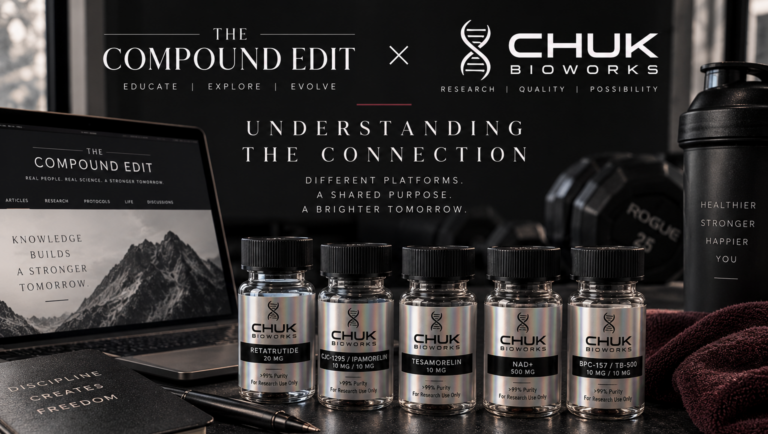
The Compound Edit is affiliated with Chuk BioWorks. You can read more about that connection and how we approach editorial independence here.
EXPLORE CHUK BIOWORKS → www.chukbioworks.com
The Compound Edit is for educational and informational purposes only and does not provide medical advice. Retatrutide is an investigational drug and is not currently FDA-approved. Discussion of investigational compounds or products marketed under their names should not be interpreted as a recommendation for human use.


4 Comments
Comments are closed.