HGH vs. CJC-1295/Ipamorelin vs. Tesamorelin: They All Affect Growth Hormone—But They’re Not the Same Thing
One gives you growth hormone directly. The others signal your body to release more of its own. That difference changes more than you might think.
HGH.
CJC-1295.
Ipamorelin.
Tesamorelin.
Spend enough time in fitness, anti-aging or peptide circles and you’ll eventually hear all four discussed as though they’re different versions of the same thing.
“They all increase growth hormone.”
There’s some truth buried in that statement.
But it leaves out the most important part.
They don’t get there the same way.
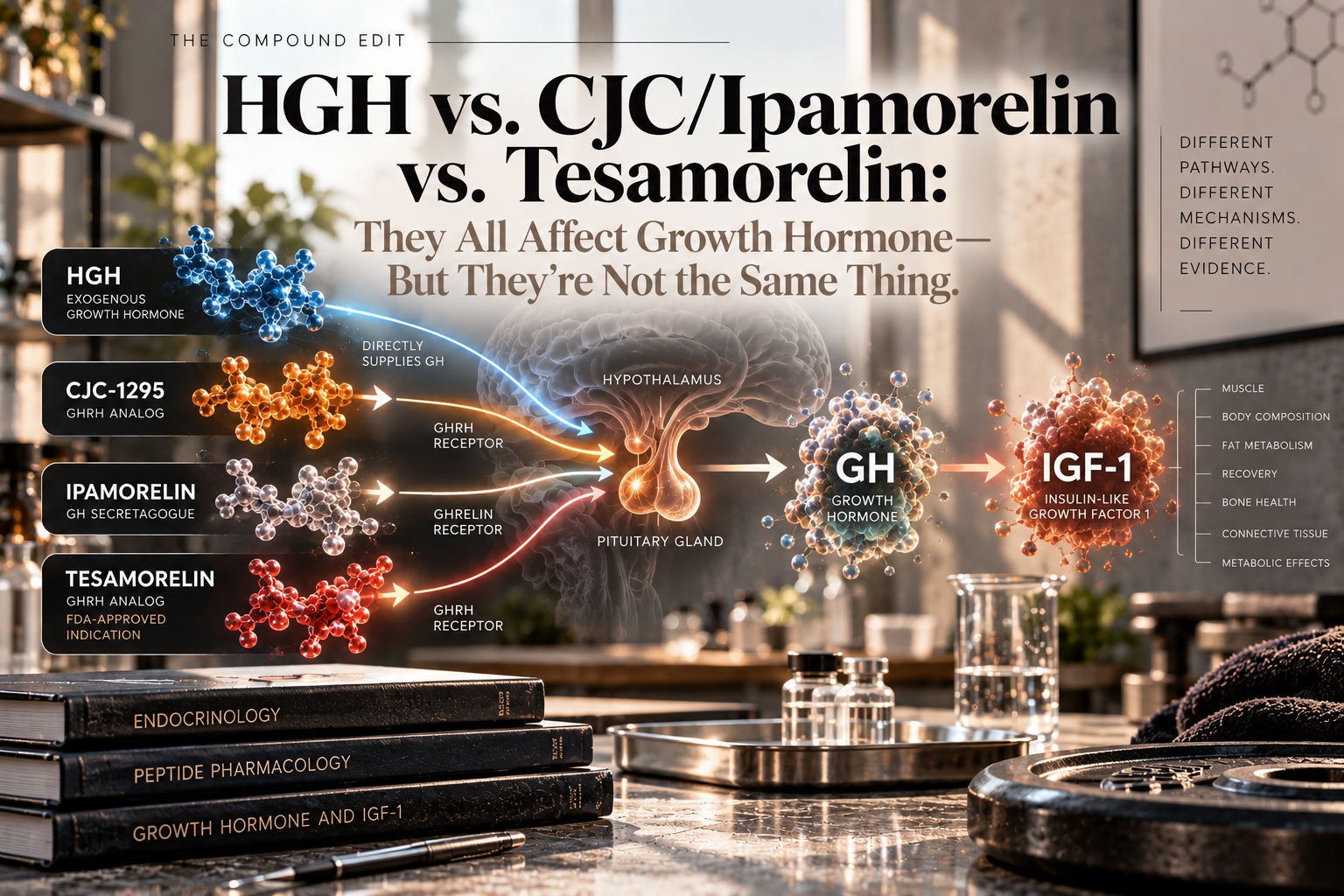
HGH supplies growth hormone directly.
CJC-1295 acts through the growth-hormone-releasing hormone pathway.
Ipamorelin stimulates a different receptor involved in growth hormone release.
Tesamorelin also acts through the GHRH pathway—but unlike CJC-1295 and ipamorelin, tesamorelin has an FDA-approved medical use.
All four can intersect with the GH/IGF-1 axis.
That doesn’t make them interchangeable.
And once you understand how that system normally works, the differences become much easier to understand.
First: How Does Your Body Normally Make Growth Hormone?
Growth hormone isn’t normally released at one constant rate throughout the day.
It’s secreted by the pituitary gland in pulses.
The hypothalamus helps control those pulses using several signals.
One of the major stimulatory signals is:
GHRH — growth hormone-releasing hormone.
GHRH essentially tells the pituitary:
Release growth hormone.
Another signaling pathway involves ghrelin and the growth hormone secretagogue receptor, or GHS-R.
Meanwhile, somatostatin acts as one of the brakes on GH secretion.
The result isn’t a steady drip.
It’s a dynamic system producing peaks and valleys throughout the day, with particularly prominent GH pulses occurring during sleep.
Once growth hormone enters circulation, it acts directly on tissues but also stimulates production of another important hormone:
IGF-1 — insulin-like growth factor 1.
The liver is a major source of circulating IGF-1.
That’s why discussions about GH almost inevitably become discussions about IGF-1 too.
Think of it as an axis:
Hypothalamus → Pituitary → GH → IGF-1
Now we can see where the different compounds enter the picture.
HGH: Skipping the Signal Entirely
When people say HGH, they’re usually referring to recombinant human growth hormone—somatropin.
This isn’t a peptide telling your pituitary to release GH.
It is growth hormone.
Recombinant human GH is structurally equivalent to the major naturally occurring human growth hormone.
So instead of stimulating the pituitary and waiting for it to release more GH, administering somatropin places exogenous GH into circulation.
That’s the fundamental difference.
With HGH, you’re supplying the downstream hormone directly.
With CJC, ipamorelin and tesamorelin, you’re manipulating signaling upstream of endogenous GH release.
That’s Also Why HGH Doesn’t Need Your Pituitary to Cooperate
This matters medically.
Growth hormone replacement is used in appropriately diagnosed adults and children with specific forms of GH deficiency.
If the body can’t produce sufficient GH, simply telling the pituitary:
“Please make more.”
may not solve the problem.
Recombinant GH bypasses that step.
This is one reason comparing HGH with a GH secretagogue isn’t really an apples-to-apples comparison.
One is replacement.
The others are attempting to stimulate the body’s own secretion.
CJC-1295: Pressing the GHRH Button
CJC-1295 takes a different approach.
It’s a synthetic analog of GHRH.
Rather than providing growth hormone itself, CJC-1295 interacts with the GHRH receptor on pituitary cells and stimulates GH secretion.
And there is actual human research demonstrating this effect.
In randomized studies of healthy adults, CJC-1295 produced sustained increases in circulating GH and IGF-1. In one study, a single administration increased mean GH concentrations for six days or more and IGF-1 for roughly 9–11 days. PubMed
That’s a pretty dramatic pharmacological difference from naturally occurring GHRH, which is short-lived.
But there’s an important wrinkle.
“CJC-1295” Can Mean Different Things Online
This is one of the messiest naming problems in peptide communities.
The CJC-1295 studied in those human trials was a long-acting analog incorporating a Drug Affinity Complex, often referred to as DAC.
It was designed to bind to circulating albumin, greatly extending its duration.
Researchers also found that despite this prolonged stimulation, pulsatile GH secretion could still be observed. PubMed
Online, however, you’ll frequently see products described as:
CJC-1295 no DAC
or simply:
CJC/IPA.
Those shorter-acting preparations are often associated with modified GRF (1-29) rather than the long-acting CJC-1295 formulation studied in those trials.
That distinction gets blurred constantly.
So when someone says:
“A study showed CJC lasts for days.”
you need to know which CJC they’re actually talking about.
Ipamorelin Gets to GH Through a Different Door
Ipamorelin isn’t a GHRH analog.
It belongs to a class commonly called growth hormone secretagogues.
Its primary target is the growth hormone secretagogue receptor, also known as the ghrelin receptor or GHS-R1a.
So imagine the pituitary has multiple ways of receiving the message:
CJC → GHRH pathway
Ipamorelin → ghrelin/GHS-R pathway
Both can ultimately encourage GH release.
But they’re pressing different buttons.
And that’s exactly why the two became so commonly paired.
Why Do People Combine CJC + Ipamorelin?
This pairing makes sense mechanistically.
One compound stimulates the GHRH pathway.
The other acts through the ghrelin receptor pathway.
Because those signals can interact in the physiological regulation of GH release, researchers have long been interested in combining GHRH-type signaling with growth-hormone secretagogues.
That’s the biological logic.
But there’s an important distinction:
A combination making biological sense doesn’t automatically mean the specific CJC/ipamorelin protocols circulating online have been clinically validated.
That’s where peptide culture frequently outruns clinical research.
You’ll see precise schedules passed around as though they came from large human trials.
Usually, they didn’t.
Then There’s Tesamorelin
Tesamorelin belongs on this list because it also stimulates the GH axis.
But its story is very different.
Tesamorelin is a synthetic growth hormone-releasing factor analog.
Like GHRH-type compounds, it stimulates the pituitary to increase endogenous growth hormone secretion.
That subsequently increases IGF-1.
But unlike most of the research peptides discussed in fitness communities:
Tesamorelin is an FDA-approved prescription drug.
The current FDA labeling for EGRIFTA WR indicates tesamorelin for reducing excess abdominal fat in adults with HIV and lipodystrophy. FDA Access Data
That’s important.
But so is the next sentence.
Tesamorelin is not FDA-approved as a general weight-loss medication.
The FDA labeling explicitly says it isn’t indicated for weight-loss management. FDA Access Data
That’s a much narrower medical indication than the way tesamorelin is often discussed in fitness circles.
Why Is Tesamorelin Associated With Visceral Fat?
This is one reason tesamorelin has become particularly interesting outside its approved indication.
Visceral adipose tissue is the fat located deeper within the abdominal cavity around internal organs.
It’s different from the subcutaneous fat you can pinch underneath your skin.
Clinical trials in people with HIV-associated lipodystrophy demonstrated reductions in excess abdominal fat, which ultimately led to tesamorelin’s approval.
But this creates another easy internet leap:
Tesamorelin reduces visceral abdominal fat in HIV-associated lipodystrophy.
becomes:
Tesamorelin burns belly fat.
Those aren’t identical claims.
The patient population and clinical indication matter.
So Where Does IGF-1 Fit Into All of This?
IGF-1 is one of the reasons these compounds can end up producing overlapping downstream effects despite starting in different places.
Growth hormone stimulates IGF-1 production.
So:
HGH → increased GH exposure → increased IGF-1
while:
CJC / Tesamorelin → pituitary GH release → increased IGF-1
and:
Ipamorelin → GH secretagogue signaling → GH release → potentially increased IGF-1 downstream
This is also why IGF-1 is frequently monitored in legitimate GH-related medical treatment.
For tesamorelin specifically, FDA labeling warns that it increases serum IGF-1 and recommends monitoring because the effects of prolonged IGF-1 elevations are unknown. FDA Access Data
More isn’t automatically better.
Which One Builds the Most Muscle?
This is probably the question half the people reading this article actually wanted answered.
And it’s also where things get messy.
Growth hormone has a powerful reputation in bodybuilding.
People hear:
“GH increases lean body mass.”
and translate that into:
“GH builds muscle.”
Those aren’t necessarily equivalent.
In controlled studies of healthy young adults, GH administration has increased measured lean body mass.
But systematic reviews have generally not found corresponding improvements in muscle strength or aerobic exercise capacity over the studied periods. PubMed
How can lean mass go up without strength going up?
One answer is water.
Lean Mass Isn’t Automatically Muscle
This distinction is incredibly important.
Body-composition measurements often divide the body broadly into:
fat mass
and
fat-free or lean mass.
Water is included in lean mass.
And growth hormone can cause fluid retention.
In one controlled study of healthy active adults receiving supraphysiologic GH, fat-free mass increased—but so did total body water and extracellular water. Researchers concluded that the increase in measured fat-free mass was explained largely by increased extracellular fluid in that experiment. PubMed
So when you see:
“GH increased lean mass by X pounds”
you cannot automatically rewrite that as:
“GH built X pounds of muscle.”
Those aren’t the same measurement.
Does That Mean HGH Doesn’t Affect Muscle?
No.
GH biology clearly interacts with muscle, connective tissue, metabolism and IGF-1 signaling.
And in people with genuine growth hormone deficiency, medically indicated GH replacement can improve body composition. PubMed
But that’s a completely different population from a healthy person using supraphysiological GH because they want bigger shoulders.
Context matters.
It’s also why bodybuilding anecdotes are difficult to interpret.
Competitive users may simultaneously be using:
testosterone
other anabolic steroids
insulin
GH
and aggressive nutrition and training programs.
Then the entire physique gets attributed to “HGH.”
Science can’t separate variables that way.
What About Fat Loss?
Growth hormone has substantial metabolic effects, including effects on lipolysis—the mobilization of stored fat.
Human trials of GH have demonstrated changes in body composition, including decreases in fat mass in some populations. PubMed
Tesamorelin has much more specific clinical evidence for reducing excess abdominal fat in its approved HIV-lipodystrophy population. FDA Access Data
But none of that means:
Every compound that raises GH is automatically a fat-loss drug.
And it definitely doesn’t mean all four produce equivalent changes.
Dose, duration, baseline physiology, population and the pattern of GH exposure all matter.
Why More GH Isn’t Automatically Better
This might be the biggest misconception of all.
If normal GH is good for:
muscle,
tissue repair,
metabolism,
and body composition,
then twice as much must be twice as good.
Right?
Human physiology rarely works that way.
Excess GH exposure can produce problems including:
fluid retention
joint discomfort
edema
carpal-tunnel-type symptoms
and changes in glucose metabolism.
Studies of GH in healthy older adults have found increased rates of edema, joint symptoms and impaired glucose regulation. PubMed
Tesamorelin’s FDA labeling similarly warns about elevated IGF-1, fluid retention and glucose intolerance/diabetes risk. FDA Access Data
The GH/IGF-1 axis isn’t a video-game stat you simply want to max out.
The Pulsatility Question
There’s another difference that’s easy to overlook.
Natural GH secretion is pulsatile.
Your body isn’t designed to maintain one enormous GH level around the clock.
Secretagogues and GHRH analogs interact with that endogenous regulatory system differently from administering exogenous GH.
Interestingly, research with long-acting CJC-1295 found that GH pulsatility persisted despite sustained stimulation. PubMed
But that doesn’t mean every secretagogue perfectly reproduces natural GH physiology.
It simply illustrates why:
stimulating GH secretion and injecting GH aren’t biologically identical interventions.
So Is “Natural GH Release” Automatically Safer?
You’ll hear this argument constantly:
“Peptides are safer because you’re just making your body release its own GH.”
That’s too simplistic.
Using an endogenous signaling pathway doesn’t automatically make an intervention harmless.
If a drug pushes that pathway hard enough, downstream GH and IGF-1 exposure can still become abnormal.
And with unapproved research products, you also have separate questions involving:
identity
purity
potency
sterility
and manufacturing quality.
“Your own GH” sounds reassuring.
It isn’t a safety study.
Four Names. Four Different Stories.
The easiest way to remember the difference is this:
HGH
Provides growth hormone directly.
CJC-1295
Acts as a GHRH analog, stimulating the pituitary to release GH. The long-acting DAC version has human research demonstrating sustained increases in GH and IGF-1. PubMed
Ipamorelin
Stimulates GH release through the ghrelin/GHS-R pathway rather than the GHRH receptor. It remains an investigational compound rather than an FDA-approved GH therapy.
Tesamorelin
A GHRF/GHRH analog that stimulates endogenous GH release and has an FDA-approved indication for reducing excess abdominal fat in adults with HIV-associated lipodystrophy—not general weight loss. FDA Access Data
They intersect.
They don’t become the same drug.
The Compound Edit Takeaway
HGH, CJC-1295, ipamorelin and tesamorelin all appear in conversations about the growth-hormone axis.
But saying:
“They all increase GH.”
is only the beginning of the explanation.
HGH supplies the hormone directly.
CJC-1295 stimulates the GHRH receptor.
Ipamorelin uses the ghrelin receptor pathway.
Tesamorelin stimulates endogenous GH through the GHRH pathway and has a specific FDA-approved medical indication.
Those differences affect how the compounds behave, how they’ve been studied and how strong the evidence is for the claims surrounding them.
And perhaps the biggest lesson is this:
Increasing GH or IGF-1 isn’t automatically synonymous with building muscle.
Increasing lean mass isn’t automatically synonymous with building muscle either.
Sometimes the most important part of understanding a study is figuring out exactly what researchers measured.
Because four compounds can eventually touch the same hormonal pathway without being four versions of the same thing.
Continue Exploring
The Compound Edit follows the evolving science around peptides, metabolic health, recovery, performance and longevity—while separating what research actually shows from what’s gaining traction online.
The Compound Edit is affiliated with Chuk BioWorks. You can read more about that connection and how we approach editorial independence here.
EXPLORE CHUK BIOWORKS → www.chukbioworks.com
The Compound Edit is for educational and informational purposes only and does not provide medical advice. Somatropin and tesamorelin are prescription medications with specific approved indications. CJC-1295 and ipamorelin are investigational compounds and are not FDA-approved for bodybuilding, anti-aging or general fat loss. Discussion of these compounds should not be interpreted as a recommendation for human use.