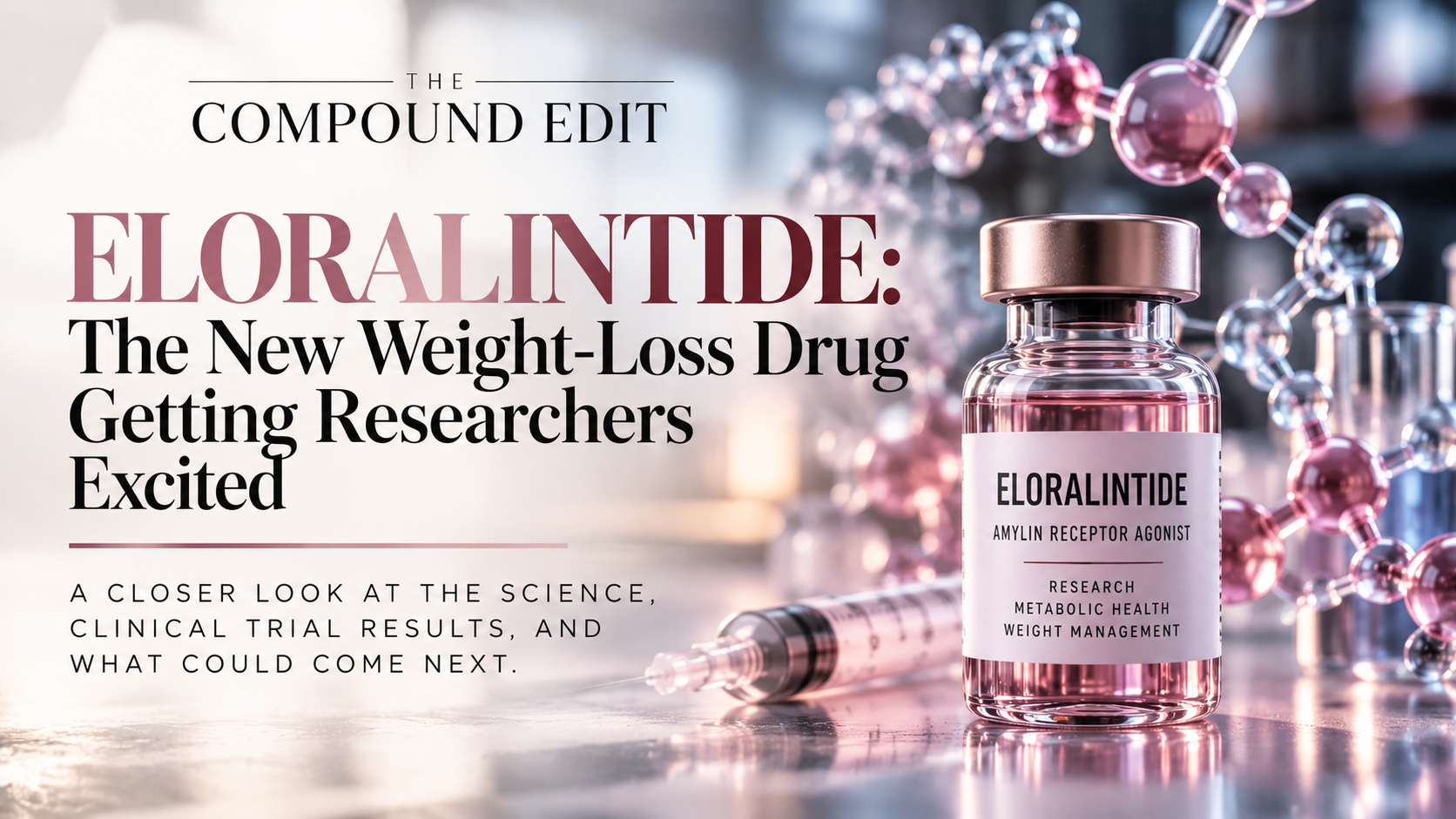
Eloralintide: The New Weight-Loss Drug Getting Researchers Excited
The Compound Edit | Peptides & Metabolic Research
Just when you thought the world of weight-loss medications couldn’t get any more interesting, another name enters the conversation.
Eloralintide.
And no, it’s not simply another version of semaglutide or tirzepatide.
While GLP-1 medications have dominated conversations about weight loss, researchers are investigating an entirely different hormonal pathway.
One involving a hormone called amylin.
And the early results?
Some participants in a Phase 2 clinical trial experienced average weight reductions of approximately 20% over 48 weeks.
That’s enough to get researchers paying attention.
But what exactly is eloralintide, how does it work, and could it eventually compete with medications like retatrutide?
Let’s get into the science.
First, What Is Eloralintide?
Eloralintide, also known by its research designation LY3841136, is an investigational medication being developed by Eli Lilly.
It’s classified as a selective amylin receptor agonist.
That’s a mouthful, so let’s make it simple.
An agonist is a substance that activates a receptor.
Eloralintide is designed to activate receptors involved in the body’s natural amylin signaling system.
And amylin has a fascinating relationship with appetite and fullness.
Unlike retatrutide, which targets GLP-1, GIP, and glucagon receptors, eloralintide focuses on the amylin pathway.
That distinction is what makes it interesting.
What Is Amylin, and Why Does It Matter?
Amylin is a hormone naturally released by pancreatic beta cells alongside insulin when you eat.
Its job isn’t identical to insulin’s.
Instead, amylin helps coordinate several processes involved in eating and digestion.
These include:
- Supporting feelings of fullness.
- Slowing gastric emptying.
- Helping regulate the release of glucagon after meals.
- Influencing appetite-related signaling in the brain.
Think about the difference between eating a meal and still wanting to snack an hour later versus eating a meal and feeling comfortably satisfied.
Amylin is one of several hormones involved in that process.
And researchers believe targeting its receptors may provide another way to influence appetite and body weight.
How Is Eloralintide Different From GLP-1 Medications?
Most people interested in metabolic research have heard of semaglutide.
Semaglutide activates GLP-1 receptors.
Tirzepatide activates GLP-1 and GIP receptors.
Retatrutide activates GLP-1, GIP, and glucagon receptors.
Eloralintide is different.
It selectively targets amylin receptors.
All of these medications are being studied or used in metabolic medicine, but they don’t activate the same hormonal pathways.
That matters because appetite regulation isn’t controlled by one hormone.
It’s a complicated network involving the brain, digestive system, pancreas, and other tissues.
Researchers are investigating whether targeting different pathways could expand treatment options for people who don’t respond sufficiently to existing medications.
And they’re also exploring what happens when these pathways are combined.
More on that in a minute.
The Phase 2 Results: How Much Weight Did Participants Lose?
This is where eloralintide started attracting serious attention.
In a Phase 2 clinical trial published in The Lancet in November 2025, researchers evaluated eloralintide in 263 adults with obesity or overweight and at least one weight-related health condition.
Participants did not have type 2 diabetes.
The study lasted 48 weeks and compared several eloralintide treatment groups with placebo.
The published results showed substantial average reductions in body weight.
| Study group | Average weight change at 48 weeks |
|---|---|
| Eloralintide 1 mg | -9% |
| Eloralintide 3 mg | -12% |
| Eloralintide 6 mg | -18% |
| Eloralintide 9 mg | -20% |
| Placebo | -0.4% |
These figures are rounded from the published efficacy analysis.
For context, a 240-pound person losing 20% of their starting weight would lose approximately 48 pounds.
That’s a substantial amount of weight.
But remember, these are group averages from a controlled clinical trial.
They don’t guarantee that every person will experience the same results.
And the doses listed describe study groups, not instructions for personal use.
Here’s Where Things Get Even More Interesting: EloraTZP
Researchers aren’t only studying eloralintide by itself.
They’re also investigating what happens when it’s combined with tirzepatide.
The investigational combination is called EloraTZP.
And in September 2026, Eli Lilly announced results from a 48-week Phase 2b study involving 367 adults with obesity or overweight and type 2 diabetes.
The combination produced greater average weight reduction than the tirzepatide comparator group.
The highest reported average weight reduction was:
- EloraTZP: 23.3%
- Tirzepatide 15 mg: 14.8%
Participants in the combination group also experienced greater average A1C reductions in the reported comparison.
The highest reported reduction was 2.9 percentage points, compared with 2.4 percentage points for tirzepatide.
These results are exciting because they suggest that combining amylin signaling with GLP-1 and GIP activity may provide additional metabolic effects.
But there’s an important detail.
These are Phase 2b results announced by the manufacturer, not proof of long-term superiority or safety.
Larger studies are still needed.
Does That Mean Eloralintide Is Better Than Retatrutide?
Not necessarily.
And this is where social media comparisons can get misleading.
It’s tempting to look at two different clinical trials, compare the percentages, and declare a winner.
But that’s not how clinical research works.
Different studies can involve different participants, treatment durations, doses, health conditions, and statistical methods.
Retatrutide and eloralintide also activate different receptors.
Retatrutide is a triple agonist targeting GLP-1, GIP, and glucagon.
Eloralintide is a selective amylin receptor agonist.
And EloraTZP combines amylin receptor activity with GLP-1 and GIP receptor activity.
Without appropriate head-to-head clinical trials, we cannot reliably determine which treatment would be more effective or better tolerated for the same population.
The interesting question isn’t necessarily which one wins.
It’s what these different approaches may teach researchers about treating obesity.
What About Side Effects?
No discussion of a new metabolic medication is complete without talking about tolerability.
In the Phase 2 eloralintide study, commonly reported adverse events included nausea and fatigue.
Gastrointestinal effects were more frequent in some higher-dose treatment groups.
The study also suggested that slower dose escalation was associated with better tolerability in certain groups.
However, that finding doesn’t establish a universally safe escalation schedule.
And it certainly doesn’t eliminate the need for longer-term safety research.
With combination treatments such as EloraTZP, researchers also need to understand how activating multiple hormonal pathways affects tolerability and treatment discontinuation.
The possibility of greater weight reduction must be weighed against potential adverse effects.
Could Amylin-Based Treatments Change Obesity Medicine?
They might.
For years, much of the excitement in metabolic medicine has centered on GLP-1 receptor agonists.
Then came dual-receptor treatments.
Then triple-receptor treatments.
Now amylin-based approaches are attracting increasing attention.
The idea is that obesity involves multiple overlapping biological systems.
Appetite, satiety, digestion, energy expenditure, insulin signaling, and the brain’s response to food all play important roles.
A treatment targeting one pathway may not produce the same response in every person.
That’s one reason researchers continue exploring new mechanisms.
And it’s why eloralintide is worth watching.
Is Eloralintide FDA-Approved?
As of October 2026, eloralintide remains investigational.
It has not received FDA approval for weight management.
Eli Lilly has advanced eloralintide into Phase 3 clinical development and announced plans to begin Phase 3 studies of the EloraTZP combination in late 2026.
That means additional research is underway to evaluate efficacy and safety in larger populations.
Products sold online under the name eloralintide are not equivalent to the investigational medicine manufactured and monitored for clinical trials.
Their identity, purity, and concentration may be uncertain.
Promising clinical results do not make an unapproved product safe for personal experimentation.
What’s Next for Eloralintide?
The next major questions involve long-term effectiveness and safety.
Researchers still need to determine:
- How well weight loss is maintained over longer periods.
- What happens when treatment is discontinued.
- How eloralintide performs in larger and more diverse populations.
- Whether combination treatment provides consistent benefits over existing medications.
- How treatment affects lean mass and body composition.
- Whether longer-term clinical outcomes improve.
Those answers will help determine where eloralintide might fit into future obesity treatment.
The Compound Edit Takeaway
Eloralintide is one of the more interesting investigational medications emerging in metabolic research.
Not because it’s another GLP-1.
But because it isn’t.
By targeting amylin receptors, researchers are exploring a different way to influence appetite, fullness, and body weight.
The Phase 2 results are promising.
The early combination findings with tirzepatide are particularly intriguing.
And the transition into larger clinical studies makes this a compound worth following.
But there’s still a difference between exciting research and an established treatment.
The real story isn’t that eloralintide has already changed obesity medicine.
It’s that scientists are discovering how many different hormonal pathways may be involved in treating obesity.
And we’re only beginning to understand what combining those pathways could mean.
Keep Exploring on The Compound Edit
Interested in metabolic research and the science behind emerging weight-loss treatments? Explore these previously published articles:
- Retatrutide Isn’t Approved Yet. So Why Is Everyone Already Talking About It?
- GLP-1, “GLP-2” & “GLP-3”: What People Really Mean by Semaglutide, Tirzepatide & Retatrutide
- Why Does Retatrutide Feel Like It Stopped Working?
Continue Exploring
The Compound Edit is dedicated to exploring the science, research, and real conversations surrounding peptides, hormones, metabolism, performance, and longevity.
The Compound Edit is affiliated with Chuk BioWorks. While the two share an ownership connection, our editorial goal is to explore scientific research with transparency, including limitations, uncertainties, and potential risks.
Research & Sources
- Billings LK, et al. Eloralintide, a selective amylin receptor agonist for the treatment of obesity: a 48-week phase 2, multicentre, double-blind, randomised, placebo-controlled trial. The Lancet. 2025. Read the published study.
- Eli Lilly and Company. Eloralintide demonstrated meaningful weight loss and favorable tolerability in a Phase 2 study. November 6, 2025. Read the announcement.
- Eli Lilly and Company. EloraTZP combination delivered greater weight loss and A1C reduction versus tirzepatide. September 30, 2026. Read the announcement.
Medical Disclaimer
The content published on The Compound Edit is intended for educational and informational purposes only and does not constitute medical advice, diagnosis, or treatment.
Eloralintide and EloraTZP are investigational treatments and are not FDA-approved for weight management as of this article’s publication. Clinical research findings should not be interpreted as recommendations for personal use. Consult a qualified healthcare professional regarding medical decisions.
Stay curious. Keep learning. Continue exploring.