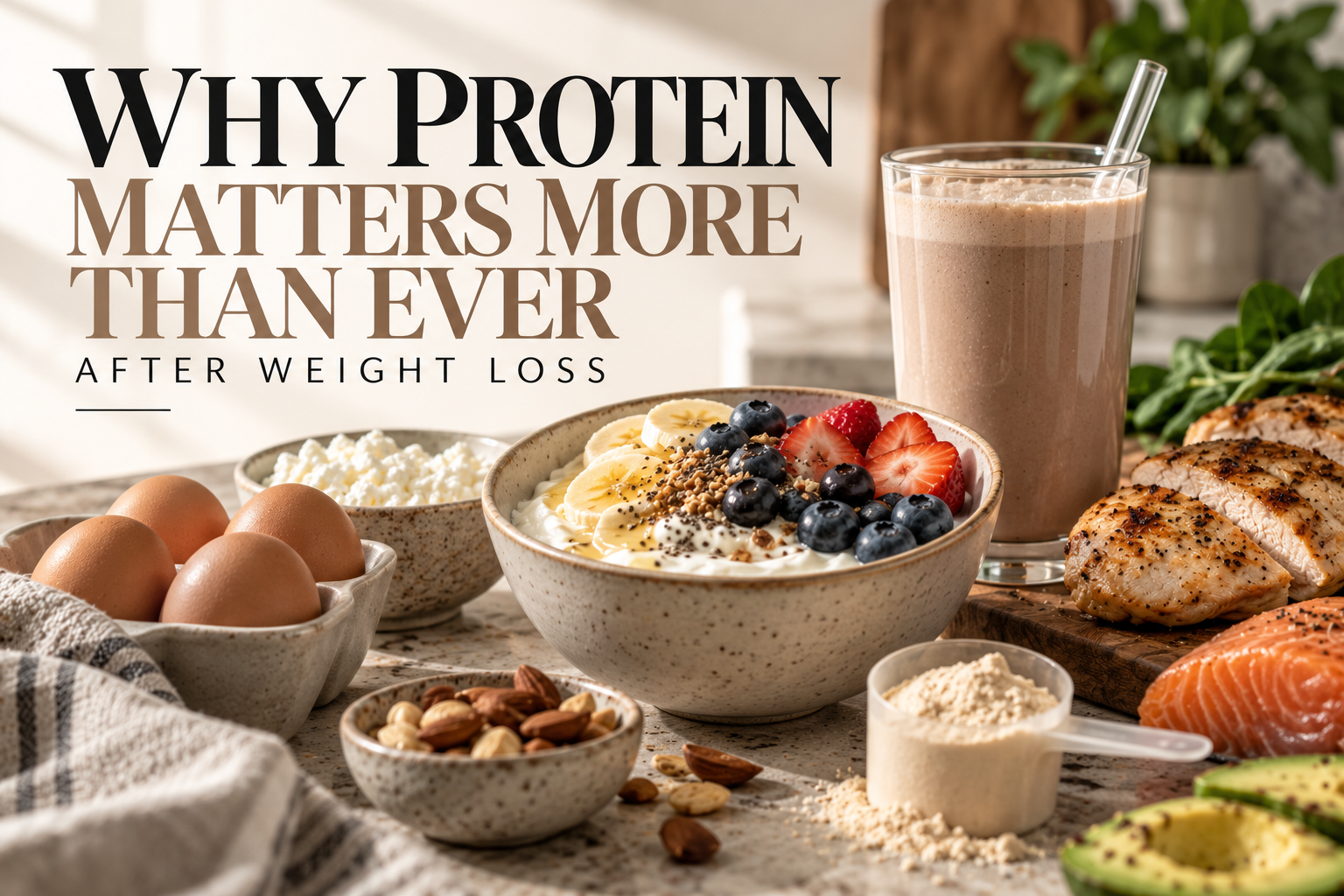
Why Protein Matters More Than Ever After Weight Loss
Losing weight changes your body. But what happens when your goal shifts from getting smaller to getting stronger?
For months, my biggest focus was losing weight.
I paid attention to calories, watched the scale, and celebrated every pound that disappeared.
And honestly? Watching that number go down was exciting.
But after losing more than 40 pounds, something changed.
I wasn’t trying to get smaller anymore.
I wanted to build muscle. I wanted more definition. I wanted my glutes back. And I wanted to feel strong.
That’s when I started paying more attention to something I hadn’t always prioritized enough.
Protein.
Not because protein is some magical solution to everything, but because I was beginning to understand just how important it is when you’re trying to change your body composition.
And I think this is something more people need to talk about, especially after significant weight loss.
Losing Weight Doesn’t Always Mean Losing Only Fat
Here’s something I wish I’d understood earlier.
When you lose weight, not every pound necessarily comes from body fat.
Depending on your nutrition, activity level, rate of weight loss, and other factors, some of that weight can come from lean tissue, including muscle.
That’s particularly important when someone loses a significant amount of weight.
You can reach your goal weight, fit into smaller clothes, and still realize your body doesn’t look quite how you imagined.
Maybe your arms aren’t as defined as you’d like.
Maybe your legs look smaller, but not necessarily stronger.
Or maybe you’ve noticed that your glutes have lost some of their fullness.
Sound familiar?
It’s one reason I’ve become much more interested in strength training and eating enough to support muscle.
Because the goal isn’t just to weigh less.
It’s to feel good in the body you’re building.
Why Protein Is So Important
Protein is made up of amino acids, which your body uses for numerous functions.
It’s involved in maintaining and repairing tissues, producing enzymes, supporting immune function, and building muscle.
When you lift weights, you’re creating a stimulus that tells your muscles they need to adapt.
Protein provides the amino acids needed to support that process.
But here’s an important distinction:
Eating more protein doesn’t automatically build muscle.
Your muscles also need resistance training, adequate energy, and recovery.
Think of protein as one important part of the process.
You can have all the building materials in the world, but without the right stimulus, you’re not going to get the same results.
How Much Protein Do You Actually Need?
This is where things get interesting.
The standard Recommended Dietary Allowance for protein is approximately 0.8 grams per kilogram of body weight per day for generally healthy adults.
But that amount is intended to meet basic nutritional requirements for most people, not necessarily to optimize muscle development.
For people who regularly participate in resistance training, sports nutrition research often supports approximately 1.4–2.0 grams per kilogram of body weight daily.
Let’s put that into perspective.
| Body weight | Approximate daily protein range |
|---|---|
| 115 lbs | 73–104 g |
| 130 lbs | 83–118 g |
| 150 lbs | 95–136 g |
| 175 lbs | 111–159 g |
| 200 lbs | 127–181 g |
These are general sports-nutrition ranges, not requirements for everyone. Your ideal intake depends on factors such as your training, total calorie intake, age, and medical history.
People with certain health conditions, including kidney disease, may need individualized recommendations.
The biggest takeaway?
If you’re lifting weights and trying to build muscle, your protein needs may be higher than you realize.
What Happens When You’re Eating Too Little?
This is something that deserves more attention in conversations about weight loss.
When you’re trying to lose weight, it’s easy to fall into the mindset that fewer calories are always better.
But when your body isn’t getting enough energy, building muscle becomes more difficult.
You might notice:
- Lower energy during workouts
- Difficulty increasing strength
- Slower recovery
- More fatigue
- Trouble meeting your nutritional needs
And even if you’re consuming protein, consistently eating too little overall can make it harder to support muscle growth.
This is especially relevant for people who experience a significant reduction in appetite during weight loss.
Which brings me to another topic.
GLP-1 Medications and the Protein Problem
Weight-loss medications have changed the conversation around obesity and weight management.
Medications that affect GLP-1 pathways can significantly reduce appetite and food intake.
For many people, that can make weight loss more manageable.
But there’s a potential downside that deserves attention.
When you’re simply not hungry, eating enough protein can become surprisingly difficult.
You might feel full after a few bites.
You might skip meals without realizing it.
Or you might focus so heavily on keeping calories low that you overlook the nutrients your body needs.
And during substantial weight loss, preserving lean muscle becomes especially important.
That doesn’t mean everyone using a GLP-1 medication will lose excessive muscle.
But it does mean nutrition and resistance training deserve attention throughout the process.
The goal should be losing unwanted body fat while preserving as much healthy muscle as reasonably possible.
Why Strength Training Makes Such a Difference
If there’s one thing I would encourage people to consider during weight loss, it’s resistance training.
You don’t need to become a bodybuilder.
You don’t need to lift the heaviest weights in the gym.
And you certainly don’t need to spend hours working out every day.
But challenging your muscles regularly can help preserve strength and lean mass.
Some effective exercises include:
- Squats and leg presses
- Romanian deadlifts
- Hip thrusts
- Rows and pulldowns
- Chest presses
- Shoulder presses
The key is gradually challenging yourself as you get stronger.
Protein supports the process, but resistance training gives your muscles a reason to adapt.
Together, they make a powerful combination.
Do You Need to Eat Protein at Every Meal?
You don’t have to obsess over the exact minute you consume protein.
Your overall daily intake is one of the biggest factors.
However, spreading protein across several meals can be a practical way to meet your needs and support muscle protein synthesis.
For example, someone aiming for approximately 100 grams of protein might structure their day like this:
| Meal | Protein |
|---|---|
| Breakfast | 25 g |
| Lunch | 30 g |
| Afternoon snack | 15 g |
| Dinner | 30 g |
| Total | 100 g |
This isn’t a required meal plan.
It’s simply an example of how manageable protein intake can become when you distribute it throughout the day.
And if you struggle with appetite, smaller protein-rich meals may feel easier than trying to consume everything at once.
Easy Ways to Add More Protein
You don’t need an elaborate meal plan or a cabinet full of supplements.
Some of the simplest foods can help you reach your goals.
Eggs and egg whites: Convenient for breakfast or quick meals.
Greek yogurt: Often a great source of protein without requiring a large portion.
Chicken and turkey: Versatile options that work in everything from salads to wraps.
Cottage cheese: A protein-rich snack that can be eaten sweet or savory.
Fish: Provides protein along with other valuable nutrients.
Lean beef: Offers protein, iron, and vitamin B12.
Protein shakes: Useful when you’re busy or have difficulty meeting your needs through meals.
And don’t overlook plant-based sources such as tofu, tempeh, lentils, beans, and soy foods.
The best protein sources are the ones that fit your preferences, digestion, budget, and overall nutrition.
What About Protein Powder?
Protein powder can be convenient.
But it’s not mandatory.
Whey protein, casein, soy protein, and other properly formulated protein supplements can help fill gaps when food alone isn’t enough.
Personally, I think the biggest advantage is convenience.
Sometimes you don’t want another full meal.
Sometimes you’re busy.
And sometimes it’s simply easier to drink a shake than prepare something else.
But protein powder shouldn’t replace a balanced diet.
Whole foods provide vitamins, minerals, fiber, and other nutrients that matter just as much.
Can You Build Muscle Without Gaining Weight?
Yes, it’s possible.
This is often called body recomposition.
It means improving the ratio of muscle to body fat, potentially without seeing a dramatic change on the scale.
For example, someone might gain muscle while losing fat over time.
Their body weight could remain relatively stable, but their appearance, strength, and measurements might change.
This is one reason I’m learning not to obsess over the scale anymore.
A number doesn’t tell you how much muscle you have.
It doesn’t tell you how strong you are.
And it doesn’t tell you whether you’re making meaningful progress in the gym.
Sometimes the changes you want most aren’t reflected in pounds.
Don’t Forget About Carbohydrates and Fats
I know we’re talking about protein, but I don’t want to leave out the rest of the picture.
Carbohydrates help provide energy for training.
Dietary fats support essential physiological functions.
And fruits, vegetables, and other nutrient-rich foods provide vitamins, minerals, and fiber.
You can’t build a well-rounded nutrition plan around protein alone.
In fact, one of the biggest changes in my mindset has been understanding that food isn’t just something to restrict.
It’s fuel.
And when you’re trying to get stronger, that matters.
The Mindset Shift I’m Still Working On
After spending months focused on losing weight, changing the way you think about food can be challenging.
You’re used to celebrating when the scale goes down.
You’re used to eating less.
You’re used to associating progress with becoming smaller.
Then suddenly, your goal changes.
Now you need to eat enough.
You need to recover.
You need to give your body the resources it needs to build muscle.
And you might even need to become comfortable with the possibility of gaining a little weight.
That’s a strange adjustment after a major weight-loss journey.
But I’m realizing something important.
Maintaining a smaller body and building a stronger body aren’t always the same goal.
And right now, strength is becoming much more important to me.
My Biggest Takeaway
If you’ve lost a significant amount of weight, first of all, appreciate how far you’ve come.
But don’t forget that your journey can evolve.
Maybe you’re happy with your weight but want more muscle definition.
Maybe you’ve noticed changes in your body shape.
Maybe you’re simply realizing that you want to feel stronger and more capable.
Whatever your reason, protein deserves a place in the conversation.
Not as another diet trend.
Not as a magic solution.
But as an essential part of supporting your body through training, recovery, and the next stage of your fitness journey.
I spent a long time focusing on how much weight I could lose.
Now I’m much more interested in what my body can build.
And that’s a goal I’m excited about.
Keep Exploring on The Compound Edit
Enjoyed this article? Here are a few more worth reading.
Creatine: Why It’s Not Just for Bodybuilders
HGH vs. CJC-1295 and Ipamorelin: Understanding the Difference between
Continue Exploring
At The Compound Edit, we believe wellness is about more than the number on a scale. It’s about understanding your body, exploring the science, and making informed decisions.
If you’re interested in learning more about the compounds discussed throughout our articles, you can explore Chuk BioWorks.
A Note on Transparency: The Compound Edit has an ownership connection to Chuk BioWorks, a supplier of research-use compounds. Our articles are intended to share educational information, research, and personal experiences—not to promote unapproved medical treatments or the personal use of research-grade compounds.
Stay curious. Keep learning. Continue exploring.
Disclaimer: This article is for educational purposes only and does not constitute individualized medical or nutritional advice. Protein and calorie needs vary based on health status, activity level, and individual circumstances. Consult a qualified healthcare professional or registered dietitian for personalized guidance.
One Comment
Comments are closed.