
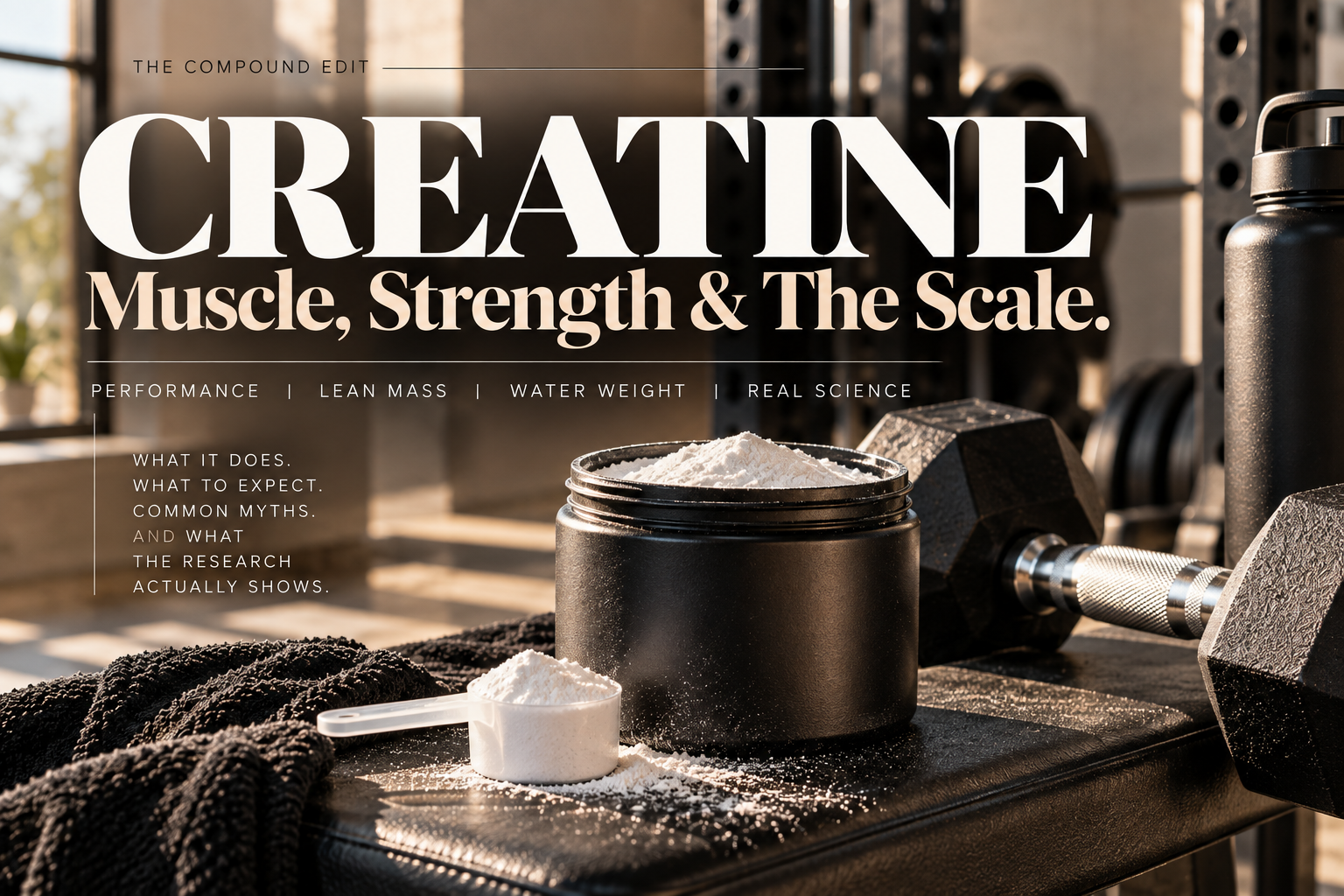
Creatine Isn’t Just for Bodybuilders: What It Actually Does to Muscle, Strength—and the Scale
Yes, the scale might go up. No, that doesn’t mean you gained fat. And the “water weight” story is more interesting than it sounds.
Creatine might be one of the strangest substances in fitness.
It’s inexpensive.
It’s been studied for decades.
It has an enormous amount of human research behind it.
It can improve performance and support gains in lean mass when combined with resistance training.
And yet plenty of people—especially women—still avoid it because of one sentence:
“Creatine makes you gain weight.”
Technically?
It can.
But that statement leaves out the part that actually matters.
What kind of weight are we talking about?
Because gaining two pounds of body fat and gaining two pounds because your muscles are holding more water are two completely different physiological events.
And if your goal is to build muscle, get stronger or improve your physique, seeing the scale increase isn’t automatically bad news.
Sometimes it’s exactly what we’d expect.
First: What Is Creatine?
Creatine isn’t a steroid.
It isn’t a peptide.
It isn’t a hormone.
And despite the way supplement stores market it, it isn’t some exotic laboratory compound either.
Your body already makes creatine from amino acids, primarily through processes involving the liver and kidneys.
You also get some from food—particularly meat and fish.
Most of the creatine stored in the body is found in skeletal muscle.
Once there, some is converted into:
phosphocreatine.
And phosphocreatine helps your muscles rapidly regenerate ATP.
That’s where the performance story begins.
ATP Is Basically Your Cellular Spending Money
ATP—adenosine triphosphate—is the immediate energy currency your cells use to perform work.
When you’re sitting on the couch, energy production isn’t particularly dramatic.
But imagine you’re doing a heavy set of squats.
Or sprinting.
Or trying to squeeze out another rep on bench press.
Your muscles suddenly need a lot of energy very quickly.
Stored ATP is limited.
The phosphocreatine system helps rapidly regenerate ATP during short-duration, high-intensity activity.
Creatine supplementation can increase muscle creatine and phosphocreatine stores.
That doesn’t magically make you stronger overnight.
But it can increase your capacity for repeated high-intensity work.
And over time, that matters.
Creatine Doesn’t Build Muscle the Way Steroids Do
This distinction is important.
Creatine doesn’t bind to androgen receptors like anabolic steroids.
It doesn’t raise testosterone to supraphysiological levels.
It isn’t directly forcing muscle tissue into an anabolic hormonal environment.
Instead, one of its biggest advantages is much less dramatic:
It may help you train a little better.
Maybe you get another rep.
Maybe you maintain power better across several sets.
Maybe your training volume increases slightly.
One workout?
Not revolutionary.
But repeat that advantage over months of progressive resistance training and those small differences can accumulate.
Does Creatine Actually Help Build Muscle?
This is where creatine separates itself from a lot of supplements.
We aren’t relying primarily on mouse studies or testimonials.
We have substantial human research.
A 2024 meta-analysis examining creatine combined with resistance training in adults younger than 50 found that creatine increased lean body mass by about 1.14 kilograms more than resistance training alone while also producing modestly greater reductions in body-fat percentage and fat mass.
That’s roughly 2.5 pounds of additional lean mass.
But there’s an important detail.
Lean mass isn’t automatically identical to new muscle tissue.
If you’ve read our HGH article, that sentence should sound familiar.
Water counts as lean mass too.
And creatine definitely affects water.
So Let’s Talk About the “Water Weight”
Creatine draws water into muscle cells.
This can increase intracellular water, particularly early in supplementation.
And yes:
That can make the scale go up.
For someone who’s spent months trying desperately to make the number on the scale go down, that can feel terrifying.
But consider what’s actually happening.
You didn’t suddenly gain two pounds of fat.
To gain two pounds of stored body fat would require a substantial sustained energy surplus.
Creatine didn’t somehow create thousands of excess calories inside your body.
Instead, part of the early weight change can reflect increased water associated with muscle creatine storage.
That’s not the same thing as getting fatter.
Does Creatine Make You Look Puffy?
This is probably the question women ask most.
There’s a big difference between:
intracellular water
and
subcutaneous water.
Intracellular water is located inside cells.
When muscle cells contain more water, muscles may actually appear slightly fuller.
That’s different from the soft, swollen look people imagine when they hear:
“water retention.”
Research reviews examining common creatine misconceptions have found that while short-term supplementation can increase water retention, longer-term studies don’t consistently show that creatine causes disproportionate extracellular water retention relative to muscle mass.
In other words:
Creatine isn’t automatically making water sit underneath your skin and blur your physique.
That’s a very different claim.
The Scale Can Mess With Your Head
Imagine this.
You’ve been dieting.
You finally hit:
130 pounds.
You start taking creatine.
A week later:
132.
Your immediate reaction?
“Nope. Creatine is making me gain weight.”
So you stop.
But what if your waist measurement didn’t increase?
What if your clothes fit exactly the same?
What if your workouts improved?
What if your muscles actually looked fuller?
The scale gave you accurate information.
Your interpretation of the information was the problem.
Body weight tells you how much your entire body weighs.
It doesn’t tell you what changed.
This Matters Even More After Weight Loss
This is something I wish more people talked about.
When someone’s goal has been weight loss for months—or years—the scale becomes the scoreboard.
Lower = success.
Higher = failure.
Then eventually they reach a healthy body weight and decide:
Now I want muscle.
But psychologically, they’re still trying to make the scale decrease.
Those goals can start fighting each other.
Building muscle means you’re trying to add tissue.
Muscle contains mass.
Glycogen contains mass.
Water contains mass.
Food inside your digestive system contains mass.
You can dramatically improve your physique while weighing the same.
You can even look leaner while weighing more.
Women Don’t Need a Different Kind of Creatine
This deserves saying.
Pink packaging doesn’t change creatine chemistry.
Women don’t need “female creatine.”
And creatine doesn’t suddenly become a different compound when a woman takes it.
Women have historically been underrepresented in sports-nutrition research, but interest in creatine specifically for women has grown substantially. Reviews have discussed potential applications across female life stages, including exercise performance, muscle, aging and other areas of physiology.
The basic mechanism—supporting muscle phosphocreatine availability—isn’t male-only biology.
Will Creatine Make a Woman Bulky?
Creatine cannot override your genetics, training program and energy intake and spontaneously turn you into a competitive bodybuilder.
Building substantial muscle is hard.
Really hard.
Women generally have much lower circulating testosterone concentrations than men.
That doesn’t prevent women from building impressive muscle.
It simply means the idea that a basic supplement will suddenly create enormous amounts of unwanted muscle is wildly exaggerated.
Creatine may help support training adaptations.
You still have to create those adaptations by training.
The supplement doesn’t lift the weights for you.
Unfortunately.
What About Strength?
This is one of the areas where creatine has particularly strong evidence.
A 2024 meta-analysis examining adults younger than 50 found that creatine combined with resistance training produced greater improvements in both upper- and lower-body strength than resistance training with placebo.
Again, this makes sense mechanistically.
If you can repeatedly perform slightly more high-intensity work, you may create a better training stimulus over time.
Creatine isn’t replacing progressive overload.
It’s helping support it.
That’s a very different promise from many “muscle-building” supplements.
Does Everyone Respond the Same Way?
No.
People begin with different baseline muscle creatine stores.
Diet matters.
Muscle mass matters.
Genetics matter.
Training matters.
Someone who already consumes a lot of creatine through animal foods may respond differently from someone with lower dietary creatine intake.
That’s another reason supplement testimonials can be misleading.
Your friend saying:
“Creatine changed my body.”
doesn’t guarantee you’ll notice the exact same thing.
And someone else saying:
“I didn’t notice anything.”
doesn’t mean creatine has no physiological effect.
Do You Need a Loading Phase?
This is another place where gym culture makes things sound more complicated than necessary.
The classic “loading” strategy uses larger amounts of creatine for several days to saturate muscle stores more quickly.
A lower consistent daily intake can also increase muscle creatine stores—it simply takes longer to reach similar saturation.
So loading isn’t some magical anabolic phase.
It’s primarily a faster route to saturation.
That distinction matters because people sometimes experience a quicker scale increase during loading and assume something has gone wrong.
Nothing necessarily went wrong.
You just changed muscle creatine—and associated water—more quickly.
Creatine Monohydrate Isn’t Sexy
This might be my favorite part of the creatine industry.
Companies have spent years trying to invent versions that sound more impressive.
Creatine HCl.
Buffered creatine.
Special delivery systems.
Proprietary creatine blends.
But plain creatine monohydrate remains the form with the enormous research history behind it.
The International Society of Sports Nutrition has described creatine monohydrate as the most effective ergogenic nutritional supplement currently available for increasing high-intensity exercise capacity and lean body mass during training.
Sometimes the boring option wins.
What About Your Kidneys?
This is probably creatine’s longest-running health scare.
Creatine supplementation can influence creatinine, a breakdown product commonly measured in blood tests and used when estimating kidney function.
That can create confusion because elevated creatinine can also occur when kidney filtration is impaired.
But those aren’t automatically the same thing.
A 2025 systematic review and meta-analysis found a small increase in serum creatinine with creatine supplementation but no significant reduction in measured glomerular filtration rate, supporting the interpretation that the creatinine change can reflect creatine metabolism rather than kidney damage in otherwise healthy individuals.
People with known kidney disease or other relevant medical conditions should still discuss supplementation with their healthcare professional.
But:
Creatinine going up isn’t automatically proof that creatine damaged someone’s kidneys.
Context matters.
Creatine vs. HGH Is Actually an Interesting Comparison
These two get put in the same conversation sometimes because both are associated with:
muscle
recovery
and increased lean mass.
But they’re not remotely equivalent interventions.
Creatine is a nutritional compound that supports the phosphocreatine energy system.
HGH is a hormone acting across multiple tissues through growth-hormone and IGF-1 signaling.
Creatine has an enormous body of sports-nutrition research in healthy people.
Exogenous HGH carries a very different risk profile and is a prescription medication with specific approved medical uses.
So asking:
“Which builds more muscle—creatine or HGH?”
misses the bigger distinction.
They’re doing completely different things.
Here’s the Part That Should Make People Think
The fitness world is constantly searching for the newest thing.
New peptide.
New fat-loss drug.
New pre-workout.
New supplement.
New “biohack.”
Meanwhile, one of the most extensively studied performance supplements costs relatively little and has been sitting on supplement shelves for decades.
That’s not nearly as exciting.
There’s no underground mystique.
No complicated pathway graphic required.
No viral before-and-after needed.
It’s just:
Creatine.
And sometimes evidence is boring.
That’s actually a good thing.
The Compound Edit Takeaway
Creatine doesn’t melt fat.
It isn’t a steroid.
It doesn’t replace training.
And taking it isn’t going to transform someone into a bodybuilder against their will.
What it can do is increase muscle creatine availability, support rapid ATP regeneration during high-intensity exercise and improve the capacity to perform repeated hard efforts.
Combined with resistance training, research supports improvements in strength and lean body mass.
And yes:
Your body weight may increase.
Particularly early on.
But the number on the scale doesn’t tell you whether the change came from:
fat
muscle
glycogen
water
or some combination of them.
That’s why perhaps the most useful lesson from creatine has nothing to do with creatine at all:
Stop asking only whether your weight went up.
Start asking what actually changed.
Because if you’re stronger, performing better, adding muscle and improving your physique…
a slightly higher number on the scale might not be a problem.
It might be progress.
Continue Exploring
The Compound Edit follows the evolving science around peptides, metabolic health, recovery, performance and longevity—while separating what research actually shows from what’s gaining traction online.
The Compound Edit is affiliated with Chuk BioWorks. You can read more about that connection and how we approach editorial independence here.
EXPLORE CHUK BIOWORKS → www.chukbioworks.com
The Compound Edit is for educational and informational purposes only and does not provide medical advice. Supplements can be inappropriate for some people depending on medical conditions, medications and other factors. Questions about individual supplementation should be discussed with an appropriate healthcare professional.

2 Comments
Comments are closed.