
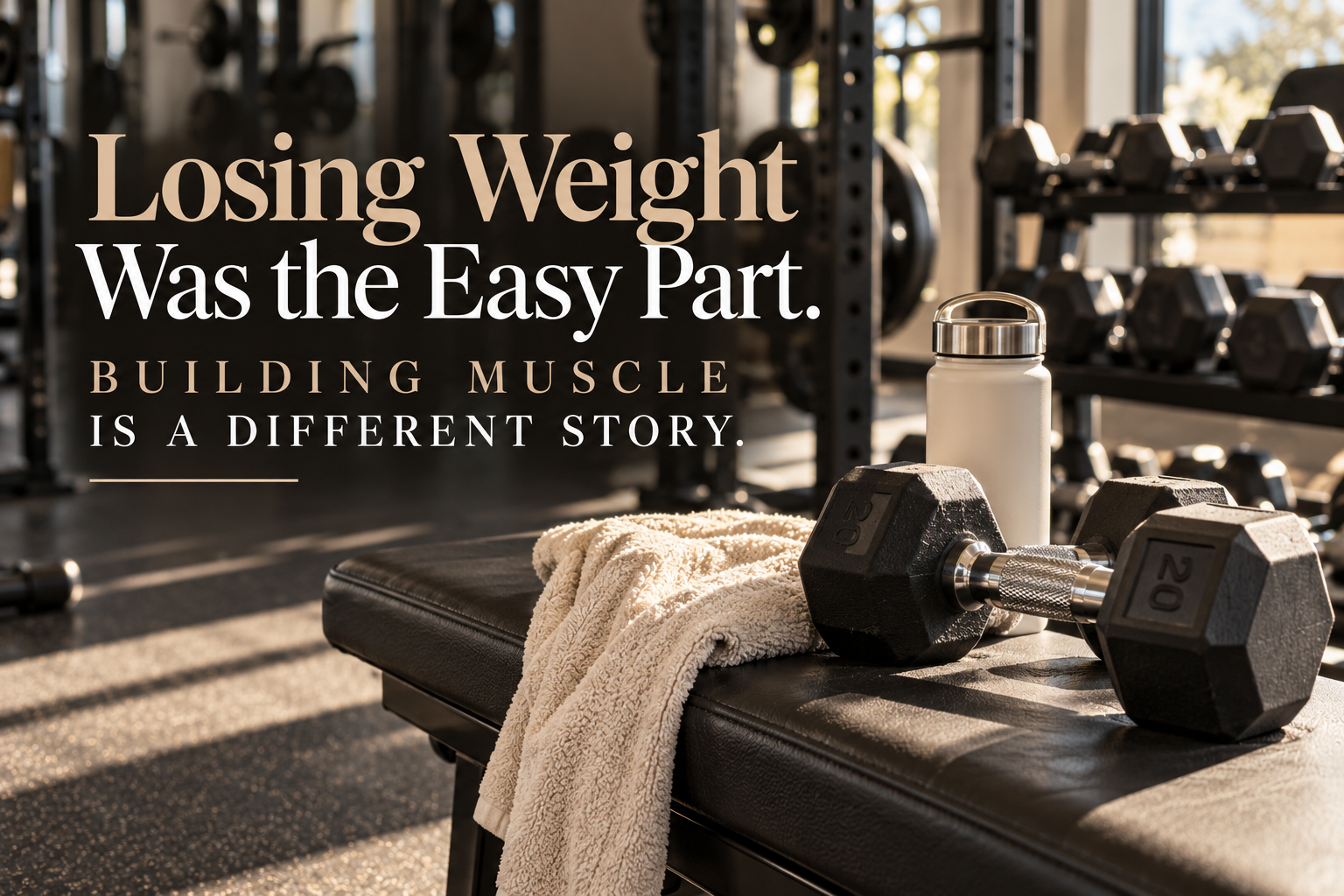
Losing Weight Was the Easy Part. Building Muscle Is a Different Story.
I spent months watching the number on the scale go down. Now I’m learning that the number isn’t nearly as important as I once thought.
For the longest time, I had one goal.
Lose weight.
I wanted to see the number on the scale get smaller. I wanted my clothes to fit differently. I wanted to look in the mirror and actually see the progress I was working toward.
And eventually, I got there.
I lost more than 40 pounds.
But something interesting happened when I reached a weight I never thought I’d see again.
I realized I wasn’t finished. My goals had just changed.
Because losing weight and building the body you actually want? Those are two very different things.
When the Scale Stops Being the Goal
There’s something incredibly motivating about watching the scale move.
Especially when you’ve been trying to lose weight for a long time.
Every few pounds feels like progress. Clothes get looser. People start noticing. You begin feeling more comfortable in your own skin.
But eventually, the scale reaches a number you’re happy with.
And then what?
For me, that was when I started looking at fitness differently.
I didn’t necessarily want to be smaller anymore.
I wanted to be stronger.
I wanted more muscle definition.
I wanted to build my glutes, improve my strength, and have a body that looked athletic rather than simply thin.
And I quickly realized that the things that helped me lose weight weren’t necessarily the same things that would help me build muscle.
The Part Nobody Really Talks About
When you’re focused on weight loss, it’s easy to develop the mindset that eating less is always better.
Less food. Fewer calories. A smaller number on the scale.
But muscle doesn’t grow just because you’re lifting weights.
Your body needs energy.
It needs protein.
It needs recovery.
And it needs a reason to build and maintain muscle.
That means resistance training consistently and eating enough to support the work you’re doing.
Honestly, changing that mindset can be harder than expected.
After spending so much time trying to make the scale go down, the idea of eating more or seeing the number increase can feel completely backward.
But muscle gain and fat loss aren’t measured the same way.
And I’m learning to appreciate that difference.
Why Losing Weight Can Change Your Shape
Here’s something I wish more people understood before starting a major weight-loss journey.
When you lose weight, you don’t get to choose exactly where it comes from.
Your body loses fat from different areas according to factors such as genetics, hormones, and overall body composition.
And depending on how you lose weight, you can lose muscle along the way, too.
This is especially important during rapid weight loss or when calorie intake is very low.
You might end up weighing exactly what you wanted, but not necessarily having the shape you imagined.
For women, one common complaint is losing fullness in the glutes.
You’ve probably heard people refer to it as “Ozempic butt.”
It’s a catchy name, but the underlying issue isn’t exclusive to any particular medication.
Significant weight loss can reduce fat in the buttocks, and muscle loss may contribute to a less full appearance.
The solution isn’t necessarily gaining all the weight back.
It’s understanding how to build muscle.
My New Goal: Stronger, Not Smaller
These days, my workouts have a different purpose.
I’m no longer going to the gym just to burn calories.
I’m going because I want to build something.
I want stronger legs.
More developed glutes.
Better muscle definition.
And I want to feel strong, not just look a certain way.
That means focusing more on progressive overload.
If you’re unfamiliar with that term, it simply means gradually increasing the challenge placed on your muscles over time.
That might mean adding weight, performing more repetitions, improving technique, or increasing your training volume.
Instead of judging a workout by how many calories I burned, I’m learning to pay attention to what I can actually do.
Am I getting stronger?
Is my form improving?
Can I lift more than I could a few weeks ago?
Those are the kinds of wins that matter to me now.
Protein Has Become a Bigger Priority
One of the biggest differences between losing weight and building muscle is how I think about food.
Protein is especially important because it provides the amino acids your body needs to repair and build muscle tissue.
For people who strength train, research often supports protein intakes around 1.4–2.0 grams per kilogram of body weight per day, although individual needs vary.
But here’s the part that matters just as much:
Protein alone isn’t enough if you’re consistently underfueling your body.
You also need adequate overall nutrition.
Carbohydrates help fuel challenging workouts.
Dietary fats support normal physiological functions.
And sufficient calories help your body recover and adapt to training.
I’ve had to rethink the idea that eating as little as possible is somehow an accomplishment.
Because at this stage, my goal isn’t to see how little I can eat.
It’s to give my body what it needs to get stronger.
The Glute-Building Reality Check
Let’s talk about glutes for a minute.
Because if you’ve experienced significant weight loss, you may understand exactly why this matters.
Losing body fat can change the appearance of your backside considerably.
And while you can’t control where your body stores fat, you can train the muscles underneath.
Some of the exercises I’m focusing on include:
- Hip thrusts
- Romanian deadlifts
- Squats
- Bulgarian split squats
- Step-ups
- Cable kickbacks and hip abduction exercises
But the exercise selection isn’t the entire story.
You need consistency.
You need enough training intensity.
You need recovery between challenging sessions.
And you need patience.
Building noticeable muscle takes time.
It’s not the same as watching the scale drop a few pounds over a couple of weeks.
Sometimes progress is happening long before you can clearly see it.
Why the Scale Can Be Misleading Now
This might be the hardest adjustment of all.
When weight loss is your goal, a lower number usually feels like success.
But when muscle building becomes the priority, that number can become much less useful.
You can gain muscle while maintaining a similar weight.
You can improve your body composition without losing another pound.
And depending on your starting point, you might even gain some weight while looking more defined.
That’s why I’m starting to appreciate other ways of tracking progress.
Strength improvements.
Progress pictures.
Measurements.
How my clothes fit.
And how I actually feel.
The scale can still provide information.
It just doesn’t get to tell the entire story anymore.
Recovery Is Part of the Process
I’ve also learned that doing more isn’t always better.
Muscles need time to recover from challenging training sessions.
Sleep, adequate nutrition, and rest all contribute to that process.
You don’t need to destroy yourself in the gym every day to make progress.
In fact, constantly training hard without recovering can make progress more difficult.
For me, that means being more intentional about balancing lifting, cardio, and recovery.
I’m still learning.
But I’m realizing that building a stronger body requires more than just working harder.
It requires working smarter, too.
Something I Didn’t Expect About Reaching My Goal Weight
I think there’s an assumption that once you reach your goal weight, everything suddenly falls into place.
You look exactly how you imagined.
You feel completely satisfied.
And the journey is over.
But that hasn’t been my experience.
I’m incredibly happy with how far I’ve come.
I feel better about myself than I have in years.
But reaching my weight-loss goal didn’t make me stop caring about fitness.
It made me want to explore what else my body could do.
And that’s actually a pretty exciting place to be.
My Biggest Takeaway
If you’re currently working toward a weight-loss goal, I want you to know something.
There’s nothing wrong with wanting to lose weight.
There’s nothing wrong with being excited when the scale moves.
But don’t forget about the body you’re building along the way.
Protect your muscle.
Eat enough protein.
Strength train when you can.
And remember that being smaller isn’t automatically the same as being stronger or healthier.
As for me?
I’m done chasing the smallest possible number.
Now I want to see how strong I can become.
And I have a feeling this part of the journey is going to be even more rewarding.
Keep Exploring on The Compound Edit
If you’re interested in strength, metabolism, and understanding how your body changes, you might also enjoy:
- Creatine: Why It’s Not Just for Bodybuilders
- HGH vs. CJC-1295 and Ipamorelin: Understanding the Differences
- 5-Amino-1MQ: What the Research Actually Says
Continue Exploring
At The Compound Edit, we believe wellness is about more than a number on the scale. It’s about understanding your body, exploring the science, and making informed decisions.
If you’re interested in learning more about the compounds discussed throughout our articles, you can explore Chuk BioWorks.
A Note on Transparency: The Compound Edit has an ownership connection to Chuk BioWorks, a supplier of research-use compounds. Our articles are intended to share education, research, and personal experiences—not to recommend unapproved medical treatments or the personal use of research-grade compounds.
Stay curious. Keep learning. Continue exploring.
Disclaimer: This article reflects personal experiences and general fitness education. It is not individualized medical or nutritional advice. Training and nutrition needs vary, and significant dietary changes should be discussed with an appropriately qualified professional when needed.
Keep Exploring on The Compound Edit
Enjoyed this article? Here are a few more worth reading.
GHK-Cu in Skincare: The Copper Peptide That Made Me Rethink My Routine
Creatine Isn’t Just for Bodybuilders: What It Actually Does to Muscle, Strength—and the Scale
One Comment
Comments are closed.