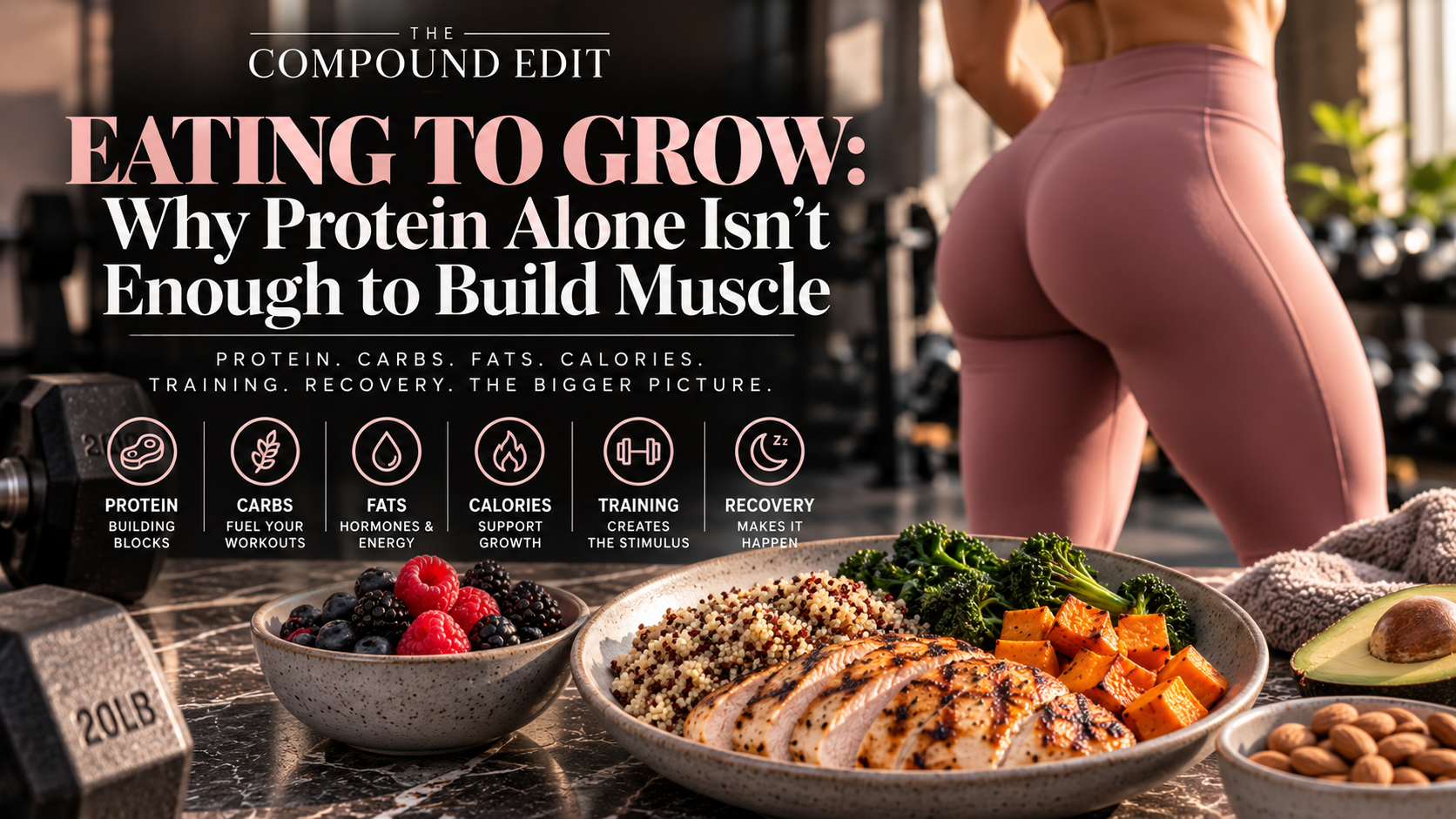
Eating to Grow: Why Protein Alone Isn’t Enough to Build Muscle
The Compound Edit | Nutrition, Muscle Growth & Metabolism
You’re hitting your protein goal.
You’re showing up to the gym.
You’re lifting heavier weights, drinking your protein shakes, and doing everything you thought you were supposed to do.
So why aren’t your muscles growing the way you expected?
Here’s something that doesn’t get talked about nearly enough:
Eating enough protein and eating enough to build muscle are not always the same thing.
And if you’ve recently lost a significant amount of weight, this conversation becomes even more important.
Because after spending months—or even years—trying to eat less, switching your mindset toward eating enough to grow can feel surprisingly difficult.
You finally love the number on the scale.
You don’t want to gain fat.
But you also want fuller glutes, stronger legs, more definition, and visible muscle growth.
Sound familiar?
Let’s talk about what your body actually needs to build muscle, why carbohydrates aren’t the enemy, and how to approach muscle growth without feeling like you’re undoing all your weight-loss progress.
First, How Does Muscle Actually Grow?
Muscle growth is called hypertrophy.
When you challenge your muscles through resistance training, you create a stimulus that encourages your body to adapt.
Over time, with sufficient nutrition and recovery, that adaptation can include increased muscle size.
But here’s the important part:
Lifting weights provides the reason to grow. Nutrition provides the resources. Recovery provides the opportunity.
All three matter.
You can eat a perfectly calculated amount of protein every day, but if your training isn’t challenging your muscles or you’re consistently under-fueling, your results may be limited.
And that’s where a lot of people get stuck.
Protein: The Building Blocks of Muscle
Let’s start with the nutrient everyone already knows matters.
Protein.
Dietary protein provides amino acids, which your body uses to build and repair tissues, including skeletal muscle.
Resistance training stimulates muscle protein synthesis.
Protein consumption also stimulates muscle protein synthesis.
And when the two are combined, they work together to support muscle adaptation.
But how much protein do you actually need?
How Much Protein Is Enough?
The International Society of Sports Nutrition recommends approximately 1.4–2.0 grams of protein per kilogram of body weight per day for most healthy exercising individuals.
For someone specifically focused on building muscle, a practical target is often around 1.6–2.0 grams per kilogram.
Here’s what that looks like:
| Body weight | Approximate daily protein target |
|---|---|
| 115 pounds | 85–105 grams |
| 135 pounds | 100–123 grams |
| 160 pounds | 116–145 grams |
| 185 pounds | 134–168 grams |
| 220 pounds | 160–200 grams |
These are starting ranges, not rigid rules.
Individual needs vary with training, body composition, age, and whether someone is gaining, maintaining, or losing weight.
And here’s something else worth understanding:
More protein isn’t automatically more muscle.
Once you’re consuming enough to support muscle protein synthesis, increasing protein indefinitely doesn’t guarantee additional growth.
That extra food energy might be more useful coming from carbohydrates or fats.
Which brings us to the macronutrient that gets unfairly blamed for almost everything.
Carbohydrates: The Fuel Behind Your Workouts
Carbs.
The nutrient that so many people spent years trying to avoid.
And now, suddenly, we’re talking about eating more of them.
Why?
Because carbohydrates are an important fuel source for resistance training.
When you eat carbohydrates, your body can store some of that glucose as glycogen in your muscles and liver.
Muscle glycogen helps fuel demanding training sessions.
And when you’re performing multiple challenging sets, trying to increase your weights, or training your legs and glutes with significant volume, having enough energy matters.
What Happens When You’re Not Eating Enough Carbs?
You might notice:
- Workouts feel harder than usual.
- You fatigue earlier during sets.
- You struggle to maintain training volume.
- Recovery between demanding sessions feels more difficult.
- You have trouble meeting your overall calorie needs.
Not everyone needs a high-carbohydrate diet to build muscle.
And research doesn’t establish that simply eating more carbohydrates always produces greater hypertrophy when calories and protein are already adequate.
But carbohydrates can help support training performance, especially when workouts are long, frequent, or demanding.
Carbs don’t directly build muscle the way amino acids do. They help fuel the work that tells your muscles to grow.
That’s a distinction worth remembering.
Let’s Talk About Fats, Too
Dietary fat often gets overlooked in bodybuilding conversations.
Protein gets all the attention.
Carbs get all the controversy.
And fats are sometimes treated like something to keep as low as possible.
But your body needs dietary fat.
Fat contributes to cell membranes, essential fatty acid intake, absorption of fat-soluble vitamins, and normal physiological function.
It also provides concentrated energy.
One gram of fat contains approximately nine calories, compared with four calories per gram of protein or carbohydrate.
That can make dietary fat useful for someone who struggles to consume enough total calories.
Does Eating Fat Make You Gain Body Fat?
Not automatically.
Body fat gain is influenced by long-term energy balance, not simply by whether you ate avocado, olive oil, nuts, or peanut butter.
And cutting dietary fat extremely low isn’t necessary for building a lean physique.
A balanced eating pattern should include sources of unsaturated fats while keeping total energy intake aligned with your goals.
The Missing Piece: Total Calories
Now we get to the part that can make people uncomfortable.
Calories.
You can hit your protein target perfectly.
You can eat nutritious meals.
You can train consistently.
But if your body is continually operating in a substantial calorie deficit, maximizing muscle growth becomes more difficult.
Why?
Because building tissue requires energy.
Do You Have to Eat in a Calorie Surplus to Build Muscle?
Not always.
Muscle growth can occur while maintaining weight or even losing fat, particularly in beginners, people returning to training, and individuals with greater body-fat reserves.
This is often called body recomposition.
But for someone who is already lean and has been training consistently, gaining additional muscle while keeping body weight completely unchanged may be slower.
A small, controlled calorie surplus can make the process easier for some people.
The goal isn’t to eat as much as possible.
It’s to provide enough energy to support productive training and recovery without gaining unnecessary body fat.
What Does a Lean-Building Approach Look Like?
Instead of immediately adding hundreds and hundreds of calories, a person might start near estimated maintenance intake.
Then they can monitor:
- Training performance.
- Body-weight trends over several weeks.
- Waist measurements.
- Progress photos.
- Strength increases.
- Recovery and energy.
If strength and muscle measurements are improving, the current intake may be sufficient.
If progress has stalled and recovery is poor, nutrition may need adjusting.
For some experienced lifters, a modest surplus is appropriate.
For others, maintenance calories are a reasonable place to begin.
The important thing is to avoid treating calorie estimates as exact numbers.
They’re starting points.
Your body’s response provides the feedback.
Why Building Muscle After Weight Loss Feels So Different
This is one of my favorite conversations because I think so many people can relate.
When you’re actively trying to lose weight, the goal is straightforward.
Eat less than you burn.
Watch the scale trend downward.
Celebrate each milestone.
But eventually, the goal changes.
You may no longer want to lose weight.
Instead, you want to change the shape of your body.
More muscle.
Better definition.
Fuller glutes.
Stronger legs.
And suddenly, the habits that helped you lose weight aren’t necessarily the habits that will help you build muscle.
The Mental Shift From Losing to Growing
Here’s what makes this stage challenging.
After losing a significant amount of weight, eating more can feel counterproductive.
Even when you understand the science.
You might find yourself thinking:
What if I gain the fat back?
What if I lose the definition I’ve worked so hard for?
What if I start eating more and the scale goes up?
But building muscle isn’t the same goal as losing weight.
And the strategy shouldn’t be identical.
At some point, you have to stop asking how little you can eat and start asking whether you’re eating enough to support the body you’re trying to build.
That doesn’t mean abandoning your goals.
It means adjusting your approach to match them.
Glute Growth: Why Protein Alone Won’t Give You a Bigger Butt
Let’s talk about glutes.
Because this is where the nutrition conversation becomes very real.
You can eat 120 grams of protein every day.
You can buy every glute-focused supplement on the market.
You can do hundreds of kickbacks.
But if you’re not creating enough mechanical tension through training—and you’re not recovering adequately—your glutes may not grow much.
What Actually Makes Glutes Grow?
Your gluteal muscles respond to resistance training just like other skeletal muscles.
Exercises commonly used to train them include:
- Hip thrusts and glute bridges.
- Squats and squat variations.
- Romanian deadlifts.
- Split squats and lunges.
- Hip abduction movements.
These exercises challenge the glutes in different positions and through different movement patterns.
But the exercise name isn’t magic.
The important variables include effort, technique, range of motion, training volume, and progression.
Progressive Overload Matters
Progressive overload means increasing the challenge to your muscles over time.
That might involve:
- Adding weight.
- Performing more repetitions with the same weight.
- Increasing productive training volume.
- Improving control or range of motion.
- Performing the same work with better technique.
You don’t need to increase the weight every single workout.
But over time, your training should provide a meaningful reason for your muscles to adapt.
And here’s another thing.
More glute workouts aren’t always better glute workouts.
If you’re training your glutes hard every day without recovering, you may be limiting the quality of your training.
The goal is productive stimulation followed by adequate recovery.
Not simply doing as much as possible.
Can You Grow Your Glutes Without Gaining Fat?
Yes, it’s possible.
But the rate of progress depends on several factors.
Someone who is relatively new to resistance training may build muscle while maintaining body weight.
Someone returning after a break may also experience relatively rapid improvements.
For a lean, experienced lifter, however, adding substantial muscle while keeping fat mass perfectly unchanged can be more challenging.
That doesn’t mean you need an aggressive bulk.
It means expectations should be realistic.
A gradual approach with adequate protein, sufficient energy, progressive training, and consistent monitoring can help limit unnecessary fat gain.
And remember that some changes on the scale aren’t body fat.
Why the Scale Might Go Up When You Start Eating More Carbs
This is important.
When carbohydrate intake increases, muscle glycogen stores may increase.
And glycogen is stored alongside water.
That means the scale can rise even when body-fat mass hasn’t meaningfully changed.
Your muscles may also appear fuller.
So if you increase your carbohydrates and notice a small weight increase over the next few days, that doesn’t automatically mean you’ve gained fat.
Short-term body weight reflects several things:
- Water balance.
- Glycogen.
- Food and digestive contents.
- Sodium intake.
- Hormonal fluctuations.
- Actual changes in body tissue.
That’s why daily scale fluctuations shouldn’t be interpreted as daily fat gain.
Look at trends over time.
And use more than one measure of progress.
Are You Eating Enough to Recover?
Muscle growth doesn’t happen only while you’re lifting.
The adaptation process continues between workouts.
That’s why recovery matters.
Consistently under-eating can contribute to fatigue, poorer performance, and inadequate recovery.
Sleep matters, too.
Adults generally benefit from seven to nine hours of sleep, although individual needs vary.
If you’re training intensely but constantly exhausted, sore, or struggling to improve, the answer isn’t always another supplement or another workout.
Sometimes the answer is better recovery.
And sometimes that starts with eating enough.
What About Meal Timing?
You may have heard that you need protein immediately after training or you’ve missed your opportunity to build muscle.
The reality is more flexible.
Your total daily protein intake matters greatly.
Distributing protein across meals can also be useful.
For many adults, meals containing roughly 20–40 grams of high-quality protein can help support muscle protein synthesis, although appropriate amounts vary with body size and circumstances.
A practical eating pattern might include protein at breakfast, lunch, dinner, and a snack.
Carbohydrates before or after training can help support energy intake and replenish glycogen, particularly for people training frequently.
But you don’t need to panic if you can’t eat within a precise 30-minute window.
Consistency matters more than perfection.
What About Supplements?
Supplements can be convenient.
But they don’t replace adequate nutrition.
Protein powder can help someone reach their protein target.
Creatine monohydrate has a strong evidence base for supporting high-intensity exercise performance and resistance-training adaptations.
But neither makes up for insufficient energy intake, poor programming, or inadequate recovery.
Before spending money on another product, ask yourself:
Am I eating enough?
Am I training with enough intensity?
Am I recovering?
Am I giving the process enough time?
Those fundamentals matter.
How Long Does It Actually Take to Build Muscle?
This is where patience comes in.
Muscle growth is generally a gradual process.
Early improvements in strength can reflect neurological adaptations, not just increased muscle size.
Visible hypertrophy often takes weeks to months of consistent training, and meaningful physique changes may take longer.
The timeline depends on training experience, genetics, nutrition, sleep, age, and the muscles being trained.
Someone new to lifting may see changes relatively quickly.
Someone who has trained seriously for years may progress more slowly.
And that’s normal.
You don’t need to see a dramatic change every week to be making progress.
A stronger lift, better technique, or improved recovery can be meaningful signs that your program is working.
The Compound Edit Takeaway
Protein is essential for building muscle.
But it isn’t the entire equation.
Carbohydrates help fuel productive workouts.
Dietary fats support normal physiological function and provide energy.
Total calories influence whether your body has enough resources to support growth.
Progressive resistance training creates the stimulus.
And recovery allows adaptation to occur.
For people who have recently lost weight, one of the biggest challenges may be learning that eating enough isn’t the opposite of making progress.
It’s part of making a different kind of progress.
Losing weight changes the number on the scale. Building muscle changes what your body can do—and, over time, how it looks.
And if your goal is stronger legs, fuller glutes, and a more muscular physique, the answer probably isn’t another extreme diet.
It’s learning how to fuel the body you’re asking to grow.
Keep Exploring on The Compound Edit
Want to learn more about muscle growth, nutrition, and body composition?
- Why Protein Matters More Than Ever After Weight Loss
- Losing Weight Was the Easy Part. Building Muscle Is a Different Story.
- Creatine Isn’t Just for Bodybuilders: What It Actually Does to Muscle, Strength, and the Scale
- The Plateau Isn’t Always the Problem
Continue Exploring
The Compound Edit is dedicated to exploring the science, research, and real conversations surrounding peptides, hormones, metabolism, performance, and longevity.
The Compound Edit is affiliated with Chuk BioWorks. While the two share an ownership connection, our editorial goal is to explore scientific research with transparency, including limitations, uncertainties, and potential risks.
Research & Sources
- Jäger R, et al. International Society of Sports Nutrition Position Stand: Protein and Exercise. Journal of the International Society of Sports Nutrition. 2017. https://doi.org/10.1186/s12970-017-0177-8
- Morton RW, et al. A Systematic Review, Meta-Analysis and Meta-Regression of the Effect of Protein Supplementation on Resistance Training-Induced Gains in Muscle Mass and Strength in Healthy Adults. British Journal of Sports Medicine. 2018. https://doi.org/10.1136/bjsports-2017-097608
- American College of Sports Medicine. Resistance Training Prescription for Muscle Function, Hypertrophy, and Physical Performance in Healthy Adults: An Overview of Reviews. 2026. https://doi.org/10.1249/MSS.0000000000003897
- Kerksick CM, et al. International Society of Sports Nutrition Position Stand: Nutrient Timing. Journal of the International Society of Sports Nutrition. 2017. https://doi.org/10.1186/s12970-017-0189-4
- Slater GJ, et al. Is an Energy Surplus Required to Maximize Skeletal Muscle Hypertrophy Associated With Resistance Training? Frontiers in Nutrition. 2019. https://doi.org/10.3389/fnut.2019.00131
Medical Disclaimer
The content published on The Compound Edit is intended for educational and informational purposes only and does not constitute individualized medical, nutrition, or exercise advice.
Nutrition and training needs vary based on health status, activity level, body composition, and personal goals. The examples provided are general educational guidance, not prescribed calorie or macronutrient targets.
Stay curious. Keep learning. Continue exploring.