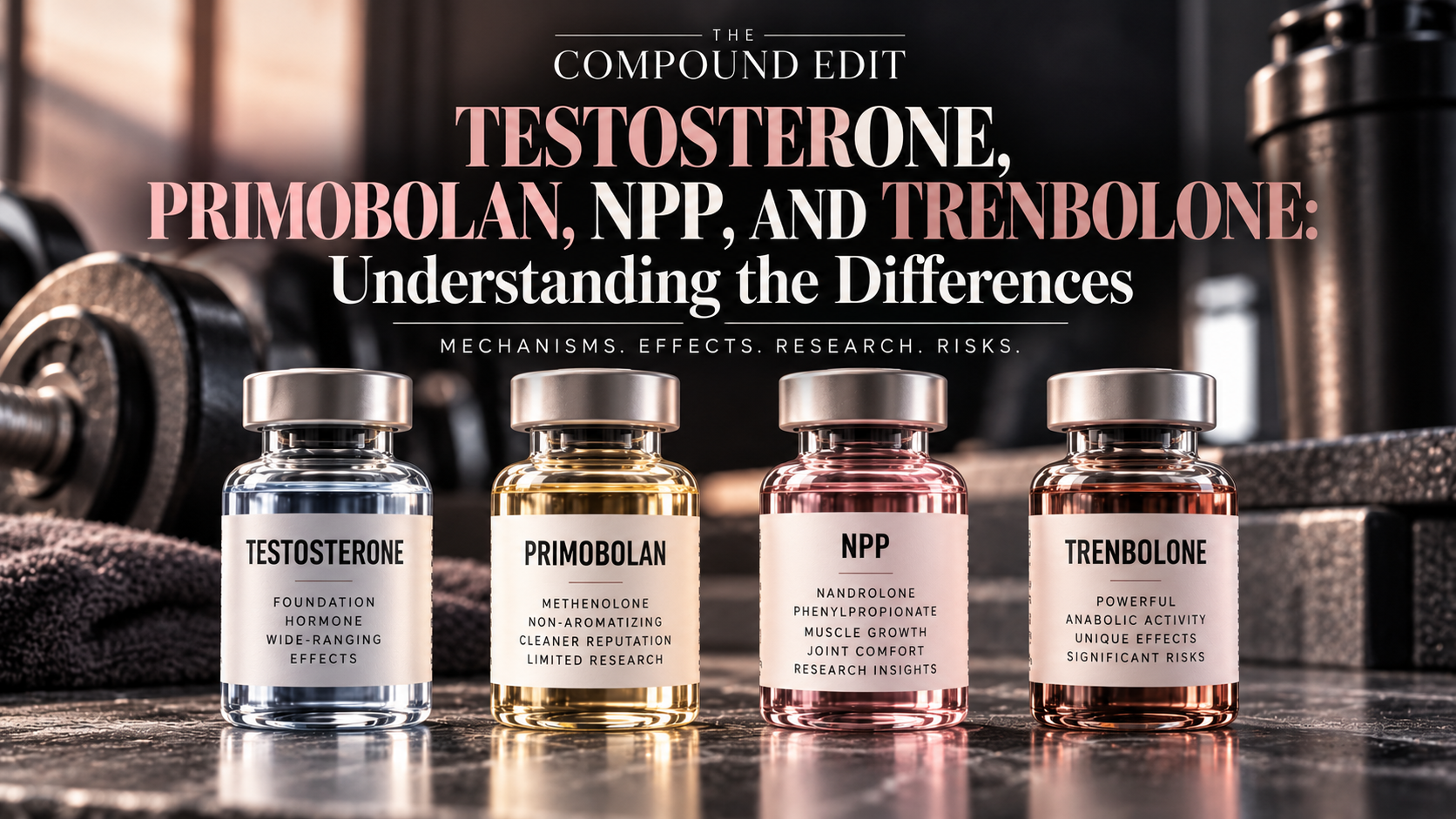
Testosterone, Primobolan, NPP, and Trenbolone: Understanding the Differences
The Compound Edit | Hormones, Performance & Research
Testosterone. Primo. NPP. Tren.
Spend enough time around bodybuilding conversations, and you’ll hear these names constantly.
One gets called the foundation.
Another has a reputation for being mild.
One is associated with muscle growth and joint comfort.
And the last has a reputation for producing dramatic results—and equally dramatic side effects.
But how much of that comes from actual science?
And how much comes from gym culture?
Because here’s something worth understanding:
Just because four compounds belong to the same family doesn’t mean they behave identically in the body.
Their chemical structures differ. Their metabolism differs. Their hormone-related effects can differ.
And perhaps most importantly, the quality of the human research behind them differs.
So today, we’re breaking down testosterone, Primobolan, NPP, and trenbolone—what each compound is, why bodybuilders talk about them differently, and what the evidence actually supports.
First, What Are Anabolic-Androgenic Steroids?
Anabolic-androgenic steroids, or AAS, are compounds that activate androgen receptors.
These receptors help regulate processes involving muscle tissue, sexual development, reproductive function, and other physiological systems.
The term anabolic refers to tissue-building effects.
The term androgenic refers to effects associated with androgen hormones, including testosterone.
But these two categories aren’t completely separate.
You can’t reliably isolate muscle growth from every other androgen-related effect.
That’s one reason a compound marketed as mild or selective can still affect cholesterol, blood pressure, fertility, skin, hair, and hormone production.
And it’s why we need to look beyond bodybuilding nicknames.
Testosterone: The Hormone Everything Else Gets Compared To
Let’s start with testosterone.
Unlike the other three compounds in this article, testosterone is a hormone naturally produced by the human body.
It plays a role in:
- Muscle protein synthesis.
- Bone health.
- Red blood cell production.
- Sexual function and libido.
- Reproductive physiology.
- Maintenance of secondary sexual characteristics.
Testosterone is also an FDA-approved prescription treatment for certain forms of testosterone deficiency.
That distinction matters.
There is a substantial difference between medically indicated testosterone replacement and using supraphysiological amounts for physique enhancement.
Why Is Testosterone Considered the Foundation?
In bodybuilding culture, testosterone is frequently described as the foundation of an anabolic steroid cycle.
Part of that reputation comes from its biological role.
Testosterone can be converted into two other important hormones:
Estradiol, through the enzyme aromatase.
Dihydrotestosterone (DHT), through the enzyme 5-alpha-reductase.
Estradiol isn’t simply a female hormone.
Men need appropriate estrogen signaling for bone health, sexual function, and other physiological processes.
DHT is a potent androgen involved in tissues such as the skin, hair follicles, and prostate.
These conversions help explain why testosterone has a broad range of effects throughout the body.
Does More Testosterone Always Mean More Muscle?
Research has demonstrated dose-dependent increases in fat-free mass and muscle size with increasing testosterone exposure in controlled experimental settings.
But that doesn’t mean increasing the amount indefinitely produces proportional benefits.
The risk of adverse effects can also rise.
Potential problems include elevated hematocrit, acne, altered cholesterol, fertility suppression, and blood-pressure changes.
And higher testosterone exposure can increase estrogen-related effects in some individuals.
The important distinction: Testosterone is both a normal human hormone and a medication with legitimate medical uses. That doesn’t make nonmedical high-dose use harmless.
Primobolan: Why Does It Have Such a Mild Reputation?
Primobolan is the common name for methenolone.
It’s a synthetic anabolic-androgenic steroid derived from the DHT family.
You’ll sometimes hear people describe it as a cleaner or milder steroid.
But those words aren’t medical classifications.
What Makes Primobolan Different?
One important distinction is that methenolone does not undergo aromatization into estrogen.
That means it doesn’t directly produce estrogen through the same pathway as testosterone.
This contributes to its reputation for producing fewer estrogen-related effects.
But there’s a catch.
Not aromatizing doesn’t mean a compound has no hormonal side effects.
Methenolone can still suppress natural testosterone production.
It can still influence lipid levels.
And it can still produce androgenic effects.
In women, those effects may include acne, increased body or facial hair, menstrual changes, and voice deepening.
Some virilizing changes can be permanent.
Does Primobolan Actually Build Muscle?
Methenolone is an anabolic steroid, so its androgen receptor activity provides a biological basis for anabolic effects.
However, high-quality modern clinical trials evaluating methenolone for bodybuilding outcomes are extremely limited.
That means claims about exactly how much muscle it produces—or how it compares with other steroids at particular amounts—are not supported by robust head-to-head research.
Much of its bodybuilding reputation comes from historical use and personal reports.
And anecdotes are not the same as controlled clinical evidence.
The Biggest Misconception About Primobolan
That it is safe because it is mild.
A compound may produce fewer noticeable estrogen-related effects and still create significant cardiovascular or endocrine risks.
Feeling fine doesn’t guarantee that cholesterol, blood pressure, or reproductive hormones are unaffected.
That’s an important distinction.
NPP: What Is Nandrolone Phenylpropionate?
NPP stands for nandrolone phenylpropionate.
Nandrolone is another synthetic anabolic-androgenic steroid.
It’s part of the 19-nortestosterone family, commonly called 19-nor compounds.
You may have heard of Deca-Durabolin.
That contains nandrolone decanoate.
NPP contains the same active hormone—nandrolone—but attached to a different ester.
NPP vs. Deca: What’s the Difference?
The ester influences how the medication is released and how long it persists after injection.
Phenylpropionate is shorter-acting than decanoate.
Once the ester is cleaved, the active hormone is nandrolone.
So the difference isn’t that one contains a completely different muscle-building hormone.
It’s primarily a difference in drug-release characteristics.
Why Is Nandrolone Associated With Muscle Growth?
Nandrolone activates androgen receptors and can promote anabolic effects.
It has also been studied medically in conditions involving muscle wasting and other health concerns.
A 2026 systematic review and meta-analysis of randomized trials involving nandrolone decanoate found an average increase in lean soft tissue compared with placebo.
However, the pooled results did not demonstrate corresponding improvements in the measured strength outcomes.
That’s an interesting reminder that an increase in lean tissue doesn’t always translate into better functional strength.
And the findings concern nandrolone decanoate in clinical research—not proof of a specific bodybuilding outcome with NPP.
What About the Joint-Comfort Reputation?
Nandrolone has a longstanding reputation in bodybuilding circles for making joints feel better.
But there isn’t strong clinical evidence demonstrating that nonmedical NPP use repairs damaged cartilage, tendons, or ligaments.
Anecdotal improvements in joint comfort should not be confused with structural healing.
That’s especially important when someone is lifting heavier weights.
Feeling less discomfort doesn’t necessarily mean the underlying tissue is more resistant to injury.
What About Sexual Side Effects?
Nandrolone can suppress the body’s natural reproductive hormone production.
And because its metabolism differs from testosterone, its effects on androgen signaling in different tissues are not identical.
Sexual dysfunction, reduced fertility, and hormonal disturbances have been reported in association with nandrolone use.
You’ll sometimes hear these issues blamed entirely on prolactin.
But sexual function involves multiple systems, including testosterone, estradiol, neurological signaling, psychological factors, and vascular health.
Blaming every symptom on a single hormone is an oversimplification.
Trenbolone: Why Does It Have Such an Extreme Reputation?
Now let’s talk about trenbolone.
Few compounds in bodybuilding culture have a reputation quite like this one.
It’s frequently described as exceptionally powerful.
It’s also associated with reports of night sweats, sleep disturbances, irritability, reduced cardiovascular endurance, and other unwanted effects.
But we need to separate reputation from evidence.
What Is Trenbolone?
Trenbolone is a synthetic anabolic-androgenic steroid related structurally to nandrolone.
It has been used in veterinary livestock production.
It is not an FDA-approved human medication.
And unlike testosterone, it doesn’t have an established modern body of controlled human therapeutic research supporting its use for muscle building.
That is a major difference.
Why Is It Considered So Potent?
Trenbolone demonstrates strong androgen receptor activity in experimental models.
But the popular practice of assigning steroids simple anabolic and androgenic ratings can be misleading.
Those ratings often come from older laboratory or animal models.
They don’t reliably predict exactly how much muscle a human will gain or how severe the side effects will be.
There is no scientifically validated conversion that tells us trenbolone will produce a certain multiple of testosterone’s muscle-building effects in humans.
What About the Mental Side Effects?
Bodybuilders frequently describe sleep problems, mood changes, irritability, and anxiety during trenbolone use.
Those reports deserve attention.
However, because rigorous human studies specifically examining trenbolone are scarce, researchers cannot confidently quantify how often these effects occur or determine which are uniquely caused by trenbolone.
The broader anabolic-steroid literature does identify psychiatric and behavioral concerns associated with nonmedical use.
So dismissing these reports would be a mistake.
But presenting every anecdote as an established scientific fact would also be inaccurate.
The Most Important Thing to Understand About Trenbolone
Its popularity in bodybuilding is not evidence of established safety in humans.
In fact, the lack of controlled human safety data is itself a significant concern.
When a compound has limited human research, uncertainty should be treated as uncertainty—not proof that the risks are exaggerated.
Comparing All Four Compounds
Here’s a simplified breakdown of their major differences.
| Compound | What makes it different | Important considerations |
|---|---|---|
| Testosterone | Naturally occurring hormone; converts to estradiol and DHT | Approved medical uses; excess exposure can affect hematocrit, fertility, skin, and cardiovascular markers |
| Primobolan (methenolone) | DHT-derived; does not aromatize | Limited modern human performance research; hormone suppression and androgenic effects remain possible |
| NPP (nandrolone phenylpropionate) | Shorter-acting ester of nandrolone | Suppresses reproductive hormones; endocrine and cardiovascular concerns; joint-healing claims remain unproven |
| Trenbolone | Synthetic steroid with strong experimental androgen activity | No approved human use; very limited controlled human safety data |
This table highlights something important.
They may all be described as anabolic steroids, but their evidence bases are not equal.
And that matters when people start making sweeping comparisons.
What About Bulking and Cutting?
In bodybuilding discussions, certain compounds become associated with bulking while others become associated with cutting.
But a steroid doesn’t magically know whether someone is trying to gain muscle or lose fat.
Body composition is influenced by several factors, including:
- Energy intake.
- Training stimulus.
- Protein consumption.
- Recovery.
- Hormonal environment.
- Genetics.
Anabolic steroids may influence muscle protein synthesis and tissue retention, but that doesn’t replace the role of nutrition and training.
And the labels bulking steroid and cutting steroid are largely bodybuilding conventions rather than formal medical classifications.
If you’ve read our article on bulking versus cutting cycles, this is the biological context behind those conversations.
What Happens When Compounds Are Combined?
Bodybuilding culture often refers to combining anabolic steroids as stacking.
The idea is that different compounds may provide different effects.
But combining compounds also creates overlapping physiological exposures.
Multiple anabolic steroids can affect the same cardiovascular, endocrine, and reproductive systems.
And the absence of an obvious side effect doesn’t mean the combination is harmless.
There are no high-quality clinical trials establishing the long-term safety of the steroid combinations commonly discussed in bodybuilding communities.
That makes claims about a particular stack being balanced or safe difficult to support scientifically.
The Cardiovascular Risks That Deserve More Attention
One of the most important parts of this conversation has nothing to do with muscle size.
It’s cardiovascular health.
Nonmedical anabolic-steroid exposure has been associated with:
- Unfavorable cholesterol changes, including lower HDL.
- Elevated blood pressure.
- Increased red blood cell production with some compounds.
- Changes in cardiac structure and function.
- Increased risk of serious cardiovascular complications.
The magnitude of risk varies with exposure, individual factors, and other health conditions.
But the general message is clear.
Looking physically fit does not guarantee that the cardiovascular system is healthy.
Someone can have visible abdominal muscles, impressive strength, and concerning blood-pressure or cholesterol measurements at the same time.
That’s why appearance is such a poor measure of internal health.
Hormone Suppression and Fertility
Another issue that often gets overlooked is the body’s own hormone production.
When external androgens are introduced, the brain can reduce signaling through the hypothalamic-pituitary-gonadal axis.
That can lower luteinizing hormone and follicle-stimulating hormone.
And those changes can suppress natural testosterone production and sperm production.
Recovery after stopping anabolic steroids varies.
Some people recover relatively quickly.
Others experience prolonged hormonal symptoms or fertility problems.
And there isn’t a guaranteed recovery timeline.
This is one reason the distinction between medically managed testosterone treatment and nonmedical anabolic-steroid use is so important.
Why Women’s Risks Deserve Their Own Conversation
Women are sometimes told that certain anabolic steroids are female-friendly or mild.
But androgen exposure can produce effects that are especially significant for women.
These include:
- Increased facial or body hair.
- Acne.
- Menstrual irregularities.
- Scalp hair loss.
- Voice deepening.
- Clitoral enlargement.
Some changes, particularly voice deepening, may be irreversible.
And because high-quality safety research is limited for many nonmedical uses, there isn’t a scientifically established threshold below which virilization cannot occur.
A compound’s reputation in fitness communities isn’t a substitute for safety evidence.
The Problem With Calling Any Steroid Safe
Here’s something I think we should talk about more openly.
In bodybuilding, people often rank compounds from mild to harsh.
And there may be legitimate pharmacological differences behind some of those descriptions.
But those rankings can create a false sense of security.
A compound that causes fewer visible side effects may still influence blood lipids.
One that doesn’t aromatize may still suppress natural hormones.
One that produces rapid muscle growth may also place stress on cardiovascular and reproductive systems.
And a compound that has been used for decades isn’t automatically proven safe.
The absence of obvious symptoms is not the same thing as the absence of harm.
That’s true for testosterone, Primobolan, nandrolone, trenbolone, and anabolic steroids generally.
The Compound Edit Takeaway
Testosterone, Primobolan, NPP, and trenbolone may all belong to the anabolic-androgenic steroid family, but they aren’t interchangeable.
Testosterone is a naturally occurring hormone with established medical uses and substantial human research.
Primobolan is a DHT-derived synthetic steroid with a reputation for being mild, although that reputation doesn’t eliminate its risks.
NPP delivers nandrolone through a shorter-acting ester and has a different metabolic profile from testosterone.
Trenbolone has strong experimental androgen activity but lacks the controlled human research needed to establish its safety or effectiveness for bodybuilding.
And across all four, one theme keeps coming up:
Muscle growth is only one part of the physiological picture.
Cardiovascular health, hormone production, fertility, psychological effects, and long-term consequences deserve just as much attention.
Understanding the differences doesn’t mean glorifying the compounds.
It means moving beyond gym rumors and looking at what the science can—and cannot—tell us.
Keep Exploring on The Compound Edit
Want to keep learning about hormones, bodybuilding, and muscle development?
- Anavar Has a Reputation as the “Mild” Steroid. Is It Actually Mild?
- Have You Ever Thought About Starting Your TRT Journey?
- I Thought I Was Just Getting Older: Shane’s Journey From Peptides to TRT
- Losing Weight Was the Easy Part. Building Muscle Is a Different Story.
Continue Exploring
The Compound Edit is dedicated to exploring the science, research, and real conversations surrounding peptides, hormones, metabolism, performance, and longevity.
The Compound Edit is affiliated with Chuk BioWorks. While the two share an ownership connection, our editorial goal is to explore scientific research with transparency, including limitations, uncertainties, and potential risks.
Research & Sources
- Bhasin S, et al. Testosterone Therapy in Men With Hypogonadism: An Endocrine Society Clinical Practice Guideline. Journal of Clinical Endocrinology & Metabolism. 2018. Read the guideline.
- Kicman AT. Pharmacology of Anabolic Steroids. British Journal of Pharmacology. 2008. Read the review.
- Patanè FG, et al. Nandrolone Decanoate: Use, Abuse and Side Effects. Medicina. 2020. Read the systematic review.
- Prokopidis K, et al. Effects of Nandrolone Decanoate on Muscle Strength, Body Composition and Bone Density: A Systematic Review and Meta-Analysis. Journal of Cachexia, Sarcopenia and Muscle. 2026. Read the analysis.
- Experimental Studies on Androgen Administration in Animal Models: Current and Future Perspectives. 2022. PubMed.
Medical Disclaimer
The content published on The Compound Edit is for educational and informational purposes only. It does not constitute medical advice, diagnosis, treatment recommendations, or instructions for anabolic-steroid use.
Nonmedical anabolic-steroid use carries potentially serious cardiovascular, endocrine, reproductive, and psychological risks. Some compounds discussed in this article are not approved for human use in the United States.
Stay curious. Keep learning. Continue exploring.