The Bloodwork Looked “Normal.” I Still Didn’t Feel Like Myself.
A personal story about low libido, disappearing motivation, frustrating workouts—and finally realizing that “in range” doesn’t always tell the whole story.
For a while, I couldn’t point to one thing that was actually wrong.
I wasn’t sick.
I wasn’t bedridden.
I wasn’t dealing with some dramatic health crisis.
I just didn’t feel like myself anymore.
And honestly, that almost made it harder to explain.
Because how do you describe feeling like someone slowly turned the volume down on you?
I was still functioning.
Still working.
Still taking care of everything that needed to be taken care of.
Still going to the gym.
But the version of me doing all of it felt increasingly disconnected from the woman I remembered being.
My drive was gone.
And I don’t just mean sex drive.
I mean drive.
The thing that makes you want things.
It Started With the Gym
The gym had always been one of the places where I felt most like myself.
I liked getting stronger.
I liked seeing progress.
I liked having something to work toward.
Then gradually, workouts started feeling different.
Weights I’d handled before felt heavier.
Progress stalled.
Recovery didn’t feel the same.
And the motivation that used to get me through the door started disappearing.
At first I blamed the obvious things.
Maybe I wasn’t eating enough.
Maybe I needed more sleep.
Maybe I was stressed.
Maybe I needed to change my training.
So I did what most of us do.
I tried harder.
That didn’t fix it.
Then There Was Sex
This was harder to ignore.
My libido wasn’t just lower.
At times, it felt practically nonexistent.
Sex could still be enjoyable, but getting genuinely interested in it was different.
There was less spontaneous desire.
Less sensitivity.
Orgasms became harder to reach.
And there was vaginal dryness that I hadn’t really dealt with before.
Individually, I could explain away every one of those things.
Together?
Something felt off.
But I was a woman in my 30s with a busy life.
You know what everyone tells women in their 30s?
You’re probably stressed.
And sure.
I was.
Who isn’t?
But I’d been busy before.
This felt different.
I Started Wondering If This Was Just Getting Older
That’s the thought that really bothered me.
Maybe this was simply what happened.
Maybe you hit a certain age and your sex drive disappears.
Maybe you don’t recover as well.
Maybe your motivation drops.
Maybe you stop feeling quite as strong.
Maybe the version of yourself you remember from a few years ago is just…
gone.
That explanation didn’t sit right with me.
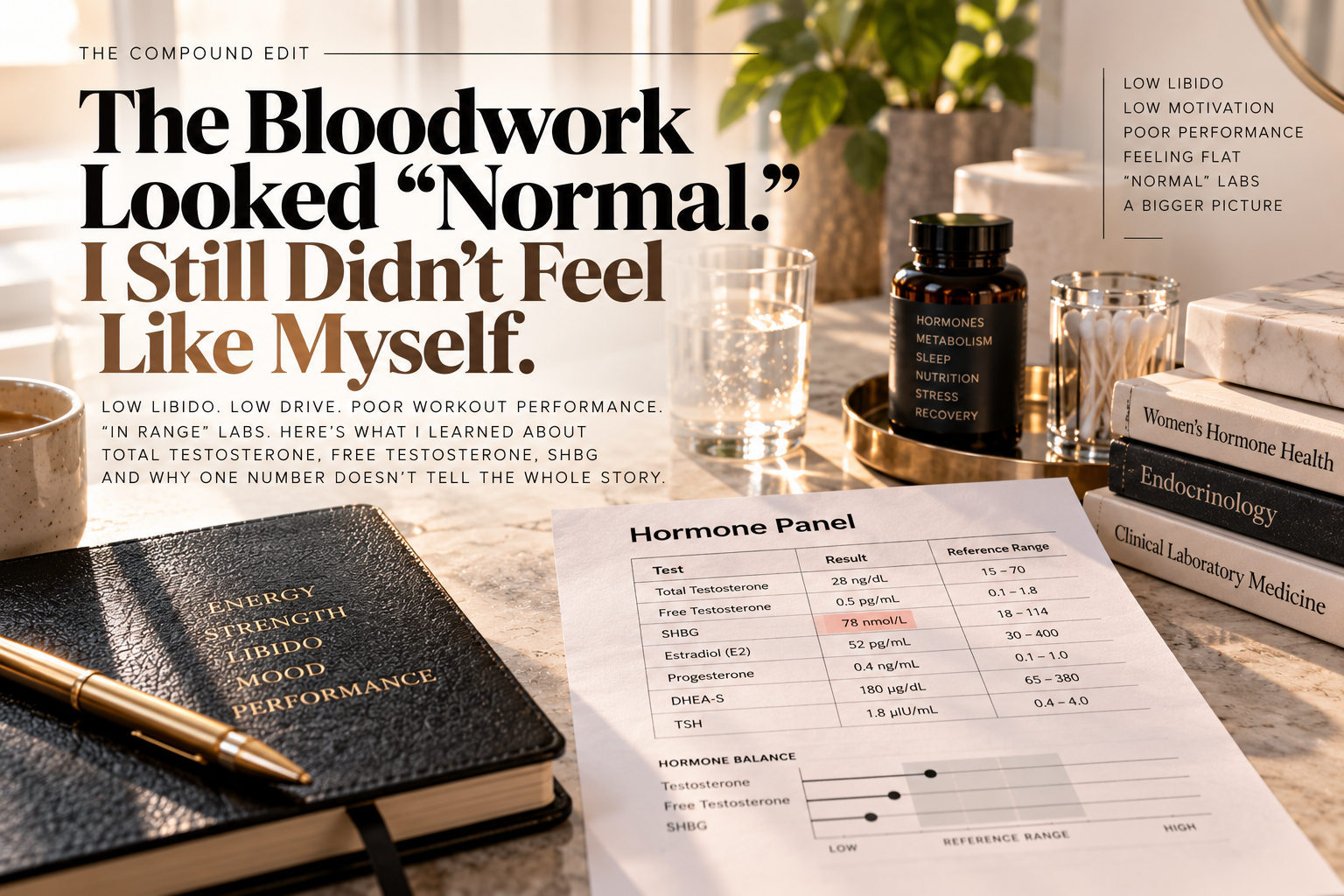
So eventually, I had bloodwork done.
And Apparently Everything Was “Normal”
If you’ve ever had labs done and been told:
“Everything looks normal.”
you probably know how weirdly defeating that sentence can feel when you don’t feel normal.
On one hand, obviously you don’t want something to be wrong.
On the other:
Okay. Then why do I feel like this?
Nothing jumped off the page as some catastrophic abnormality.
There wasn’t one giant red number with an arrow beside it explaining everything.
So I started looking more closely.
And that’s when I learned something I wish more women understood.
Total testosterone isn’t the entire testosterone story.
Wait—Women Have Testosterone?
Absolutely.
Testosterone gets treated like it’s exclusively a male hormone.
It isn’t.
Women normally produce testosterone too, just at substantially lower concentrations than men.
And androgen signaling is involved in multiple aspects of female physiology.
The relationship between testosterone levels and individual symptoms isn’t simple enough to diagnose a woman based on a single number, and professional guidelines specifically caution against diagnosing an “androgen deficiency syndrome” in otherwise healthy women solely from symptoms and testosterone measurements.
But that doesn’t mean testosterone physiology is irrelevant.
It means it’s complicated.
And one of the reasons it’s complicated is something called:
SHBG.
The Number Nobody Had Ever Explained to Me
SHBG stands for:
sex hormone-binding globulin.
It’s a protein produced primarily by the liver.
And, as the name suggests, it binds sex hormones—including testosterone and estradiol.
Most testosterone circulating in your bloodstream isn’t floating around completely unattached.
Some is bound strongly to SHBG.
Some is more loosely associated with albumin.
And a small fraction exists as free testosterone.
That means two women can have similar total testosterone measurements while having different amounts of testosterone available in the free fraction.
Suddenly, I was looking at my labs very differently.
Total Testosterone and Free Testosterone Aren’t the Same Thing
Imagine two checking accounts.
Both technically contain $1,000.
But in one account, almost all of that money is locked and unavailable.
In the other, considerably more is accessible.
The headline number is identical.
The amount you can actually use isn’t.
That’s an imperfect analogy, but it helped me understand why looking only at total testosterone can leave out information.
Higher SHBG can be associated with a lower proportion of free testosterone.
So instead of asking only:
“What’s my testosterone?”
I started realizing there were several separate questions:
What’s my total testosterone?
What’s my SHBG?
What’s my free testosterone?
How reliable was the assay used to measure it?
And, perhaps most importantly:
Does any of this actually explain my symptoms?
This Is Where the Internet Gets Dangerous Too
Once you discover something that seems to explain how you’ve been feeling, it’s incredibly easy to swing too far in the other direction.
You go from:
“Nobody looked at my hormones.”
to:
“THIS NUMBER IS THE REASON FOR EVERYTHING.”
And human biology rarely works that cleanly.
Low libido alone can have numerous contributors.
Hormonal changes.
Medications.
Relationship factors.
Stress.
Sleep.
Depression and anxiety.
Pain.
Menopause-related changes.
Body image.
Other medical conditions.
And sometimes several things are happening simultaneously.
Professional guidance on female sexual dysfunction emphasizes evaluating the broader clinical picture rather than using a testosterone level alone to diagnose the problem.
That part matters.
Because bloodwork can provide clues.
It isn’t a personality test for your hormones.
But “In Range” Isn’t a Diagnosis Either
This is the other extreme.
Laboratory reference ranges are useful.
They’re also frequently misunderstood.
A reference interval generally describes the distribution of laboratory values observed in a particular reference population using a particular testing method.
It doesn’t mean:
Everyone inside this box feels amazing.
And it doesn’t mean:
Everyone outside this box is sick.
Interpretation depends on the test, laboratory method, age, medications, menstrual or menopausal status, clinical history and the question being investigated.
That’s why:
“You’re technically in range”
and
“We’ve figured out why you feel this way”
aren’t synonymous statements.
SHBG Isn’t the Enemy
Once people discover SHBG, there’s another predictable internet reaction:
“How do I lower it?”
But SHBG isn’t some useless protein sabotaging your hormones.
It’s part of normal physiology.
And higher or lower SHBG can occur for numerous reasons.
Estrogen exposure can influence it.
Thyroid function can influence it.
Liver physiology matters.
Body composition and insulin status can influence it.
Certain medications can change it.
Genetics matter too.
So simply trying to crush SHBG because someone online said lower is better misses the point.
The question is why it’s where it is.
Then I Started Reading About Free Testosterone
This was another rabbit hole.
You’d think measuring free testosterone would be straightforward.
It isn’t always.
Testosterone concentrations in women are much lower than those typically found in men, which makes accurate laboratory measurement more technically challenging.
Professional recommendations have emphasized the importance of sensitive, validated assays when evaluating testosterone in women.
Free testosterone can also be measured or calculated in different ways.
So even when someone posts:
“My free T is 2.0.”
that number doesn’t tell you much without knowing:
the units
the assay
the laboratory
and the reference interval.
Sound familiar?
It’s basically the hormone version of our:
“Stop saying I take 10 units.”
article.
Numbers require context.
What About Testosterone Therapy for Women?
This is where the conversation gets especially nuanced.
Testosterone therapy in women isn’t simply:
“Your testosterone is low, so replace it.”
The strongest evidence-based indication for testosterone therapy in women is much narrower.
An international consensus statement supported by several major medical societies concluded that the only evidence-based indication is treatment of hypoactive sexual desire disorder (HSDD) in postmenopausal women after appropriate assessment.
The International Society for the Study of Women’s Sexual Health has also published clinical guidance addressing systemic testosterone for appropriately assessed women with HSDD, including some circumstances involving late reproductive age, while emphasizing careful evaluation and monitoring.
That’s considerably different from:
“Every tired woman with low free testosterone needs testosterone.”
We don’t have evidence supporting that conclusion.
And More Testosterone Isn’t Better
This is another lesson worth learning before entering the hormone world.
Once someone feels better after correcting something, there’s a temptation to think:
If some helped, more will help more.
Hormones don’t work that way.
Excess androgen exposure in women can produce:
acne
increased facial or body hair
scalp hair changes
and, at sufficiently high exposure, potentially more significant androgenic effects.
Clinical guidance recommends keeping testosterone exposure within the physiological premenopausal female range when it’s appropriately prescribed rather than pushing levels into male or supraphysiological territory.
The goal isn’t to win the testosterone scoreboard.
The goal is appropriate treatment of an actual clinical problem.
The Biggest Thing I Learned
For months, I kept trying to answer one question:
“Is my testosterone normal?”
Eventually I realized that wasn’t actually the question I needed answered.
The better question was:
“What’s happening in the context of my entire hormonal and medical picture?”
Total testosterone was part of that.
Free testosterone was part of it.
SHBG was part of it.
But so were estrogen status, thyroid function, nutrition, sleep, stress, medications, training and everything else happening in my body.
No single number got to claim ownership of every symptom.
And yet…
looking beyond the headline number finally gave me better questions to ask.
That alone mattered.
“Normal” Shouldn’t End the Conversation
This is probably the part of the experience that stayed with me most.
There can be an enormous difference between:
nothing obviously dangerous showed up on your bloodwork
and:
we understand why you don’t feel like yourself.
Sometimes normal labs really do mean hormones probably aren’t the explanation.
Sometimes additional context changes the interpretation.
Sometimes the answer isn’t hormonal at all.
But when someone has persistent symptoms affecting their quality of life, “you’re in range” shouldn’t automatically be the end of their curiosity.
It should be one piece of information.
The Compound Edit Takeaway
This isn’t a story about discovering that every woman needs testosterone.
And it isn’t a story about finding one magical lab value that explains motivation, sex, strength and happiness.
It’s about something much simpler.
Context matters.
Total testosterone doesn’t tell you everything about androgen physiology.
Free testosterone doesn’t tell you everything about how a woman feels.
SHBG isn’t automatically good or bad.
And a laboratory reference range isn’t a guarantee that a particular hormone explains—or doesn’t explain—a symptom.
For me, learning the difference between total testosterone, free testosterone and SHBG changed the questions I was asking.
And sometimes that’s where getting answers starts.
Not with:
“Am I in range?”
But with:
“Are we looking at the whole picture?”
Continue Exploring
The Compound Edit follows the evolving science around peptides, metabolic health, recovery, performance and longevity—while separating what research actually shows from what’s gaining traction online.
The Compound Edit is affiliated with Chuk BioWorks. You can read more about that connection and how we approach editorial independence here.
EXPLORE CHUK BIOWORKS → www.chukbioworks.com
The Compound Edit is for educational and informational purposes only and does not provide medical advice. Symptoms involving libido, menstrual changes, sexual function, fatigue or suspected hormonal abnormalities should be evaluated by an appropriate healthcare professional. Hormone therapy should be individualized and medically supervised.