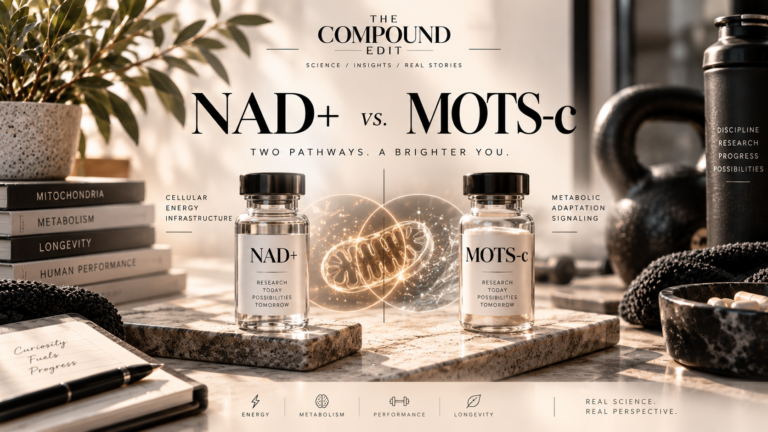
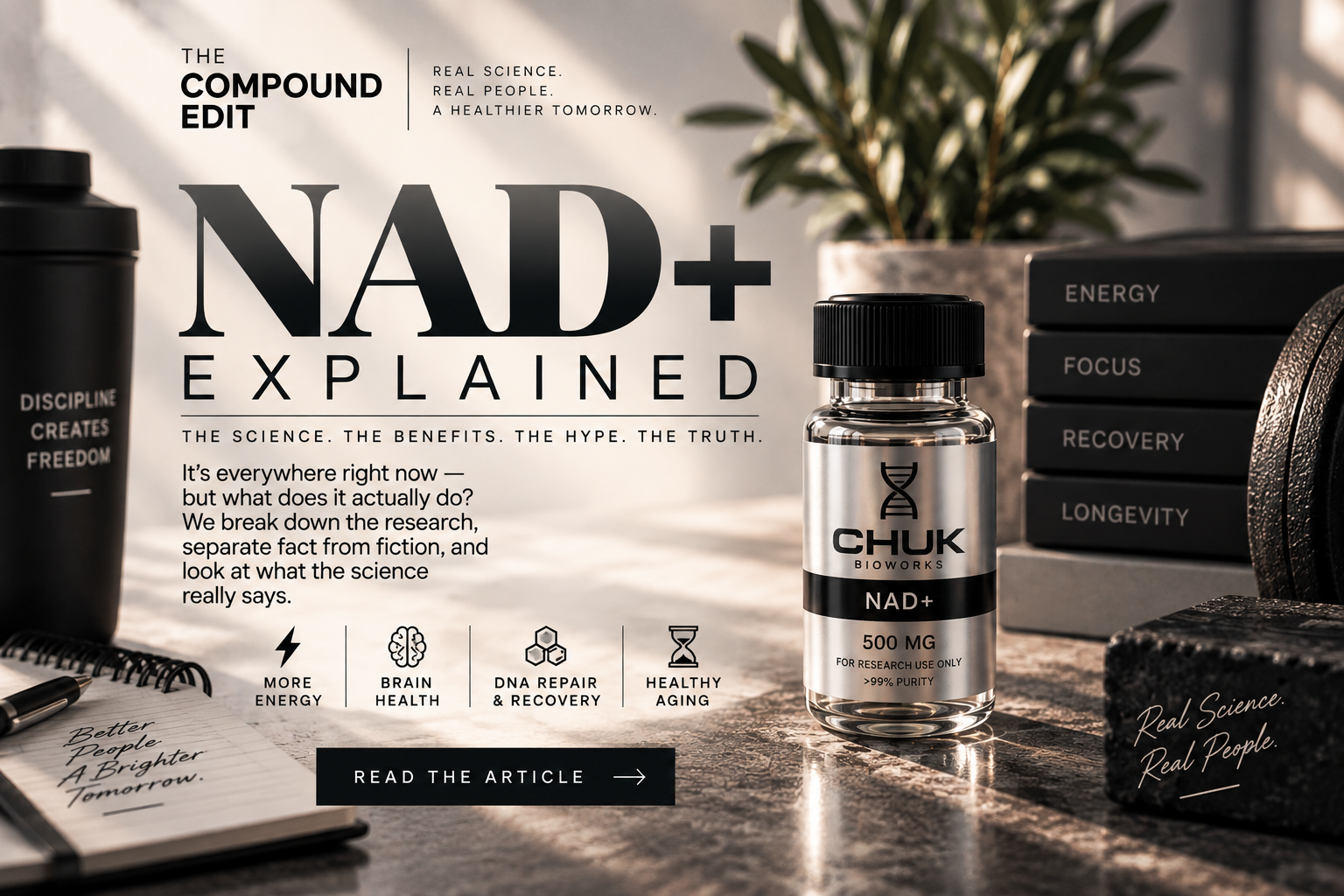
NAD+ Is Everywhere Right Now — But What Does It Actually Do?
Energy. Recovery. Brain health. Longevity. Anti-aging.
Spend enough time in the wellness world and eventually you’ll hear all of those words attached to one molecule:
NAD+.
It has shown up in longevity clinics, supplements, IV infusions, injections and seemingly every corner of the biohacking world.
And some of the claims surrounding it are huge.
More energy. Better focus. Faster recovery. Healthier aging. Improved metabolism. Even the idea that replenishing NAD+ could somehow help us slow down the aging process itself.
So what exactly is NAD+?
And more importantly:
How much of the excitement is actually supported by research?
First: What Is NAD+?
NAD+ stands for nicotinamide adenine dinucleotide.
Despite its complicated name, the basic concept isn’t terribly difficult.
NAD+ is a molecule found throughout the body that cells need to function normally. One of its best-known roles is helping cells carry out reactions involved in converting nutrients into usable energy.
Think of it less like an energy drink for your cells and more like part of the machinery that allows cellular energy production to happen in the first place.
But NAD+ does more than participate in energy metabolism.
It is also used by enzymes involved in processes such as cellular signaling, DNA repair and regulation of cellular stress responses. That involvement in fundamental cellular processes is one reason NAD+ has attracted so much attention in aging research.
So Where Did the Anti-Aging Hype Come From?
This is where things get interesting.
Researchers have found strong connections between NAD+ metabolism and aging biology, particularly in laboratory and animal studies.
That led to a compelling theory:
If declining NAD+ contributes to some aspects of aging, could increasing NAD+ help preserve healthier cellular function?
In animals, boosting NAD+ has produced some genuinely interesting findings involving metabolism, mitochondrial function, inflammation and physical function.
Naturally, that created enormous excitement.
But there’s an important distinction that often gets lost once research makes its way onto social media:
What works in mice doesn’t automatically work in humans.
A major 2025 review in Nature Metabolism concluded that even the commonly repeated idea that NAD+ universally declines with human aging is more complicated than it sounds. Evidence differs depending on the tissue being measured, and human clinical benefits from NAD+-precursor supplementation have so far been limited.
In fact, research published in 2026 found that whole-blood NAD+ levels did not decline with healthy aging across the cohorts studied—another reminder that NAD biology is considerably more nuanced than “we get older, NAD disappears.”
NAD+ vs. NMN vs. NR: What’s the Difference?
This is probably one of the most confusing parts of the conversation.
NAD+ is the molecule cells ultimately use.
NMN (nicotinamide mononucleotide) and NR (nicotinamide riboside) are molecules the body can use as precursors to produce NAD+.
That’s why many human studies haven’t actually given participants NAD+ itself.
Researchers have often given them NR or NMN and then measured whether NAD-related metabolites increase.
And on that particular question, the evidence is fairly encouraging.
Human trials have repeatedly demonstrated that oral NR and NMN can increase NAD-related biomarkers. For example, controlled studies have shown NR can stimulate NAD+ metabolism in middle-aged and older adults, while NMN supplementation has increased blood NAD+ concentrations in older men.
But here’s the catch:
Increasing a biomarker isn’t the same thing as proving someone will feel better, live longer or age more slowly.
That’s the part researchers are still trying to figure out.
What About Energy?
This may be the claim people associate with NAD+ more than anything else.
And biologically, the connection makes sense.
NAD+ participates in the chemical reactions cells use to extract energy from carbohydrates, fats and proteins. It is intimately connected with mitochondrial metabolism.
But saying NAD+ is involved in cellular energy production is different from saying:
“Taking NAD+ will give everyone noticeably more energy.”
Those are two very different claims.
Some people using NAD+-related therapies report feeling more energetic or mentally sharp.
Those experiences are interesting.
They’re just not yet the same thing as strong clinical evidence showing that NAD+ reliably produces those effects across the general population.
What About Brain Function and Mental Clarity?
This is another area attracting considerable research interest.
NAD+ metabolism intersects with mitochondrial function, cellular stress responses and other processes relevant to neurological health.
Researchers are therefore investigating NAD-targeted strategies in aging and neurodegenerative disease.
But we’re still largely in the “interesting biological target” stage rather than the “proven cognitive enhancer” stage.
A 2025 review of NAD-targeted clinical strategies specifically emphasized the need for larger studies addressing effectiveness, long-term safety, dosing, administration route and differences between individuals.
So when someone says NAD+ completely transformed their mental clarity?
That may genuinely be their experience.
It just shouldn’t be presented as something science has established will happen for everyone.
And What About Longevity?
This is probably the biggest question of all.
Can raising NAD+ actually help humans live longer?
We don’t know.
There is fascinating preclinical research surrounding NAD metabolism and aging.
But we currently do not have evidence demonstrating that taking NAD+, NMN or NR extends human lifespan.
That doesn’t mean the research is pointless.
It means longevity research takes time—and biological plausibility is not the same thing as a proven outcome.
What Does the Human Research Actually Show?
A particularly useful answer came in 2026.
Researchers conducted a systematic review covering 113 studies, including 33 human intervention studies and 80 rodent studies.
The animal research frequently showed improvements in areas including metabolism, mitochondrial function and inflammation.
Human results were much less dramatic.
NR and NMN generally increased NAD-related biomarkers and were reasonably well tolerated during the studied periods, but improvements in metabolic health, physical function, vascular measures and other health-related outcomes were mixed, sometimes specific to particular endpoints, and often absent altogether.
In other words:
We know we can manipulate the NAD system.
We’re still figuring out exactly what that translates to in terms of meaningful human health outcomes.
And that’s a pretty important distinction.
What About NAD+ Injections and IVs?
This deserves its own section because injections and IV infusions are frequently discussed as though they’re simply more powerful versions of the supplements studied in clinical trials.
The evidence doesn’t support making that assumption.
A small human pilot study has examined what happens metabolically during a six-hour intravenous NAD+ infusion, so IV NAD+ isn’t completely unstudied. But that study was primarily looking at how NAD+ and its metabolites behaved—not proving anti-aging, energy or longevity benefits.
More importantly, the 2026 systematic review found no eligible clinical-outcomes trials of intravenous or intramuscular NAD+ itself for anti-aging or wellness purposes.
That means something surprisingly important:
Some of the most heavily marketed forms of NAD+ have some of the least clinical-outcomes evidence behind them.
There are also safety and quality considerations with sterile compounded products. The FDA has warned about inappropriate ingredients being used to compound injectable NAD+ and has received reports of reactions including severe chills, shaking, vomiting and fatigue associated with injectable products suspected of excessive endotoxin contamination.
That doesn’t establish that every compounded NAD+ product is unsafe. It does show why sterility, sourcing and manufacturing quality matter enormously when something is being injected.
Interesting? Absolutely. Proven Anti-Aging Miracle? Not Quite.
This may be the most accurate way to describe NAD+ right now.
NAD+ isn’t meaningless wellness hype.
It’s a fundamental molecule involved in cellular metabolism, and researchers have legitimate reasons for studying it in aging, metabolism and disease.
There is also solid evidence that certain NAD+ precursors can alter NAD-related biomarkers in humans.
But there is a large leap between:
“This pathway is biologically important.”
and
“Boosting this pathway will make healthy people feel younger and live longer.”
Science hasn’t crossed that bridge yet.
And that’s actually what makes NAD+ interesting.
The story isn’t finished.
The Bottom Line
If you’ve heard incredible things about NAD+, there’s real science underneath some of the excitement.
But there are also enormous claims being made that extend well beyond what human trials have established.
Right now, the evidence tells us that NAD+ is biologically important, NAD-targeted interventions can alter NAD metabolism, and the pathway deserves continued research.
What we don’t yet know is whether manipulating that pathway will consistently translate into major improvements in energy, cognition, recovery, healthspan—or longevity—in humans.
Sometimes the most exciting areas of science aren’t the ones where we already have all the answers.
They’re the ones where we’re finally beginning to ask the right questions.
Continue Exploring
The Compound Edit is affiliated with Chuk BioWorks, a research compound company. If you’re interested in exploring the compounds discussed throughout The Compound Edit, you can learn more through Chuk BioWorks or read more about the connection between the two platforms.
EXPLORE CHUK BIOWORKS → www.ChukBioWorks.com
Disclosure: The Compound Edit is affiliated with Chuk BioWorks. References and links to Chuk BioWorks should not be interpreted as independent third-party endorsements. Content on The Compound Edit is provided for educational purposes only and does not constitute medical advice. NAD+-related products and routes of administration may differ substantially in their evidence, regulatory status, manufacturing standards and risks.