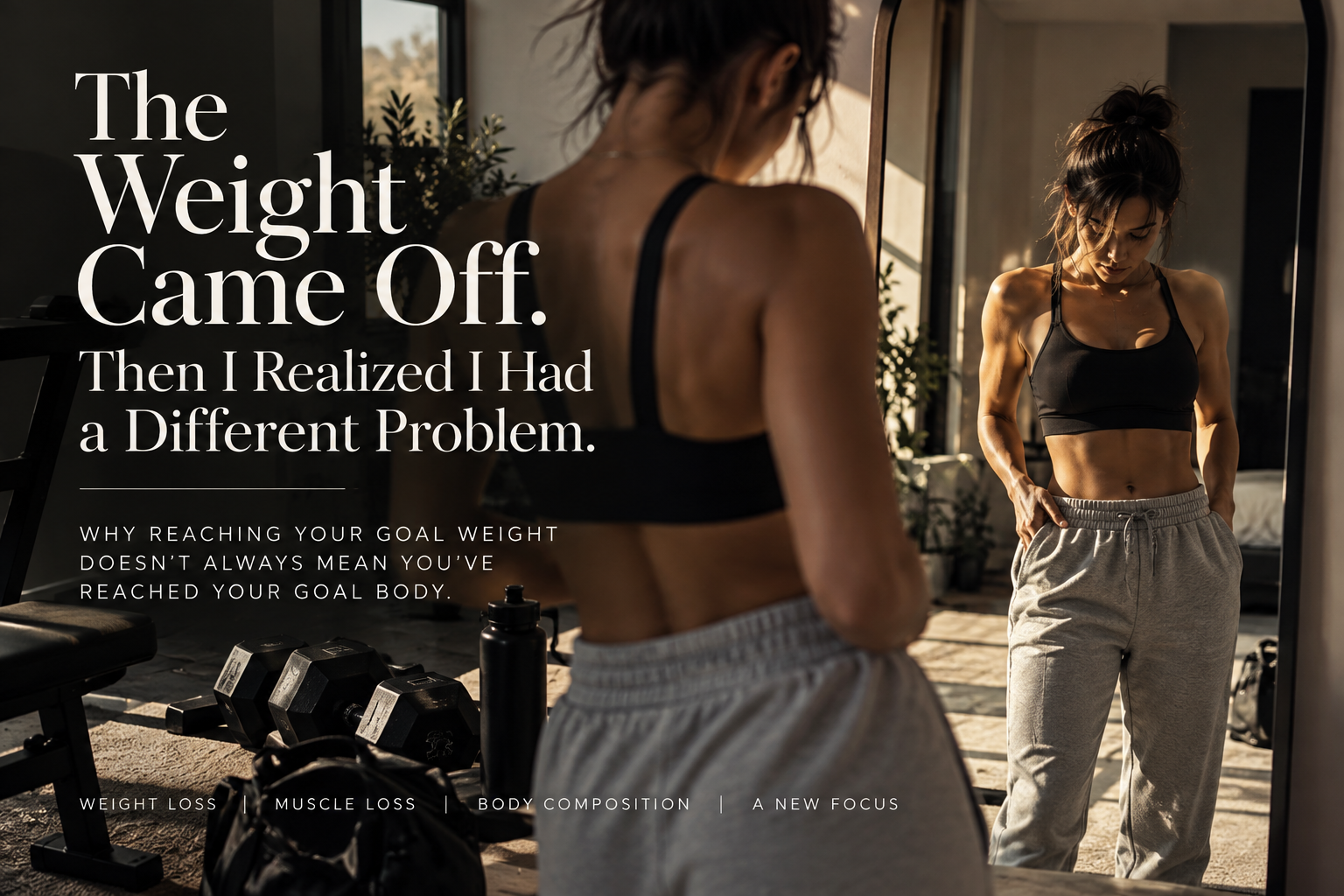
The Weight Came Off. Then I Realized I Had a Different Problem.
This is a composite story inspired by experiences commonly described by people navigating significant weight loss. Details have been fictionalized, and the story is not intended to represent one individual’s medical experience.
For years, I thought I knew exactly what I wanted.
I wanted to be smaller.
That was it.
I didn’t have a complicated goal involving body composition or muscle mass or metabolic health. I didn’t know what half of those things meant.
I wanted to put on jeans without immediately looking at my stomach.
I wanted to stop deleting pictures of myself.
And more than anything, I wanted the number on the scale to go down.
So when it finally started happening, I became obsessed with it.
Not in a scary way—or at least I didn’t think so at the time.
It just felt like I was finally winning.
Every new number felt like an accomplishment.
For the first time in years, I wasn’t avoiding the scale.
I couldn’t wait to step on it.
Eventually, I hit the number I’d been chasing.
And I remember standing there, looking down at it, thinking:
Okay. I did it.
Except there was one problem.
I didn’t actually love what I saw in the mirror.
I Was Smaller. But I Didn’t Look How I Thought I Would.
This was the part nobody had really prepared me for.
My clothes were smaller.
My stomach was smaller.
My face was thinner.
Everything I had spent years wanting to shrink had finally shrunk.
But so had everything else.
My legs looked smaller.
My shoulders had lost their shape.
And my butt?
Let’s just say that had apparently participated enthusiastically in the weight-loss program.
At first, I told myself I needed to lose a few more pounds.
Because that had always been my answer.
Don’t like something?
Lose more weight.
So I did.
And somehow I looked even less like the body I had pictured in my head.
That’s when something finally clicked.
Maybe the problem wasn’t that I still had too much fat.
Maybe I didn’t have enough muscle.
I Had Never Thought About Muscle Before
I exercised during my weight loss.
But if I’m being completely truthful, most of it was about burning calories.
I’d walk longer because my watch said I’d burned 300 calories.
I’d choose cardio over lifting because cardio made the calorie number climb faster.
And if I had to choose between eating another 300 calories or seeing another pound disappear?
I wanted the pound gone.
Protein was something gym people talked about.
Creatine was something I associated with giant tubs at supplement stores.
Heavy lifting seemed like something you did when you wanted to get big.
I wanted to be small.
It took reaching my smallest adult size to realize those two goals weren’t necessarily opposites.
Weight Loss and Body Composition Aren’t the Same Thing
When body weight decreases, the weight lost isn’t automatically 100% body fat.
Some lean mass can be lost too.
That’s true with traditional calorie restriction, and preserving lean mass has also become an important conversation around GLP-1-based weight-loss medications.
How much lean mass someone loses varies considerably based on factors including the amount of weight lost, protein intake, resistance training, age and individual physiology.
And here’s the part I wish I’d understood earlier:
The scale can’t tell you what you lost.
It just tells you that you’re lighter.
Two people can weigh exactly the same amount and look completely different because their body composition is different.
Suddenly, the number I’d been chasing didn’t seem nearly as informative as I’d believed.
My Goal Changed
This was probably the biggest mental adjustment.
For months, success had meant:
Eat less. Weigh less.
Now I needed to do something that felt completely backwards.
I needed to eat enough to support training.
I needed protein.
I needed recovery.
And instead of asking:
“How many calories did I burn?”
I started asking:
“Am I getting stronger?”
That one question changed almost everything.
I Started Lifting Differently
I stopped treating weights like the thing I did before cardio.
They became the workout.
Squats.
Romanian deadlifts.
Hip thrusts.
Rows.
Presses.
Pulldowns.
Nothing particularly exotic.
The difference was that I started tracking them.
If I did eight reps with a certain weight one week, I tried to get nine or ten eventually.
If that became easy, I increased the weight.
For the first time, I wasn’t exercising to erase something I’d eaten.
I was training to build something.
That felt completely different.
Then I Had to Make Peace With Protein
This was harder than lifting.
After spending so long thinking about eating less, intentionally eating more of anything felt wrong.
Especially when my weight-loss medication had made it incredibly easy not to feel hungry.
There were days when I could have accidentally made it to dinner having eaten almost nothing.
Before, I would have considered that a fantastic day.
Now I started seeing the problem.
If I wanted my body to build and maintain muscle, I had to actually give it something to build with.
So instead of asking how little I could eat while still functioning, I started building meals around protein.
Not perfectly.
Not with six meal-prep containers lined up in my refrigerator.
I just started paying attention.
And that alone was a huge shift.
I Started Taking Creatine Too
This one makes me laugh now because I avoided creatine for years.
I thought it was basically for bodybuilders.
Then I learned that creatine is one of the most extensively studied sports supplements available.
Its role isn’t to magically create muscle.
Creatine helps increase phosphocreatine availability in muscle, which can support rapid energy production during high-intensity activity.
In practical terms, that can help support training performance—and better training can support strength and muscle development over time.
So I started taking it consistently.
Nothing dramatic happened overnight.
There was no morning when I suddenly woke up looking like I had gained ten pounds of muscle.
I just kept training.
And Then Something Weird Happened
The scale stopped being exciting.
Not because I suddenly hated it.
It just stopped being the most interesting measurement.
Some weeks it didn’t move at all.
There were even weeks when it went up.
Old me would have panicked.
New me was standing in front of the mirror thinking:
Wait. My legs look better.
My jeans fit differently.
My shoulders had shape again.
My butt started making a comeback.
And in the gym, weights that used to feel impossible weren’t impossible anymore.
The number wasn’t getting smaller.
But my body was still changing.
That was the moment I finally understood body recomposition.
The Part Nobody Talks About Enough
Losing weight can become its own identity.
Especially when you’ve spent years trying to do it.
People notice.
They compliment you.
You buy smaller clothes.
Every few weeks there’s another visible change.
Then eventually you reach maintenance.
And suddenly you’re supposed to stop doing the thing you’ve been rewarded for doing over and over again.
That was surprisingly difficult.
There was a part of me that always thought:
Five more pounds wouldn’t hurt.
Except eventually I had to ask myself:
Five more pounds toward what?
Because I wasn’t trying to become infinitely smaller.
I wanted to look athletic.
I wanted legs that looked strong.
I wanted shoulders.
I wanted curves.
I wanted to walk into the gym and feel capable.
At some point, losing more weight was no longer moving me toward that goal.
GLP-1s Didn’t “Destroy” My Muscle
I think this distinction matters.
It’s easy to see conversations online where muscle loss gets framed as though GLP-1 medications uniquely melt muscle away.
That’s too simplistic.
Significant weight loss by many methods can include loss of lean mass.
And when appetite is dramatically reduced, it can become especially easy to under-eat protein and calories while neglecting resistance training.
Those are things we can actually pay attention to.
The lesson I took from my experience wasn’t:
“Weight-loss medication ruined my body.”
It was:
I spent so much time thinking about losing weight that I forgot to think about what I wanted to keep.
That’s a very different lesson.
Smaller Was Never Actually the Goal
This is the realization that took me the longest.
I thought I wanted to weigh a certain number.
But what I really wanted was the feeling I had attached to that number.
Confidence.
Comfort.
Strength.
Being able to put something on without immediately wondering whether it made me look bigger.
I assumed becoming lighter would automatically give me all of those things.
Some of it did.
Some of it didn’t.
And that’s okay.
Because reaching the first goal gave me the opportunity to discover the second one.
Now I’m Trying to Build
My priorities look completely different today.
I still care about maintaining the weight I lost.
But I’m much more interested in:
strength
protein
muscle
recovery
performance
and how I actually feel.
I don’t celebrate eating almost nothing anymore.
I don’t choose every workout based on how many calories my watch says I burned.
And I don’t automatically assume that a lower number on the scale means I’m moving in the right direction.
Some days, I still have to remind myself of that.
Years of wanting to be smaller don’t disappear overnight.
But now when I look in the mirror, I’m not asking:
“How much more can I lose?”
I’m asking:
“What can I build from here?”
And for the first time, that feels like a much better goal.
The Compound Edit Takeaway
Weight loss and body composition aren’t interchangeable.
The scale measures total body weight. It doesn’t tell you whether a change came from fat, lean tissue, water or some combination of all three.
That’s particularly worth thinking about during substantial weight loss, regardless of the method used to achieve it.
Resistance training, adequate nutrition and sufficient protein become important parts of the conversation when preserving—or eventually building—muscle matters.
And sometimes reaching your goal weight reveals something you couldn’t see while you were chasing it:
Maybe you never wanted to be as small as possible.
Maybe you wanted to feel strong in your body.
Those aren’t the same goal.
Continue Exploring
The Compound Edit follows the evolving science around peptides, metabolic health, recovery, performance and longevity—while separating what research actually shows from what’s gaining traction online.
The Compound Edit is affiliated with Chuk BioWorks. You can read more about that connection and how we approach editorial independence here.
EXPLORE CHUK BIOWORKS → www.chukbioworks.com
The Compound Edit is for educational and informational purposes only and does not provide medical advice. Individual responses to weight-loss medications, nutrition and exercise vary. Medication decisions should be discussed with an appropriate healthcare professional.