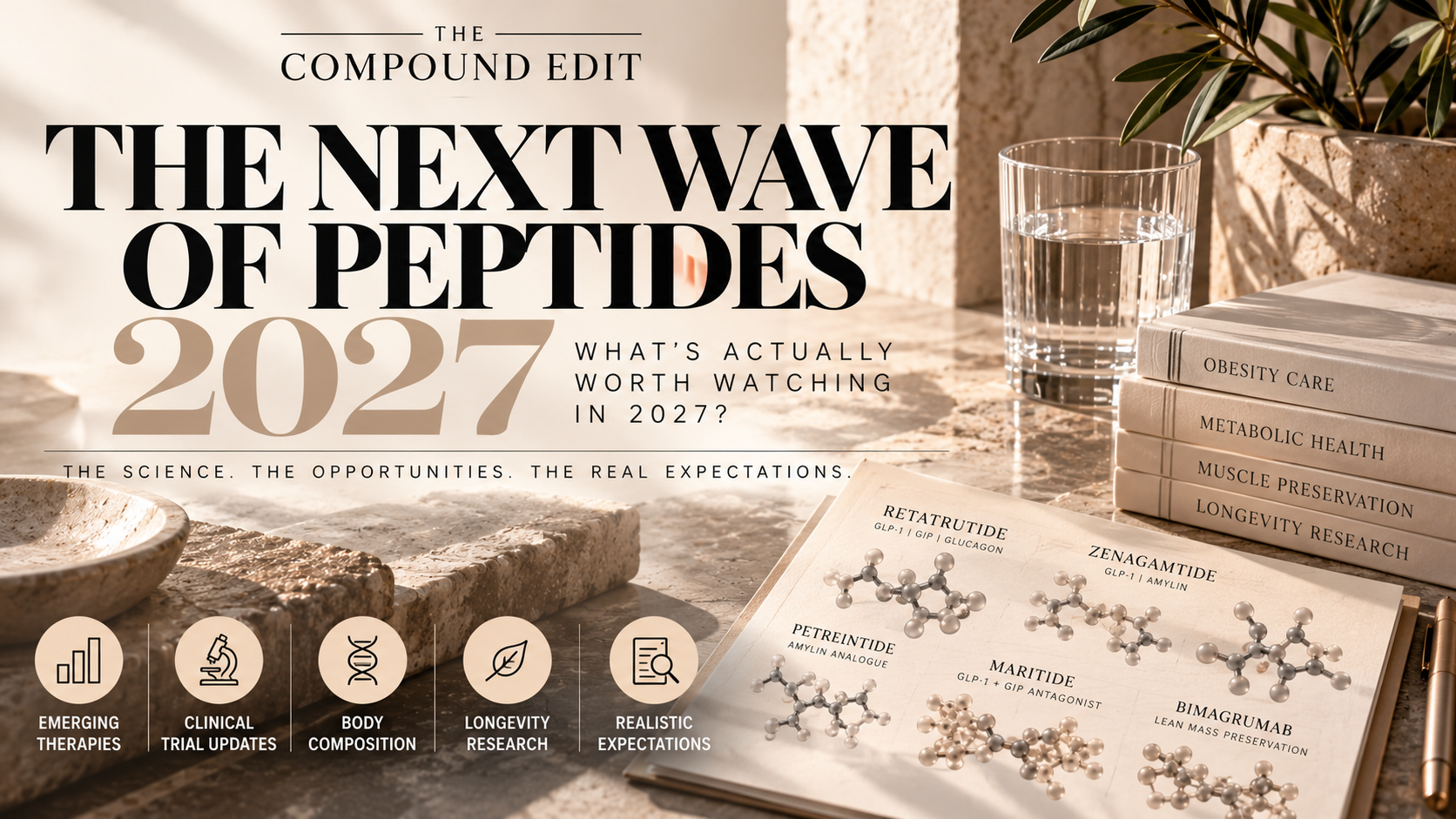
The Next Wave of Peptides: What’s Actually Worth Watching in 2027?
The Compound Edit | Peptides, Metabolism & Longevity
Remember when the entire weight-loss conversation seemed to revolve around semaglutide?
Then came tirzepatide.
Then retatrutide.
And suddenly, researchers weren’t just investigating one hormone pathway anymore.
They were exploring combinations of hormones, new appetite-regulating systems, longer-lasting medications, and even treatments designed to change how much fat and lean tissue someone carries.
But here’s where things get interesting.
The next generation of metabolic medicine may not be defined by which compound produces the biggest number on the scale.
It may be defined by which treatments are easier to tolerate, require less frequent administration, preserve physical function, and produce meaningful long-term health benefits.
And as we approach 2027, several investigational therapies deserve attention.
Not because they’re guaranteed breakthroughs.
But because they represent genuinely different scientific approaches.
Let’s look at what’s worth watching, what the research actually shows, and which claims are getting ahead of the evidence.
First, What Counts as a Peptide?
Before we dive in, there’s an important distinction.
A peptide is a chain of amino acids.
Some peptide-based medications mimic or modify hormones that naturally occur in the body.
Others are engineered to interact with specific receptors or biological processes.
But not every treatment discussed in the peptide community is technically a peptide.
Some are antibodies.
Some are small molecules.
Others combine different technologies.
That matters because the term peptide has become a catch-all label for almost anything associated with weight loss, performance, recovery, or longevity.
A compound’s scientific classification matters more than whether it’s trending under the peptide hashtag.
For this article, we’re looking at the broader next generation of peptide-based and related metabolic therapies.
1. Retatrutide: The Triple Agonist Moving Toward Regulatory Review
Let’s start with the compound that’s already generated enormous interest.
Retatrutide is an investigational medication developed by Eli Lilly.
It activates three hormone receptors:
- GLP-1
- GIP
- Glucagon
That combination distinguishes it from semaglutide, which targets GLP-1 receptors, and tirzepatide, which targets GLP-1 and GIP receptors.
Why Researchers Are Interested
The GLP-1 and GIP pathways influence appetite and glucose regulation.
Glucagon receptor signaling also affects energy metabolism.
By combining these pathways, researchers are investigating whether retatrutide can produce substantial weight reduction alongside improvements in metabolic health.
What Does the Evidence Show?
In the Phase 3 TRIUMPH-1 trial, adults with obesity without diabetes received retatrutide or placebo over 80 weeks.
In the highest-dose group, the average weight reduction was approximately 25.0% in the treatment-regimen analysis and 28.3% in an efficacy-oriented analysis.
These are different statistical approaches, and the numbers should not be treated as interchangeable.
Additional Phase 3 trials have reported substantial weight reductions in people with type 2 diabetes and other obesity-related complications.
What to Watch in 2027
Eli Lilly has announced plans to submit retatrutide for U.S. regulatory review in the first quarter of 2027.
That makes regulatory review, detailed safety findings, and longer-term outcomes major developments to watch.
But a planned submission does not guarantee approval.
And as of October 2026, retatrutide remains investigational.
Why it matters: Retatrutide is one of the most clinically advanced examples of triple-receptor metabolic therapy.
2. Zenagamtide: Combining GLP-1 and Amylin in One Molecule
You may recognize this compound by its earlier name:
Amycretin.
Now known as zenagamtide, this investigational therapy is being developed by Novo Nordisk.
And its approach is different from retatrutide.
Instead of targeting GLP-1, GIP, and glucagon, zenagamtide activates:
- GLP-1 receptors
- Amylin receptors
Why Is Amylin Interesting?
Amylin is a hormone involved in regulating appetite, satiety, gastric emptying, and glucose-related responses after meals.
Researchers believe that targeting amylin and GLP-1 signaling together may produce complementary effects.
The interesting part is that zenagamtide is designed to activate both pathways through one molecule.
What Have Trials Shown?
In a Phase 2 study involving adults with type 2 diabetes, Novo Nordisk reported that once-weekly injectable zenagamtide produced average weight reductions of up to approximately 14.6% at 36 weeks.
The company also reported improvements in A1C.
However, these were mid-stage findings in a specific study population.
They cannot establish how zenagamtide compares directly with retatrutide or other therapies.
What to Watch in 2027
Novo Nordisk initiated its Phase 3 AMAZE obesity program in 2026 and announced plans for Phase 3 development in type 2 diabetes.
The next questions are about reproducibility, tolerability, longer-term results, and whether combining GLP-1 and amylin pathways offers meaningful advantages.
Why it matters: Zenagamtide represents a different kind of multi-hormone strategy—and may help clarify the value of amylin-based treatments.
3. Petrelintide: Could Better Tolerability Become a Competitive Advantage?
Not every new treatment is trying to produce the most dramatic possible weight-loss percentage.
Some researchers are also focusing on the treatment experience.
And that’s where petrelintide becomes interesting.
Petrelintide is an investigational long-acting amylin analogue being developed by Zealand Pharma in collaboration with Roche.
Like cagrilintide, it targets amylin-related biology.
But it is a separate compound with its own clinical development program.
What Have the Trials Shown?
In March 2026, Roche reported results from the Phase 2 ZUPREME-1 trial.
Participants receiving petrelintide achieved average weight reductions of up to 10.7% at 42 weeks, compared with 1.7% for placebo.
The company also reported a favorable gastrointestinal tolerability profile in that study.
In October 2026, Zealand Pharma announced results from ZUPREME-2, involving adults with overweight or obesity and type 2 diabetes.
Weight reductions reached 9.2% at 28 weeks, compared with 2.0% for placebo.
These findings came from company-reported topline results and require continued evaluation.
Why Is This Interesting?
A medication doesn’t have to produce the greatest average weight loss to be clinically valuable.
If it can offer meaningful benefits with acceptable adverse effects, it may fill an important role.
But favorable results in one study don’t guarantee superior tolerability across different treatments or populations.
What to Watch in 2027
The advancement of petrelintide into larger clinical trials will help clarify its efficacy, safety, and potential role alone or in combination with other therapies.
Why it matters: Petrelintide may help answer whether amylin-based treatments can offer a different balance between effectiveness and tolerability.
4. MariTide: What If Weight-Loss Treatment Didn’t Require Weekly Injections?
Here’s a development that could change the treatment experience.
MariTide, also known as maridebart cafraglutide, is an investigational therapy developed by Amgen.
And unlike traditional peptide-only medications, MariTide is an antibody-peptide conjugate.
Its mechanism is particularly interesting.
It activates the GLP-1 receptor while blocking the GIP receptor.
That’s different from tirzepatide and retatrutide, which activate GIP receptors.
Wait, Why Would Blocking GIP Be Helpful?
That’s an excellent question.
Researchers are investigating different ways to manipulate GIP signaling.
Some approaches activate the receptor.
Others block it.
And both strategies have shown potential in different experimental settings.
The full biological explanation is complex, and the clinical implications are still being studied.
The Biggest Difference: Duration
MariTide is engineered to remain active for an extended period.
Its development program is evaluating monthly administration and potentially less frequent schedules.
Imagine the difference between a treatment requiring weekly administration and one that might eventually require substantially fewer injections.
That could affect convenience, adherence, and patient preference.
But longer duration also raises important questions about managing adverse effects and treatment discontinuation.
What to Watch in 2027
Amgen’s Phase 3 MARITIME program is investigating weight management and several obesity-related health conditions.
Future findings should help determine whether less frequent dosing provides meaningful practical benefits without unacceptable tradeoffs.
Why it matters: The next generation of treatments may compete on convenience and long-term usability, not just weight-loss percentages.
5. Bimagrumab: The Research Moving Beyond the Scale
Now we get to a topic that I think deserves much more attention.
Body composition.
Because when someone loses a significant amount of weight, not all of that change necessarily comes from fat.
Some lean tissue can be lost too.
And researchers are increasingly interested in whether medications can help reduce fat while better preserving lean mass.
Enter bimagrumab.
What Is Bimagrumab?
Bimagrumab is an investigational monoclonal antibody that targets type II activin receptors.
It is not a peptide.
But it’s relevant to the next generation of metabolic treatments because of its potential effects on fat and lean tissue.
What Does the Research Show?
In March 2026, researchers published a Phase 2 trial in Nature Medicine examining bimagrumab, semaglutide, and combinations of the two.
The trial enrolled 507 adults with obesity.
At 48 weeks, combination-treatment groups demonstrated substantial reductions in body-fat mass.
One combination group also showed particularly favorable preservation of lean mass.
These findings are promising.
But it’s important to understand the distinction between lean mass and muscle.
Lean mass includes water, organs, and other nonfat tissues.
It isn’t a direct measurement of muscle strength or physical performance.
Why This Could Matter
For someone who has already lost a large amount of weight, the next goal may not be becoming lighter.
It may be maintaining strength, preserving muscle, and improving body composition.
That’s why treatments that influence fat and lean tissue separately are attracting attention.
What to Watch in 2027
The biggest questions involve whether improvements in body-composition measurements translate into better strength, mobility, physical function, and long-term health.
Why it matters: The future of obesity medicine may increasingly focus on what weight is lost—not just how much.
6. Oral Treatments: Why Convenience May Be Just as Important as Potency
Not every important development is an injectable peptide.
Some of the most consequential changes involve oral medications.
For example, orforglipron is a small-molecule GLP-1 receptor agonist developed by Eli Lilly.
It is not a peptide.
By October 2026, it had already launched in the United States under the brand name Foundayo.
That’s a reminder that the next wave of metabolic medicine isn’t limited to experimental injectables.
Why Do Oral Treatments Matter?
For some people, avoiding injections may make treatment more acceptable.
Oral formulations can also differ in storage, administration, and distribution requirements.
But pills aren’t automatically safer, more effective, or easier to tolerate.
And different oral medications may have different instructions.
What to Watch in 2027
The key questions involve real-world effectiveness, access, adherence, cost, and how oral treatments compare with injectable alternatives.
Why it matters: The most effective treatment in a clinical trial isn’t necessarily the most practical treatment for every patient.
7. Longevity Peptides: Where the Evidence Is Still Much Weaker
Now let’s move away from obesity medications for a moment.
Because the word peptide is also everywhere in longevity and biohacking communities.
You’ve probably seen discussions about:
- MOTS-c
- Epitalon
- BPC-157
- TB-500
- Other experimental compounds marketed for recovery or healthy aging
These compounds are often discussed alongside medications that have completed large randomized clinical trials.
But that can create a misleading impression that the evidence is comparable.
It isn’t.
MOTS-c
MOTS-c is a mitochondria-derived peptide investigated for its possible role in cellular metabolism and stress responses.
Much of the interest comes from laboratory and animal research.
That work is scientifically interesting.
But it does not establish that administering MOTS-c improves human longevity, athletic performance, or metabolic health.
Epitalon
Epitalon has attracted interest because of research involving aging-related biological processes.
However, robust, modern human clinical evidence demonstrating meaningful longevity benefits is lacking.
Claims about extending lifespan or reversing biological age go far beyond what current evidence can establish.
BPC-157 and TB-500
These compounds are frequently promoted for tissue repair and recovery.
But controlled human evidence supporting routine therapeutic use remains inadequate.
Preclinical findings cannot establish safety or effectiveness in people.
Why This Distinction Matters
There is a major difference between:
A compound influences an interesting pathway in a laboratory experiment.
And:
A compound has been shown to improve a meaningful health outcome in a well-designed human clinical trial.
The first can justify further research.
The second is the kind of evidence needed to support medical use.
Exciting biology is not the same thing as demonstrated clinical benefit.
How to Tell Which Research Is Actually Worth Following
With so many compounds being discussed, it’s easy to get overwhelmed.
Here’s how I evaluate new developments.
1. What Stage Is the Research In?
Preclinical research tells us whether a concept is biologically plausible.
Phase 1 studies primarily examine early safety, tolerability, and pharmacology.
Phase 2 studies explore efficacy and dose selection.
Phase 3 studies generally provide larger-scale evidence to support regulatory decisions.
These stages aren’t interchangeable.
2. What Outcome Was Measured?
Did researchers measure body weight?
Body-fat mass?
Blood glucose?
Muscle strength?
Cardiovascular events?
Lifespan?
A change in a laboratory biomarker isn’t automatically evidence of better health.
3. How Long Was the Study?
A treatment that produces impressive results over 12 weeks may behave differently over two years.
Durability matters.
4. How Many People Participated?
Small studies can generate promising findings.
But larger, well-designed trials are often needed to establish whether results are reliable and to identify less common adverse effects.
5. Has the Research Been Peer-Reviewed?
Company announcements can provide useful early information.
But detailed peer-reviewed publications allow independent readers to evaluate methods, statistical analyses, limitations, and adverse events more carefully.
6. What Happens After Treatment Stops?
This may become one of the most important questions in metabolic medicine.
Long-term treatment strategies need to account for maintenance, discontinuation, weight regain, and sustained health outcomes.
The Compounds Worth Watching: At a Glance
| Compound | Research approach | Why it’s interesting |
|---|---|---|
| Retatrutide | GLP-1/GIP/glucagon triple agonist | Advanced Phase 3 evidence and planned regulatory submission |
| Zenagamtide | GLP-1/amylin dual agonist | Combines two appetite-regulating pathways |
| Petrelintide | Long-acting amylin analogue | Investigating weight loss with a potentially favorable tolerability profile |
| MariTide | Antibody-peptide conjugate | Longer-lasting effects and less frequent dosing |
| Bimagrumab | Activin receptor antibody | Fat reduction and lean-mass preservation research |
| MOTS-c and other longevity peptides | Primarily experimental pathways | Interesting biology but much weaker human clinical evidence |
These therapies are at different stages of development and should not be compared as though they have equivalent evidence. Bimagrumab is an antibody, and some other metabolic treatments discussed in this article are not peptides.
What I Think Will Matter Most in 2027
If there’s one thing the next generation of research is showing us, it’s that weight management is becoming more sophisticated.
The conversation is expanding beyond simply suppressing appetite.
Researchers are investigating different hormone pathways, longer-acting medications, body-composition outcomes, and ways to improve treatment tolerability.
But I think the biggest shift will be in what we consider a successful outcome.
Not simply:
How much weight did someone lose?
But also:
Did they preserve muscle and physical function?
Did their metabolic health improve?
Could they tolerate the treatment?
Were the benefits sustained?
Did their quality of life improve?
Those are the questions that will help separate truly meaningful advances from temporary excitement.
The Compound Edit Takeaway
The next wave of metabolic medicine is already taking shape.
Retatrutide is advancing triple-receptor therapy.
Zenagamtide is exploring GLP-1 and amylin signaling within one molecule.
Petrelintide is helping researchers better understand amylin-based treatment.
MariTide is investigating whether longer-lasting therapies can change the treatment experience.
And bimagrumab is part of a growing conversation about fat loss, lean mass, and physical function.
Meanwhile, many compounds marketed as longevity peptides remain far behind these therapies in terms of human clinical evidence.
The most promising treatment isn’t necessarily the one with the loudest claims or the biggest weight-loss percentage.
It’s the one that ultimately demonstrates meaningful benefits, acceptable risks, and outcomes that matter in real life.
And that’s what makes 2027 worth watching.
Not the hype.
The science.
Keep Exploring on The Compound Edit
- Retatrutide Isn’t Approved Yet, So Why Is Everyone Already Talking About It?
- GLP-1, GLP-2, GLP-3: What People Really Mean
- Why Protein Matters More Than Ever After Weight Loss
- Losing Weight Was the Easy Part. Building Muscle Is a Different Story.
Continue Exploring
The Compound Edit is affiliated with Chuk BioWorks. While the two share an ownership connection, our editorial goal is to explore scientific research with transparency, including limitations, uncertainties, and potential risks.
Research & Sources
- Jastreboff AM, et al. Retatrutide, a Triple Hormone Receptor Agonist, for Treatment of Obesity. New England Journal of Medicine. 2026. https://doi.org/10.1056/NEJMoa2604169
- Eli Lilly. Retatrutide Phase 3 TRIUMPH-2 and TRIUMPH-3 Results. July 2026. https://investor.lilly.com/news-releases/news-release-details/lillys-triple-agonist-retatrutide-successful-two-additional
- Novo Nordisk. Investigational Zenagamtide Phase 2 Results in Type 2 Diabetes. June 2026. https://www.novonordisk.com/news-and-media/news-and-ir-materials/news-details.html?id=916559
- Roche. Positive Phase II Results for Petrelintide. March 2026. https://www.roche.com/investors/updates/inv-update-2026-03-05
- Zealand Pharma. ZUPREME-2 Phase 2 Results for Petrelintide. October 2026. https://view.news.eu.nasdaq.com/view?id=bc1e6ac809532b09824e1a5f7f43ca6bf&lang=en
- Amgen. The Story of Maridebart Cafraglutide (MariTide). 2026. https://www.amgen.com/stories/2026/05/the-story-of-maridebart-cafraglutide
- Heymsfield SB, et al. Bimagrumab Plus Semaglutide Alone or in Combination for the Treatment of Obesity: A Randomized Phase 2 Trial. Nature Medicine. 2026. https://www.nature.com/articles/s41591-026-04204-0
Medical Disclaimer
The information provided by The Compound Edit is intended for educational and informational purposes only and does not constitute medical advice, diagnosis, or treatment recommendations.
Investigational therapies may not have established safety, effectiveness, or approved dosing regimens. Clinical trial findings should not be used as instructions for self-experimentation, combining compounds, or obtaining unapproved products.
Stay curious. Keep learning. Continue exploring.