Retatrutide: The Latest Clinical Trial Results and What They Mean
The Compound Edit | Peptides & Metabolic Research
Retatrutide has been making headlines for years, but 2026 brought something far more important than online excitement: major Phase 3 clinical trial results.
And the findings are getting harder to ignore.
We’re talking about average weight reductions approaching 25% in one of the largest trials, improvements in blood sugar control, and research exploring potential benefits beyond weight loss.
But before we start calling retatrutide the next miracle medication, let’s break down what the science actually tells us.
First, What Makes Retatrutide Different?
Most people are familiar with medications like semaglutide and tirzepatide.
Semaglutide activates GLP-1 receptors. Tirzepatide activates both GLP-1 and GIP receptors.
Retatrutide takes things one step further.
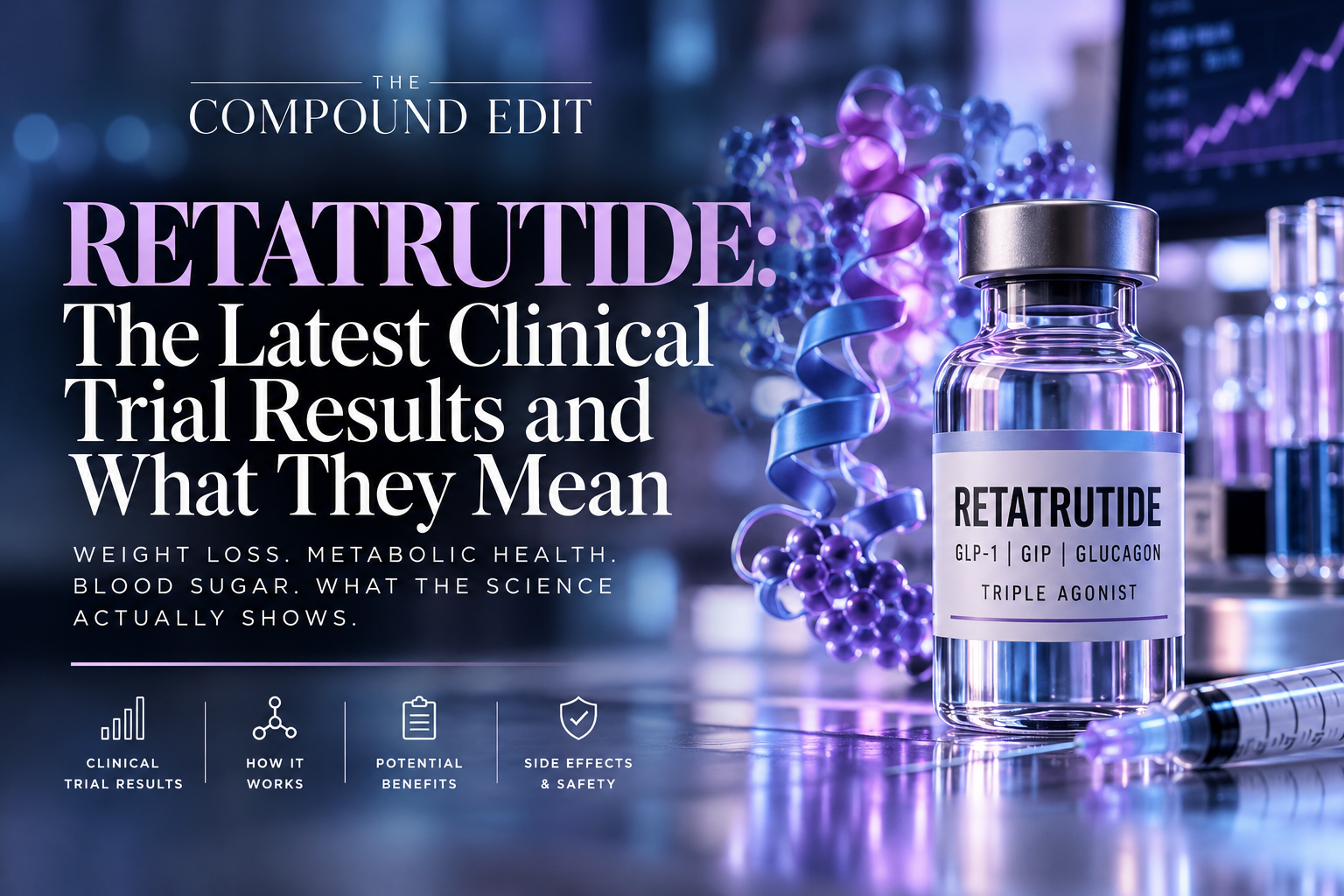
It’s a triple hormone receptor agonist, meaning it activates three different pathways:
- GLP-1: Helps regulate appetite, fullness, and blood sugar.
- GIP: Influences insulin secretion and metabolic regulation.
- Glucagon: Plays a role in energy metabolism and glucose regulation.
The glucagon component is especially interesting because researchers are investigating whether activating this additional pathway can contribute to greater energy expenditure and weight reduction.
It’s a different approach to metabolic treatment, and the clinical results suggest it deserves attention.
The 2026 Results: How Much Weight Did Participants Actually Lose?
In the Phase 3 TRIUMPH-1 trial, 2,339 adults with obesity were randomly assigned to receive retatrutide or placebo over 80 weeks.
The published results showed average weight changes of:
- 4 mg retatrutide: 17.6% reduction
- 9 mg retatrutide: 23.7% reduction
- 12 mg retatrutide: 25.0% reduction
- Placebo: 3.9% reduction
These numbers come from the treatment-regimen analysis, which accounts for participants regardless of whether they remained on treatment.
To put the highest-dose result into perspective, a 250-pound person losing 25% of their starting weight would lose approximately 62.5 pounds.
That’s a substantial change.
Of course, clinical trial averages don’t predict exactly what any individual will experience.
What About People With Type 2 Diabetes?
Another Phase 3 study, TRIUMPH-2, evaluated retatrutide in adults with obesity or overweight and type 2 diabetes.
At 80 weeks, participants receiving the highest studied dose experienced an average weight reduction of 20.8%.
Researchers also reported average A1C reductions of up to 1.6 percentage points.
That’s significant because managing obesity and blood sugar together remains a major challenge in metabolic medicine.
The Research Goes Beyond Weight Loss
One of the most interesting developments is that researchers aren’t exclusively studying the number on the scale.
The TRIUMPH-1 trial also examined outcomes in participants with knee osteoarthritis and obstructive sleep apnea.
Researchers observed improvements in knee pain scores and reductions in sleep apnea events.
These findings suggest that substantial weight reduction may have meaningful effects on other obesity-related health conditions.
However, they don’t establish that retatrutide independently treats every one of these conditions through a mechanism separate from weight loss.
That’s an important distinction.
What About Side Effects?
Here’s where the conversation needs some balance.
The most commonly reported adverse effects in retatrutide studies have been gastrointestinal, including nausea, vomiting, and diarrhea.
These effects can be particularly relevant during treatment escalation.
Researchers are also continuing to evaluate long-term safety, treatment discontinuation, and how retatrutide affects different populations.
A medication producing dramatic results doesn’t automatically mean it’s appropriate or safe for everyone.
Is Retatrutide FDA-Approved?
As of October 2026, retatrutide remains investigational and has not received FDA approval.
Eli Lilly has indicated plans to submit an application to the FDA in early 2027.
That means the results are promising, but regulatory review and additional safety evaluation remain important.
Products sold online claiming to contain retatrutide are not equivalent to the regulated investigational medication used in clinical trials. Their identity, purity, and concentration may be uncertain.
So, Is Retatrutide the Future of Weight-Loss Medicine?
Possibly.
The results certainly suggest that triple-receptor agonists could become an important part of metabolic treatment.
But there’s still more to learn.
How well will participants maintain their results over several years? What happens after treatment stops? How does retatrutide compare directly with other medications? And what are its long-term effects on body composition and cardiovascular outcomes?
Those are the questions worth following.
The Compound Edit Takeaway
Retatrutide isn’t just another trending name in peptide research. It’s an investigational medication backed by increasingly substantial clinical evidence.
The weight-loss results are impressive. The potential metabolic benefits are intriguing. And the next stage of research may tell us even more.
But impressive science deserves accurate interpretation, not exaggerated promises.
And that’s exactly why we’re paying attention.
Keep Exploring on The Compound Edit
Curious about the science behind retatrutide and other metabolic compounds? Keep reading:
- Retatrutide Isn’t Approved Yet. So Why Is Everyone Already Talking About It?
- GLP-1, “GLP-2” & “GLP-3”: What People Really Mean by Semaglutide, Tirzepatide & Retatrutide
- Why Does Retatrutide Feel Like It Stopped Working?
- From 175 to 115: What My Retatrutide Journey Actually Looked Like
Continue Exploring
The Compound Edit is dedicated to exploring the science, research, and real conversations surrounding peptides, hormones, metabolism, performance, and longevity.
The Compound Edit is affiliated with Chuk BioWorks. While the two share an ownership connection, our editorial goal is to explore scientific research with transparency, including limitations, uncertainties, and potential risks.
Medical Disclaimer
The content published on The Compound Edit is intended for educational and informational purposes only and does not constitute medical advice, diagnosis, or treatment.
Some compounds discussed are investigational and may not be FDA-approved for human use. Research findings, personal experiences, and discussions of compounds should not be interpreted as recommendations for use. Always consult a qualified healthcare professional regarding medical decisions.
Stay curious. Keep learning. Continue exploring.
Research & Sources
- Jastreboff AM, et al. Retatrutide, a Triple Hormone Receptor Agonist, for Treatment of Obesity. New England Journal of Medicine. September 29, 2026. DOI: 10.1056/NEJMoa2604169.
- Eli Lilly. Retatrutide delivered substantial weight loss and A1C reduction in TRIUMPH-2. September 29, 2026.
- American Diabetes Association. Breakthrough Studies Demonstrate Effectiveness of the First Triple-Hormone Therapy for Type 2 Diabetes and Obesity. June 6, 2026.
Disclaimer: This article is for educational and research purposes only. It does not constitute medical advice or endorse the use of investigational medications.