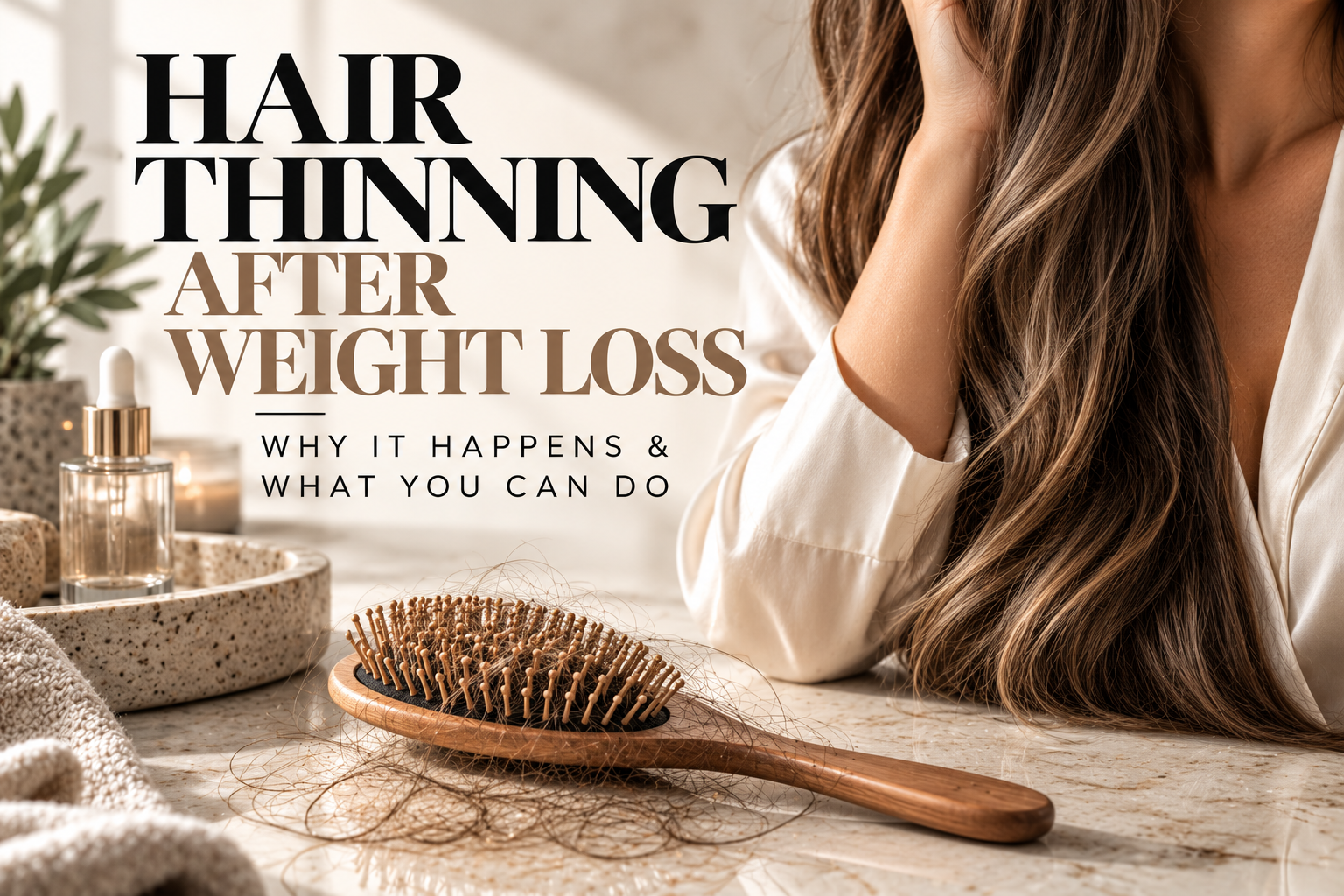
Hair Thinning After Weight Loss: Why It Happens and What You Can Do
You finally reach your weight-loss goal. You’re feeling healthier, your clothes fit differently, and you’re proud of your progress. Then one day, you notice more hair in your brush.
Weight loss can change so many things about your body.
Some changes are exciting. Others are unexpected.
And one of the more frustrating surprises can be hair thinning.
Maybe you’re noticing more strands in the shower. Maybe your ponytail feels smaller. Or maybe your hair just doesn’t seem as full as it used to.
If this sounds familiar, you’re definitely not the only one.
Hair shedding after significant weight loss is a recognized phenomenon, and there’s actually a scientific explanation for why it happens.
The good news? In many cases, it’s temporary.
But understanding what’s happening inside your body can make a big difference in how you approach it.
Why Does Hair Fall Out After Weight Loss?
Your hair grows in cycles.
At any given time, different hairs are in different stages of growth, transition, resting, and shedding.
Most scalp hairs are normally in the active growth phase, called anagen.
But significant physical stress can disrupt that cycle.
Rapid weight loss, major dietary changes, illness, surgery, and nutritional deficiencies can sometimes push more hair follicles than usual into a resting phase.
This can lead to a condition called telogen effluvium.
Instead of shedding the usual number of hairs each day, you may suddenly notice much more.
And because hair growth cycles take time, the shedding often doesn’t begin immediately.
It commonly becomes noticeable two to three months after the triggering event.
That’s why someone might start losing hair after they’ve already made substantial progress toward their weight-loss goal.
What Is Telogen Effluvium?
Telogen effluvium is a form of diffuse hair shedding.
Unlike some types of hair loss that create distinct bald patches, telogen effluvium typically causes thinning across the scalp.
You might notice:
- More hair coming out when washing or brushing
- A smaller or thinner ponytail
- Less overall volume
- Increased shedding throughout the day
- More scalp visibility when parting your hair
One important distinction is that telogen effluvium generally involves increased shedding rather than permanent destruction of hair follicles.
When the underlying trigger resolves, the hair cycle often gradually returns to normal.
But regrowth takes time.
And for someone who’s already been through a major physical transformation, waiting for their hair to recover can feel incredibly frustrating.
Is Rapid Weight Loss the Problem?
The speed and extent of weight loss can matter.
When someone loses a substantial amount of weight quickly, the body may experience physiological stress.
If that weight loss also involves very low calorie intake, inadequate protein, or nutritional deficiencies, the risk of shedding may increase.
Your body needs energy and nutrients to support many different functions.
Hair growth is one of them.
And when resources are limited, your body prioritizes processes essential for survival.
This doesn’t mean every person who loses weight quickly will experience hair thinning.
It simply means significant weight loss can be one of several triggers.
What About GLP-1 Medications?
This is a question that comes up frequently.
People using medications such as semaglutide or tirzepatide sometimes report increased hair shedding.
Hair loss has also been reported in clinical trials of some weight-management medications.
But there’s an important distinction.
The medication itself isn’t necessarily the direct cause of every case of hair shedding.
Substantial weight loss, reduced calorie intake, changes in nutrition, and other factors may contribute.
Researchers are still investigating how much of the reported hair loss is related to weight loss itself versus possible medication-specific effects.
So if you’re taking a weight-management medication and noticing shedding, it’s worth discussing with your healthcare professional rather than assuming you know the cause.
Protein Matters for Your Hair, Too
We’ve talked about protein in relation to building muscle after weight loss.
But protein also matters for hair.
Hair is made largely of keratin, a structural protein.
Your body needs adequate amino acids to produce and maintain healthy hair.
When protein intake is consistently inadequate, hair growth can be affected.
And this is especially important when appetite is reduced.
You might be eating less without realizing just how little protein you’re getting.
That’s why I think nutritional awareness becomes so important during and after significant weight loss.
Not because protein alone will magically regrow hair.
But because meeting your body’s basic nutritional needs is essential for normal hair growth.
Other Nutrients That May Play a Role
Protein isn’t the only nutritional consideration.
Several vitamins and minerals are involved in normal hair follicle function.
Iron
Iron deficiency can contribute to hair shedding in some people.
Low iron stores may be particularly relevant for individuals with heavy menstrual bleeding, restrictive diets, or other risk factors.
A healthcare professional may consider checking a complete blood count and ferritin when clinically appropriate.
Zinc
Zinc plays a role in cell growth and tissue function.
Severe zinc deficiency can cause hair changes, including shedding.
However, taking excessive zinc isn’t harmless and can actually interfere with copper absorption.
Vitamin D
Vitamin D has been studied in relation to several hair-loss conditions.
But the evidence doesn’t establish that taking extra vitamin D will improve hair growth in someone whose levels are already sufficient.
Vitamin B12
Vitamin B12 is important for normal blood cell production and neurological function.
Deficiency can occur in certain dietary patterns or medical conditions.
Correcting a deficiency is important for health, but B12 injections aren’t a proven hair-growth treatment when someone already has adequate B12.
Biotin
Biotin is probably one of the most heavily marketed hair supplements.
But here’s something worth knowing:
True biotin deficiency is uncommon, and there is limited evidence that extra biotin improves hair growth in people who aren’t deficient.
High-dose biotin supplements can also interfere with certain laboratory tests, including thyroid and cardiac tests.
That’s a good reason not to assume that more supplements automatically mean healthier hair.
Could Hormones Be Involved?
Absolutely.
Not every case of hair thinning after weight loss is caused by telogen effluvium.
Hormonal changes can also affect hair.
Thyroid disorders, androgen-related hair loss, menopause-related changes, and other medical conditions may contribute.
For example, female pattern hair loss often causes gradual thinning around the central part or crown.
That pattern can look different from the more generalized shedding associated with telogen effluvium.
It’s also possible to have more than one type of hair loss happening at the same time.
This is why identifying the underlying cause matters so much.
If shedding persists, becomes patchy, or is accompanied by scalp symptoms, a dermatologist can help evaluate what’s happening.
What About GHK-Cu and Copper Peptides?
Since we’ve explored GHK-Cu in skincare on The Compound Edit, it’s worth mentioning its connection to hair research.
Copper peptides have been investigated in laboratory and early research settings for their possible effects on skin biology and hair follicles.
Some preclinical findings have generated interest in whether these compounds might influence processes associated with hair growth.
But the evidence is still limited.
There isn’t strong clinical evidence showing that GHK-Cu reliably reverses hair loss caused by rapid weight loss.
And research-grade injectable peptides should not be treated as established hair-loss therapies.
If you’re interested in copper peptides for cosmetic use, it’s important to distinguish commercially formulated topical products from experimental compounds.
The science is interesting, but we shouldn’t confuse early research with proven results.
How Long Does Hair Shedding Last?
This is probably the question everyone wants answered.
With acute telogen effluvium, shedding often improves within approximately three to six months once the trigger has been addressed.
However, visible regrowth and restoration of hair density can take considerably longer.
Hair grows slowly, so even after the shedding settles, it may take many additional months for fullness to return.
If the trigger continues, or if another condition is contributing, shedding may persist.
That’s why ongoing hair loss deserves evaluation rather than endless waiting.
What Can You Actually Do About It?
There isn’t a single supplement or product that guarantees recovery.
But there are several sensible steps worth considering.
1. Make sure you’re eating enough.
If you’ve been maintaining an extremely low calorie intake, your body may not be getting adequate energy or nutrients.
2. Prioritize protein.
Include protein-rich foods regularly, especially if you’ve been struggling with appetite.
3. Avoid unnecessary nutritional restrictions.
Very restrictive diets can make it difficult to meet your body’s needs.
4. Be gentle with your hair.
Avoid excessive heat, harsh chemical processing, and hairstyles that pull tightly on the scalp.
5. Consider a medical evaluation.
Depending on your symptoms and history, your healthcare professional may investigate iron deficiency, thyroid dysfunction, nutritional issues, or other causes.
6. Give recovery time.
Hair growth doesn’t happen overnight, even when the underlying issue has been corrected.
And be cautious of expensive products promising dramatic regrowth in a matter of days or weeks.
When Should You See a Dermatologist?
Hair shedding after weight loss is often temporary, but there are situations where professional evaluation is especially important.
Consider seeing a dermatologist if you experience:
- Distinct bald patches
- Redness, scaling, pain, or scarring on the scalp
- Rapidly worsening thinning
- Hair shedding lasting longer than six months
- Other symptoms suggesting a hormonal or nutritional problem
A dermatologist can examine your scalp and help distinguish between different forms of hair loss.
That matters because treatment depends on the cause.
The Part Nobody Talks About
There’s something emotionally complicated about experiencing hair thinning after weight loss.
You work hard to change your body.
You reach goals that once felt impossible.
And then another change appears that you never asked for.
It’s easy to become frustrated.
But I think it’s important to remember that your body has been through a major adjustment.
Significant weight loss affects far more than the number on the scale.
It can influence your energy needs, muscle mass, hormones, and hair growth cycle.
That’s why the next phase of a weight-loss journey shouldn’t be focused only on maintaining a certain number.
It should also be about nourishment, strength, and overall health.
My Final Thoughts
If you’re noticing hair shedding after losing weight, don’t automatically assume something permanent is happening.
Telogen effluvium is a recognized response to physiological stress, and many people experience regrowth once the underlying trigger resolves.
But don’t automatically assume every case is harmless, either.
Persistent hair loss can have other causes that deserve attention.
For me, this topic is another reminder that losing weight and taking care of your body aren’t always exactly the same thing.
Sometimes the healthiest next step isn’t eating less.
It’s making sure you’re giving your body enough of what it needs.
And that’s a conversation worth having.
Keep Exploring on The Compound Edit
If you’re interested in the changes that happen during and after weight loss, here are a few more articles to explore:
GHK-Cu in Skincare: The Copper Peptide That Made Me Rethink My Routine
Continue Exploring
The Compound Edit is about asking questions, exploring emerging science, and understanding the changes that happen inside our bodies.
For more information about research compounds and the science behind them, visit Chuk BioWorks.
A Note on Transparency: The Compound Edit has an ownership connection to Chuk BioWorks, a supplier of research-use compounds. These products are not approved for human consumption or unapproved cosmetic treatment. Our content is educational and does not recommend self-administering experimental compounds.
Stay curious. Keep learning. Continue exploring.
Disclaimer: This article is for educational purposes only and is not a substitute for medical advice, diagnosis, or treatment. Hair loss can have multiple causes. Consult a qualified healthcare professional or dermatologist for evaluation and personalized guidance.