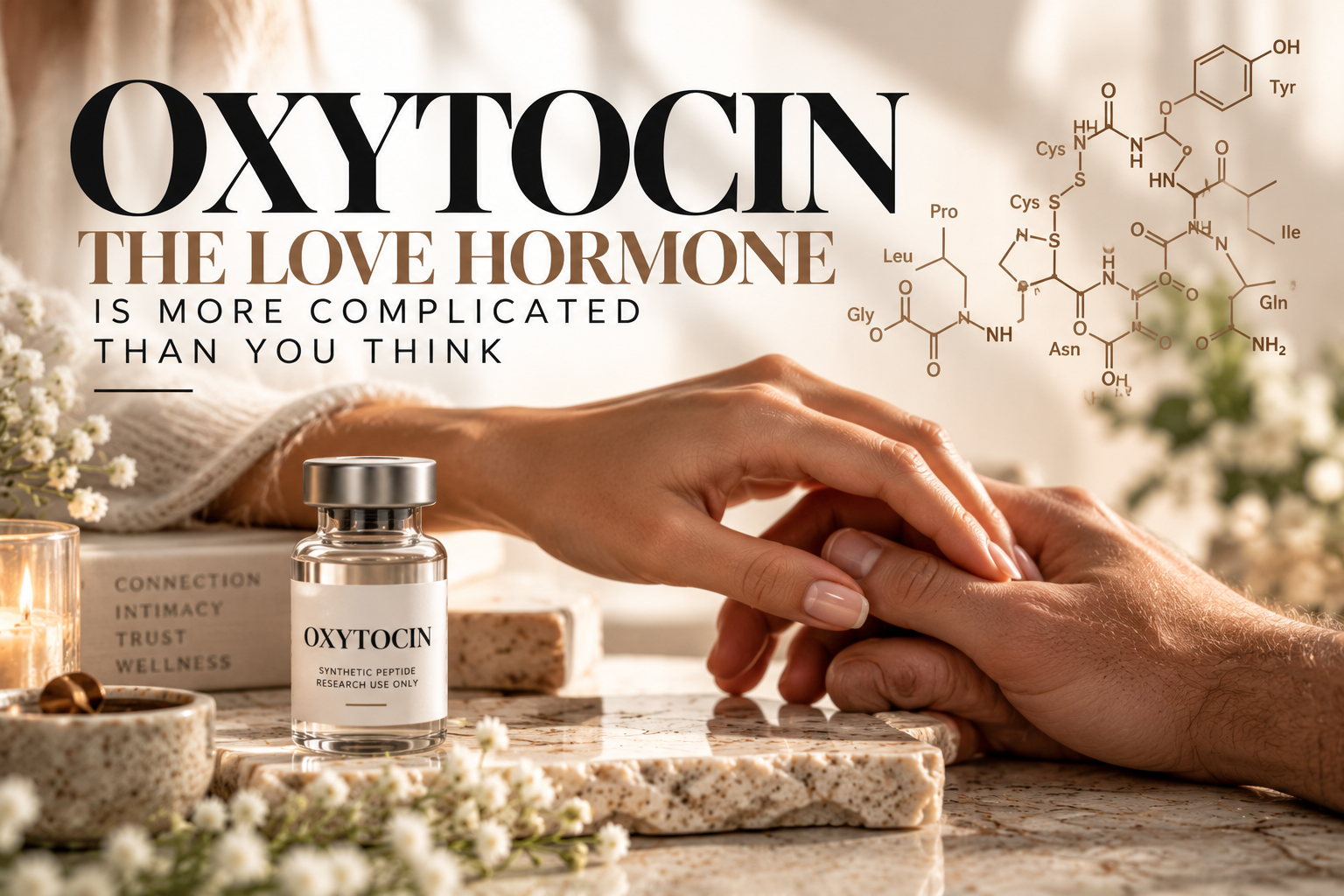
Oxytocin: The Love Hormone Is More Complicated Than You Think
Love, attraction, trust, connection, and even social anxiety. One tiny hormone has been linked to all of them. But can oxytocin really change the way we feel around other people?
We’ve all heard people talk about dopamine and serotonin.
But there’s another hormone that deserves a little attention.
Oxytocin.
Often called the love hormone or cuddle hormone, oxytocin has become associated with everything from romantic attraction to emotional bonding.
And lately, it’s also been getting attention in conversations about confidence, social interactions, intimacy, and experimental peptide research.
Naturally, that caught my attention.
Because wouldn’t it be interesting if something our bodies already produce could influence how comfortable, connected, or emotionally open we feel?
But as I’ve learned while exploring hormones and peptides, the science is rarely as simple as the nickname.
And oxytocin is a perfect example.
What Exactly Is Oxytocin?
Oxytocin is a naturally occurring peptide hormone made primarily in the hypothalamus, a region of the brain involved in regulating many important bodily functions.
It’s released into the bloodstream through the posterior pituitary gland.
Oxytocin is also involved in signaling within the brain, where researchers have studied its relationship to emotional processing and social behavior.
It’s made up of just nine amino acids, making it a relatively small peptide.
Despite its size, oxytocin plays several important roles in the body.
Two of its best-established functions involve childbirth and breastfeeding.
During labor, oxytocin helps stimulate uterine contractions.
After childbirth, it helps trigger the milk-ejection reflex during breastfeeding.
These are well-understood physiological effects.
But oxytocin’s possible influence on the brain is where the research becomes especially interesting.
Why Is It Called the Love Hormone?
The nickname comes from oxytocin’s involvement in social bonding and attachment.
Researchers have investigated its role in relationships between parents and infants, romantic partners, and other social connections.
Oxytocin activity can be associated with physical touch, affection, and certain forms of positive social interaction.
For example, hugging, close physical contact, and intimate experiences have all been studied in relation to oxytocin.
But here’s where the popular explanation gets a little misleading.
Oxytocin doesn’t simply create love or make everyone feel happier.
Human relationships involve many different brain systems, hormones, experiences, and emotions.
Oxytocin is one piece of that much larger picture.
And its effects can depend heavily on the situation.
Could Oxytocin Make You More Social?
This is probably one of the most interesting questions surrounding oxytocin.
Scientists have studied whether administering oxytocin might influence social attention, emotional recognition, trust, and responses to social situations.
Some early experiments suggested that oxytocin could affect how people interpret facial expressions or respond to other individuals.
That led to considerable interest in whether it might help people who struggle with certain aspects of social interaction.
But later studies have produced mixed results.
In some situations, oxytocin appeared to influence social behavior.
In others, researchers found little or no meaningful effect.
And some studies suggest its effects may depend on personality, previous experiences, the surrounding environment, and the specific social context.
In other words, oxytocin doesn’t appear to be a universal confidence booster.
It’s not necessarily going to make a shy person outgoing or turn an uncomfortable social event into an enjoyable one.
The research is much more complicated than that.
Oxytocin and Social Anxiety
Social anxiety involves more than simply feeling nervous around people.
It can include intense fear of judgment, avoidance of social situations, and significant distress during interactions.
Because oxytocin is involved in social processing, researchers have investigated whether it might influence some of these experiences.
Studies have explored its potential effects on emotional recognition, social attention, and anxiety-related responses.
However, results have been inconsistent.
Some small studies have reported changes in particular laboratory measures, while others have not demonstrated meaningful improvements in anxiety symptoms.
Oxytocin is not an established treatment for social anxiety disorder.
And there isn’t reliable evidence that using it before a party, wedding, or social gathering will consistently improve confidence or comfort.
For someone dealing with significant social anxiety, evidence-based approaches such as cognitive behavioral therapy and, when appropriate, prescribed medications have much stronger clinical support.
What About Oxytocin and Intimacy?
This is another reason oxytocin attracts so much attention.
Oxytocin has been studied in relation to sexual arousal, orgasm, attachment, and romantic relationships.
The body can release oxytocin during sexual activity, and researchers have explored how it may interact with other systems involved in sexual behavior.
But it’s important to distinguish a natural hormonal response from the effects of taking additional oxytocin.
Just because the body releases oxytocin during intimacy doesn’t mean administering it will reliably increase desire, arousal, or sexual satisfaction.
Human studies investigating these effects have been limited and inconsistent.
Sexual desire is influenced by many factors, including hormones, medications, relationship dynamics, physical health, stress, and emotional well-being.
Oxytocin alone isn’t a proven solution for low libido or difficulty reaching orgasm.
Oxytocin Is Not the Same as Testosterone or Estrogen
When we talk about hormones, it’s easy to group them together.
But they don’t all do the same thing.
Testosterone and estrogen are steroid hormones involved in reproductive function and many other physiological processes.
Oxytocin is a peptide hormone.
It works through different receptors and signaling pathways.
Although these systems can interact, oxytocin doesn’t replace testosterone, estrogen, or other hormones.
And there’s no established evidence that adding oxytocin corrects a hormonal imbalance or reliably improves symptoms caused by low sex hormones.
This distinction matters when people begin exploring hormone-related treatments.
Different symptoms can have very different causes.
What Happens When Oxytocin Is Given as a Medication?
Oxytocin already has legitimate medical uses.
Synthetic oxytocin is used in clinical settings for specific obstetric purposes, including inducing or strengthening labor and managing certain cases of postpartum bleeding.
In those situations, it’s administered under medical supervision because it can have powerful physiological effects.
That is very different from experimental use for mood, social confidence, or intimacy.
Researchers have also investigated intranasal oxytocin in human studies.
But the amount that reaches the brain, the consistency of its effects, and its clinical usefulness for behavioral conditions remain subjects of investigation.
There is no FDA-approved oxytocin treatment for improving social confidence, increasing libido, or making social interactions easier.
What About Injectable Oxytocin?
Injectable oxytocin sometimes appears in online discussions about peptides and wellness.
But this is an area where I think people need to be particularly cautious.
An injection doesn’t necessarily reproduce the effects of oxytocin naturally released within the brain.
Oxytocin circulating in the bloodstream and oxytocin signaling within the central nervous system are not interchangeable.
Researchers still have important questions about how different routes of administration influence the brain and behavior.
Injectable oxytocin also carries potential medical risks.
Depending on the dose, route, and circumstances, oxytocin can affect uterine contractions, blood pressure, heart rate, and fluid balance.
Serious complications are possible with inappropriate use, especially during pregnancy.
And products sold as research compounds may not have the same manufacturing, purity, or sterility assurances as approved medications.
For these reasons, injectable research-grade oxytocin shouldn’t be viewed as a casual supplement for social events or intimacy.
Could Oxytocin Actually Make Social Experiences Worse?
Here’s something I found especially interesting.
Oxytocin isn’t always associated with positive social behavior.
Some research suggests it may increase attention to certain social cues rather than simply making those cues feel pleasant.
Depending on the circumstances, this could potentially heighten sensitivity to social threats, negative interactions, or feelings of exclusion.
Researchers have also investigated how oxytocin might influence group attachment and responses to people perceived as outsiders.
These findings don’t mean oxytocin automatically causes negative emotions.
They simply show that its effects can be context-dependent.
That makes the idea of a universal social confidence peptide much less convincing.
Why Do People Respond Differently?
One of the biggest challenges in oxytocin research is that human social behavior is incredibly complex.
Consider how many factors influence your experience at a social gathering.
Your mood.
How well you slept.
Whether you know anyone there.
Your stress level.
Your past experiences.
Your relationship with the people around you.
And even whether you actually want to be there.
All of those factors can affect how comfortable and connected you feel.
So it makes sense that a single hormone wouldn’t produce the same emotional response in everyone.
Researchers are still working to understand which effects are reproducible, which are context-dependent, and whether any of them could eventually translate into useful treatments.
What Does the Future of Oxytocin Research Look Like?
Despite the mixed results, oxytocin remains an interesting research topic.
Scientists continue studying its involvement in:
- Social cognition and emotional processing
- Parent-infant bonding
- Stress responses
- Certain psychiatric and neurodevelopmental conditions
- Sexual and reproductive physiology
The hope is that a better understanding of oxytocin signaling might eventually help researchers develop more targeted interventions.
But there’s a difference between understanding a hormone’s biological role and having a treatment that produces predictable benefits.
And that gap is particularly important in behavioral research.
What I Find Most Fascinating
What interests me most about oxytocin is how it challenges the idea that hormones have one simple purpose.
We hear love hormone and immediately imagine something that makes us feel affectionate, confident, and connected.
But our brains don’t work that way.
Connection isn’t just chemistry.
Confidence isn’t controlled by one molecule.
And intimacy involves far more than a single hormone.
I think oxytocin research is fascinating precisely because it shows how complicated our biology really is.
It reminds me that something can be scientifically interesting without being a proven treatment.
And sometimes the most valuable thing we can do is understand the research before deciding what to believe.
The Bottom Line
Oxytocin is a naturally occurring peptide hormone with essential roles in childbirth, breastfeeding, and aspects of social biology.
Its relationship to bonding, emotional processing, and social behavior has inspired decades of research.
But despite the nickname, it isn’t a proven love potion, confidence booster, or treatment for low libido.
Studies investigating its behavioral effects have produced mixed findings, and the safety and effectiveness of experimental use remain uncertain.
For now, oxytocin is a fascinating hormone with plenty of unanswered questions.
And maybe that’s what makes it worth exploring.
Keep Exploring on The Compound Edit
Interested in hormones, relationships, and the science behind how our bodies work? Explore these earlier articles:
TRT in Men: What Testosterone Replacement Therapy Really Involves
HGH vs. CJC-1295 and Ipamorelin: Understanding the Differences
NAD+ vs. MOTS-C: Two Different Approaches to Cellular Health
Continue Exploring
The Compound Edit explores wellness, hormones, and emerging research with curiosity and a commitment to understanding the science.
To learn more about research compounds, visit Chuk BioWorks.
A Note on Transparency: The Compound Edit has an ownership connection to Chuk BioWorks, a supplier of research-use compounds. These products are not approved for human consumption or for treating medical or psychological conditions. Our content is educational and does not recommend self-administering experimental compounds.
Stay curious. Keep learning. Continue exploring.
Disclaimer: This article is for educational purposes only and does not constitute medical advice. Oxytocin has approved medical uses in specific supervised settings, but experimental use for social confidence, intimacy, or mood is not an established treatment. Consult a qualified healthcare professional about medical concerns or treatment decisions.