
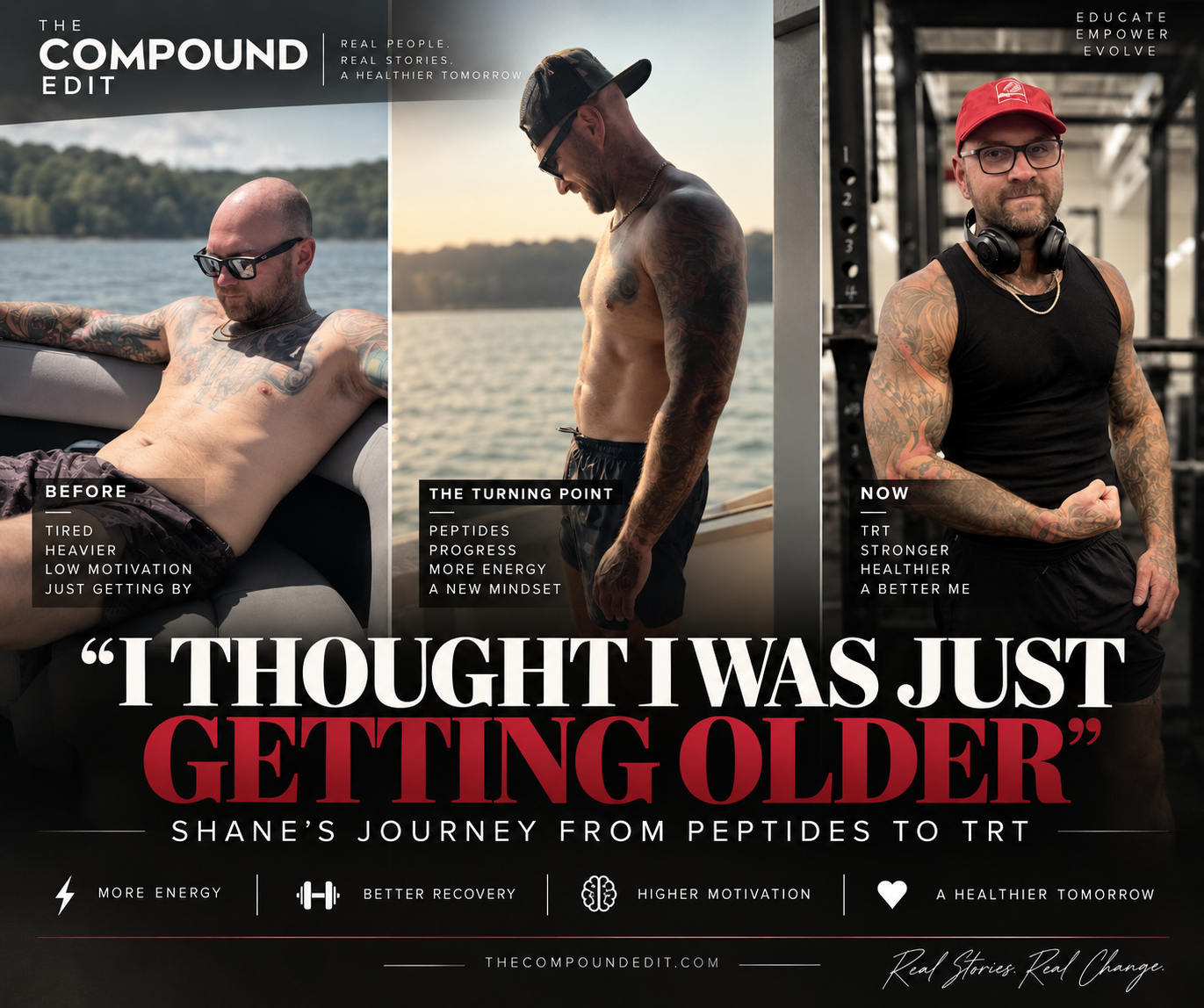
“I Thought I Was Just Getting Older”: Shane’s Journey From Peptides to TRT
There comes a point for a lot of men when feeling tired starts to seem normal.
The energy isn’t what it used to be. Motivation slips. Weight becomes harder to manage. The gym feels different. Recovery takes longer. Joints hurt. Blood pressure starts creeping up.
And eventually there’s a simple explanation for all of it:
You’re getting older.
For Shane, that explanation didn’t tell the whole story.
His journey into peptides, health, and eventually testosterone replacement therapy became less about trying to turn back the clock and more about asking a different question:
What if feeling this way isn’t something you simply have to accept?
It Didn’t Start With TRT
Shane’s journey actually began with peptides.
Like a lot of people entering this world, the initial goals were pretty straightforward: improve body composition, lose weight, recover better, feel better, and become healthier overall.
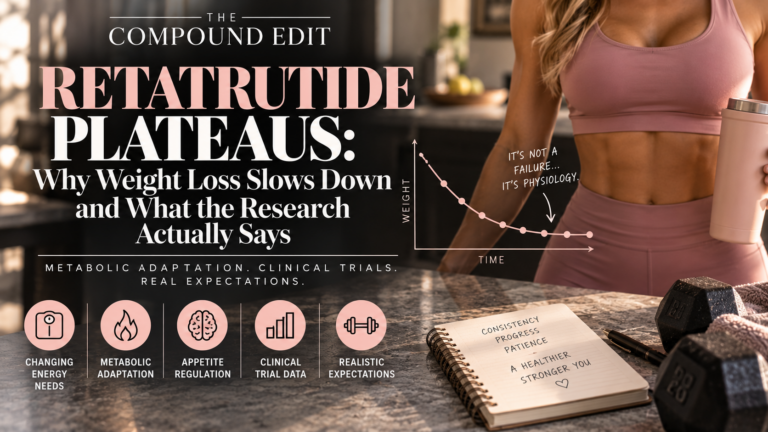
Retatrutide became part of his weight-loss journey. Other compounds entered the picture as he became more interested in recovery, body composition, performance, and longevity.
But something else was happening at the same time.
The more attention he started paying to his health, the more obvious it became that weight wasn’t the entire story.
There was fatigue.
Lower motivation.
Aches and pains.
Difficulty losing weight.
Blood-pressure concerns.
And that general feeling that his body wasn’t responding the way it once had.
Those symptoms aren’t unique to low testosterone. Sleep apnea, obesity, medications, thyroid problems, depression, chronic disease, poor sleep and plenty of other conditions can produce remarkably similar symptoms.
But testosterone deficiency is one possibility—and it’s something that can actually be measured.
The Bloodwork Changed the Conversation
Eventually, testosterone entered the conversation.
And this is where Shane’s story becomes something worth talking about beyond just his own experience.
There is a big difference between taking testosterone because someone wants to optimize their physique and medically treating a man who actually has testosterone deficiency.
Current clinical guidance recommends diagnosing hypogonadism only when symptoms are present alongside consistently low testosterone levels. Because testosterone naturally fluctuates, the Endocrine Society recommends confirming a low result with a second early-morning fasting test.
In other words:
Don’t guess. Test.
And don’t stop investigating simply because you’re told you’re getting older.
“Normal Aging” Can Become an Easy Explanation
This is probably the biggest takeaway from Shane’s experience.
A man walks into a doctor’s office and says:
I’m exhausted.
I’ve gained weight.
I don’t have the drive I used to.
My workouts suck.
My body aches.
I just don’t feel like myself anymore.
Some of those changes absolutely can accompany aging.
But symptoms alone don’t tell you why they’re happening.
Testosterone deficiency is only one possibility. But when symptoms warrant evaluation, hormone testing can provide another piece of the puzzle.
Interestingly, the Endocrine Society’s 2026 statement makes essentially this distinction: symptoms such as low energy, libido and mood have numerous potential causes, so clinicians should evaluate reversible contributors rather than diagnosing low testosterone from symptoms alone.
TRT Wasn’t a Magic Switch
This is another part of Shane’s story worth being transparent about.
TRT didn’t replace everything else.
He still had to work on his weight.
He still had to train.
Nutrition still mattered.
Blood pressure still needed attention.
Sleep and recovery still mattered.
Peptides didn’t suddenly become irrelevant either. Instead, TRT became another piece of a much larger health and performance picture.
And his treatment has required something that sometimes gets lost in conversations about testosterone:
ongoing bloodwork and monitoring.
TRT isn’t simply “get your testosterone higher and you’re done.”
Testosterone levels, hematocrit and other health markers need to be followed, and prostate-related monitoring may also be appropriate depending on age and individual risk.
What Does the Research Say About TRT?
For men with properly diagnosed hypogonadism, testosterone therapy is an established medical treatment—not simply a bodybuilding tool.
Clinical trials have found benefits in areas including sexual function, bone density, anemia and some mood outcomes in appropriately selected men.
One of the largest safety studies was the TRAVERSE trial, which enrolled more than 5,200 men ages 45–80 who had symptoms of hypogonadism, two fasting testosterone measurements below 300 ng/dL, and existing cardiovascular disease or elevated cardiovascular risk.
Over roughly three years of follow-up, testosterone therapy was not associated with a higher rate of major cardiovascular events than placebo. However, researchers observed higher rates of atrial fibrillation, acute kidney injury and pulmonary embolism in the testosterone group.
So the takeaway isn’t that TRT is dangerous.
And it isn’t that TRT is harmless.
It’s that TRT is medical treatment that should be used for the right person, for the right reason, with appropriate monitoring.
Maybe More Men Should Ask the Question
Shane’s story isn’t an argument that every tired 40- or 50-year-old man needs testosterone.
It’s an argument for asking better questions about your health.
If something feels dramatically different than it did several years ago, don’t automatically write it off as age.
Talk to your healthcare provider.
Look at sleep.
Look at metabolic health.
Look at medications.
Look at nutrition and activity.
And when symptoms are consistent with testosterone deficiency, ask whether testosterone testing is appropriate.
Because there is an enormous difference between trying to avoid aging and identifying a legitimate medical problem that happens to appear as you get older.
For Shane, stepping into the world of peptides eventually opened the door to looking much more closely at his overall health.
TRT became part of that story.
But perhaps the more important change was realizing that “I’m getting older” didn’t have to be the end of the conversation.
Continue Exploring
The Compound Edit is affiliated with Chuk BioWorks. For more information about the relationship between the two platforms, visit The Compound Edit + Chuk BioWorks: Understanding the Connection.
EXPLORE CHUK BIOWORKS → www.ChukBioWorks.com
Disclosure: The Compound Edit is affiliated with Chuk BioWorks. This article describes an individual experience and is provided for educational purposes only. It is not medical advice or a recommendation to use testosterone, peptides, or other compounds. Testosterone therapy requires appropriate medical evaluation, diagnosis and ongoing monitoring.
One Comment
Comments are closed.