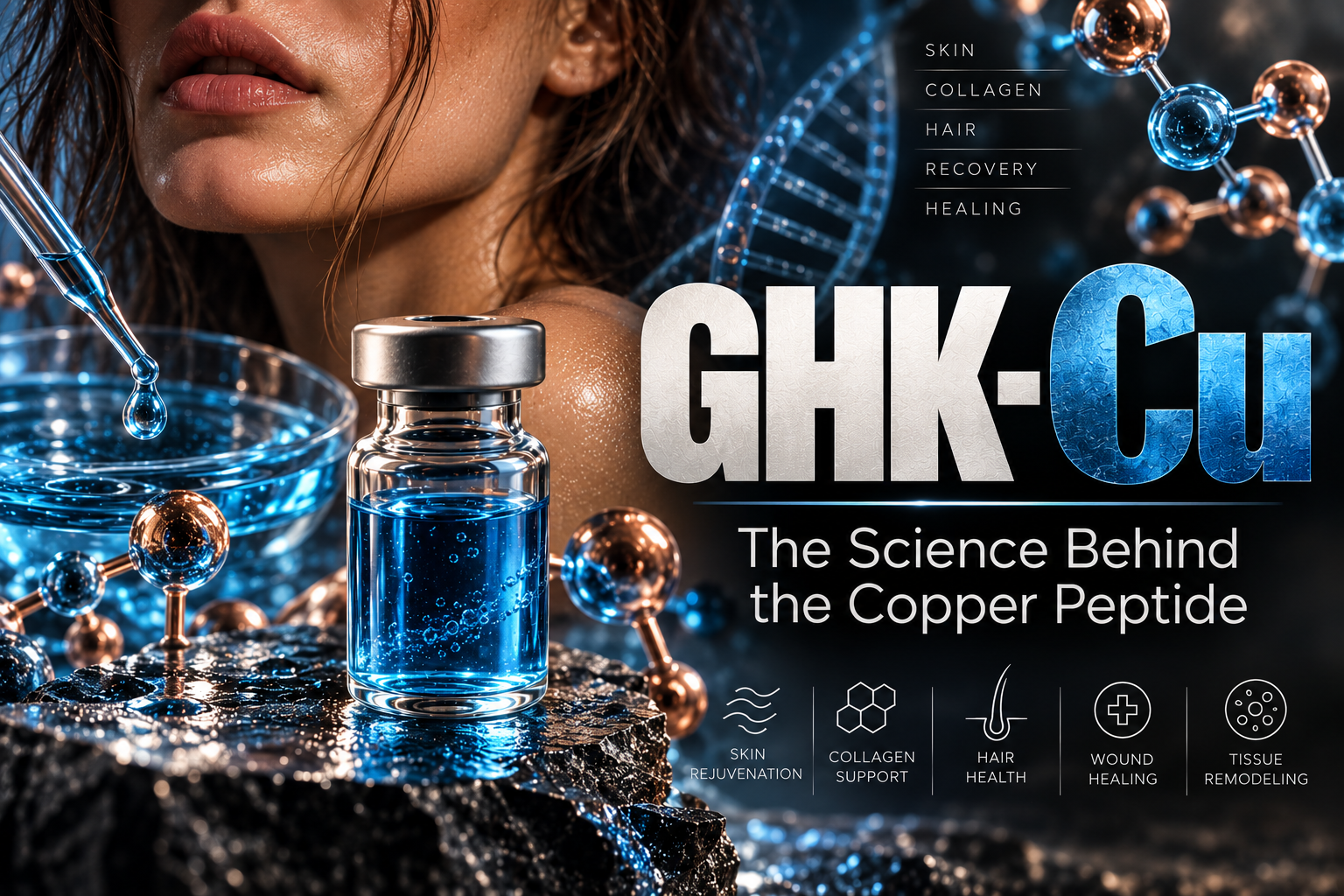
GHK-Cu: Why the “Copper Peptide” Is Suddenly Everywhere
Skin, collagen, hair and healing sound impressive—but how much of the GHK-Cu story is actually supported by research?
If you’ve spent any time in skincare, longevity or peptide circles lately, you’ve probably seen GHK-Cu.
It’s in serums.
It’s discussed for hair.
It’s associated with collagen, skin quality and wound healing.
And in peptide communities, you’ll also see people talking about injectable GHK-Cu as though it’s simply a more powerful version of the copper peptide already sitting in someone’s skincare cabinet.
But GHK-Cu actually has a much longer scientific history than its recent popularity might suggest.
And, like many peptides, there’s an important distinction between:
what the molecule appears capable of doing biologically
and
what has actually been demonstrated in well-controlled human trials.
So let’s separate the two.
First: What Is GHK-Cu?
GHK stands for:
Glycyl-L-histidyl-L-lysine.
It’s a tiny peptide made from just three amino acids.
GHK occurs naturally in the human body and has an affinity for copper. When it binds a copper ion, it forms the complex commonly called:
GHK-Cu.
That copper-binding ability is important because copper participates in several biological processes involved in tissue structure and repair.
GHK has been identified in human plasma, saliva and urine, and researchers have been investigating its biological effects for decades.
This isn’t a peptide that appeared because social media discovered it.
The interesting part is what researchers have observed it doing.
Why Is Everyone Talking About GHK-Cu?
Most of the excitement surrounding GHK-Cu comes down to one broad concept:
Tissue remodeling.
Our tissues are constantly breaking down damaged components and rebuilding new ones.
Research involving GHK-Cu has connected the peptide with several processes involved in that remodeling, including fibroblast activity, collagen and extracellular-matrix production, angiogenesis and inflammatory signaling.
That’s why you’ll see GHK-Cu associated with such a wide range of claims.
Skin.
Wrinkles.
Elasticity.
Wound healing.
Hair.
Recovery.
But those claims aren’t all supported by the same level of evidence.
And that’s where things get interesting.
GHK-Cu and Collagen
This is probably the reason GHK-Cu has become so popular in aesthetics.
Collagen provides much of the structural framework of skin.
As we age, collagen production and organization change. That’s part of why skin gradually becomes thinner, less firm and more prone to wrinkles.
Laboratory and preclinical research suggests GHK-Cu can influence fibroblasts—the cells heavily involved in producing collagen and other components of the extracellular matrix.
Studies have reported effects involving:
collagen synthesis
elastin
glycosaminoglycans
fibroblast activity
and enzymes involved in breaking down and rebuilding extracellular tissue.
This is where the idea that GHK-Cu is a “skin remodeling peptide” comes from.
And biologically, that description makes sense.
But there’s an important catch.
The Human Evidence Isn’t Nearly as Large as the Hype
This is probably the most important part of the entire GHK-Cu conversation.
There is a substantial amount of laboratory and preclinical research involving GHK-Cu.
There are far fewer high-quality human clinical trials.
A 2026 systematic review examining GHK-Cu in aesthetic medicine identified 20 eligible studies.
Of those:
18 were preclinical studies.
Only:
2 were randomized controlled trials.
The review found encouraging biological effects involving extracellular-matrix production, angiogenesis, cellular proliferation and inflammatory pathways, along with some favorable clinical findings.
But the authors also emphasized the limited number of well-designed human trials and the need for standardized formulations, delivery methods and dosing.
That’s a very different statement from:
“GHK-Cu has been clinically proven to reverse aging.”
It hasn’t.
There’s promising biology.
There’s interesting early clinical evidence.
And there’s still a considerable gap between those things and many of the claims circulating online.
What About Wrinkles and Skin Quality?
This area has generated some particularly interesting findings.
GHK-Cu has been incorporated into cosmetic products for years because of its proposed effects on collagen, skin structure and tissue repair.
Some published research and reviews describe improvements in characteristics such as skin firmness, elasticity, wrinkles and photodamage.
But the evidence isn’t uniformly impressive.
One randomized study looked at a topical copper tripeptide regimen following CO₂ laser resurfacing.
Participants reported better perceived skin quality in the copper-peptide group, but investigators did not find significant objective improvements in wrinkle appearance or overall skin quality compared with the control regimen.
That’s exactly why individual studies matter.
A compound can have an interesting mechanism without every real-world application producing a dramatic result.
There’s Another Problem With Topical GHK-Cu
Putting something on the skin doesn’t automatically mean enough of it reaches the tissue where researchers want it to act.
Skin is designed to be a barrier.
Peptides aren’t always particularly good at crossing that barrier.
A recent review examining topical GHK specifically highlighted the lack of sufficient published information regarding skin permeability and clinical effectiveness, despite the widespread use of GHK-Cu and related peptides in anti-wrinkle products.
Researchers are therefore investigating delivery systems intended to improve penetration.
That includes things such as:
liposomes
microneedles
and other specialized delivery technologies.
So even with topical GHK-Cu, formulation matters.
Two products containing “copper peptides” aren’t necessarily equivalent.
What About Wound Healing?
This may actually be one of the most biologically interesting areas of GHK-Cu research.
Wound healing requires an incredibly coordinated sequence of events.
Inflammatory cells arrive.
New blood vessels develop.
Fibroblasts become active.
Collagen and extracellular matrix are produced.
Then the tissue has to remodel itself.
GHK-Cu has been studied in connection with several of these processes.
Research has reported effects involving recruitment of repair-related cells, fibroblast and keratinocyte proliferation, angiogenesis, collagen production and inflammatory signaling.
That doesn’t mean GHK-Cu should automatically be considered a proven treatment for injuries.
But it helps explain why wound healing became such a major part of its scientific story in the first place.
And Then There’s Hair
This is another area where the internet tends to move faster than the clinical evidence.
GHK-Cu is frequently discussed for:
hair growth
hair density
follicle health
and sometimes even hair-loss treatment.
There is biological rationale behind the interest.
Research on GHK-Cu and tissue remodeling has described effects involving hair follicles, including changes in follicle size and biological processes relevant to tissue repair.
But that doesn’t make GHK-Cu equivalent to established treatments for common forms of hair loss.
The clinical evidence supporting GHK-Cu specifically as a stand-alone hair-loss treatment remains limited.
So this is another case where:
“There is research related to hair follicles”
isn’t the same thing as:
“This has been proven to regrow hair in humans.”
Those are very different claims.
Topical GHK-Cu and Injectable GHK-Cu Are Not the Same Conversation
This distinction gets lost constantly online.
GHK-Cu has a long history of use as an ingredient in cosmetic formulations.
Injecting GHK-Cu introduces an entirely different route of exposure.
And the evidence supporting injectable use in humans is extremely limited.
FDA has specifically discussed compounded GHK-Cu intended for injectable administration and has identified potential concerns involving immunogenicity, aggregation and peptide-related impurities, while noting that human data available to inform safety considerations are limited.
That’s important.
It doesn’t tell us that every injectable exposure will cause harm.
It tells us something much simpler:
We don’t have enough human safety data to confidently characterize the risk.
And that uncertainty shouldn’t disappear simply because injectable GHK-Cu has become common in online peptide communities.
What About FDA Status?
This area deserves some nuance because the regulatory situation has evolved.
As of FDA’s May 2026 update, GHK-Cu for non-injectable routes was listed as a Category 1 bulk drug substance under evaluation for use in compounding under Section 503A.
FDA also stated that it intends to consult its Pharmacy Compounding Advisory Committee regarding GHK-Cu before the end of February 2027.
That should not be interpreted as FDA approval of GHK-Cu as a drug.
And compounded drugs themselves are not FDA-approved; FDA does not review them for safety, effectiveness and quality before they are marketed in the way it reviews approved medications.
The distinction matters because you’ll sometimes see phrases like:
“It’s available from compounding pharmacies.”
used as though that means:
“It’s FDA approved.”
Those aren’t interchangeable statements.
Where the Research Ends and the Internet Begins
This is probably the best way to understand GHK-Cu.
There are several layers of evidence.
The biological evidence is interesting.
GHK-Cu interacts with pathways involved in tissue remodeling, collagen, extracellular matrix, fibroblasts, angiogenesis and inflammation.
Preclinical research is extensive compared with clinical research.
Cell and animal models have produced a large portion of the findings associated with GHK-Cu.
Human evidence exists—but it’s much smaller.
The 2026 systematic review found only two randomized controlled trials among the 20 studies that met its criteria for aesthetic applications.
Topical and injectable use shouldn’t be lumped together.
Different delivery routes create different questions about absorption, exposure and safety.
And “promising” isn’t the same thing as “proven.”
That’s probably the single most useful sentence to remember.
So Is GHK-Cu Just Hype?
No.
Calling it just hype would ignore decades of interesting biological research.
But calling every claim made about GHK-Cu scientifically established would go too far in the opposite direction.
GHK-Cu sits somewhere much more interesting.
It’s a naturally occurring peptide-copper complex with legitimate biological activity and a surprisingly broad research history.
Its effects on tissue remodeling, extracellular matrix biology and skin repair provide a reasonable scientific explanation for why researchers continue to study it.
What we don’t yet have is the same depth of large, standardized human clinical trials that would allow many of today’s popular claims—particularly around injectable use—to be stated with the same confidence.
And that’s an important distinction.
The Compound Edit Takeaway
GHK-Cu didn’t become interesting because the internet decided copper peptides were trendy.
Researchers have been studying GHK and GHK-Cu for decades.
The biology behind collagen production, fibroblast activity, tissue remodeling and wound repair is genuinely fascinating.
But when someone says:
“GHK-Cu builds collagen, regrows hair, heals injuries and reverses aging.”
several very different levels of evidence have just been compressed into one sentence.
Some of those ideas have meaningful biological support.
Some have limited human evidence.
And some claims have traveled considerably further online than the clinical research supporting them.
GHK-Cu may be promising. Promising and proven aren’t synonyms.
That’s exactly the distinction The Compound Edit is here to make.
Continue Exploring
The Compound Edit follows the evolving science around peptides, metabolic health, recovery, performance and longevity—while separating what research actually shows from what’s gaining traction online.
The Compound Edit is affiliated with Chuk BioWorks. You can read more about that connection and how we approach editorial independence here.
EXPLORE CHUK BIOWORKS → www.chukbioworks.com
The Compound Edit is for educational and informational purposes only and does not provide medical advice. Discussion of investigational compounds, research findings or routes of administration should not be interpreted as a recommendation for human use.