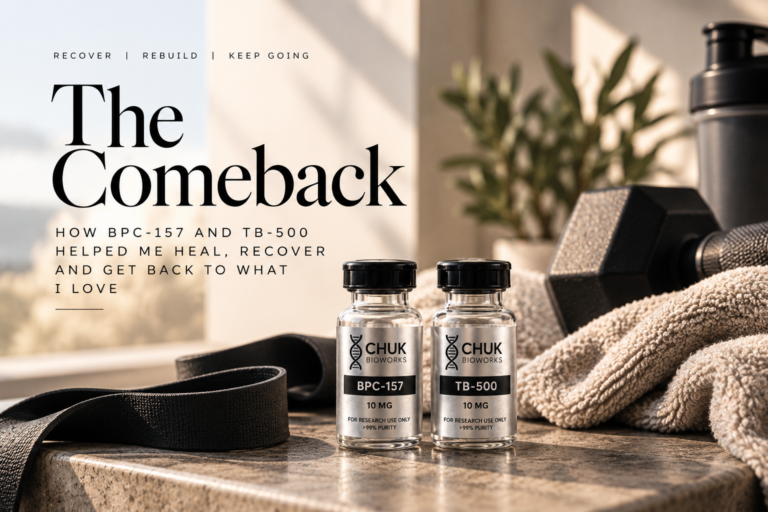
The Injury Was Healed. So Why Did It Still Hurt?
The doctor said everything looked fine. My shoulder apparently hadn’t gotten the message.
This is a composite story inspired by experiences commonly described in peptide and recovery communities. Details have been fictionalized, and the story is not intended to represent one individual’s medical experience.
The frustrating thing wasn’t the injury.
Injuries happen.
I’m 46 years old. I’ve lifted weights most of my adult life, played sports when I was younger and spent enough weekends doing projects around the house to know I’m not indestructible.
The frustrating part was that according to everyone else:
I was better.
My shoulder didn’t agree.
It Started With Something Stupid
There wasn’t some dramatic moment.
No giant weight crashing down.
No torn shoulder during a football game.
I was bench pressing.
I’d felt a little irritation in my right shoulder for a few weeks, but it wasn’t anything that stopped me from training.
So naturally, I kept training.
Because that’s what men do when our bodies give us a very clear warning.
We ignore it until the warning becomes a problem.
One rep felt wrong.
Not catastrophic.
Just a sharp pain that made me immediately rack the bar.
I remember sitting up thinking:
Well, that’s probably not good.
It wasn’t.
I Did Everything I Was Supposed to Do
Eventually, I went in.
Imaging.
Evaluation.
Physical therapy.
Rest.
Anti-inflammatory medication.
Exercises involving tiny resistance bands that somehow humbled me more than a heavy bench press ever had.
And slowly, it improved.
I got my range of motion back.
Daily activities stopped bothering me.
I could sleep on that side again.
Eventually I was cleared to return to normal activity.
Problem solved.
Except it wasn’t.
“Normal Activity” Apparently Didn’t Include Anything I Actually Wanted to Do
Could I put dishes into an overhead cabinet?
Absolutely.
Could I carry groceries?
Yep.
Could I bench press without thinking about my shoulder every second?
No.
Could I overhead press?
Not comfortably.
Could I throw a football with my son without regretting it afterward?
Sometimes.
My shoulder worked.
It just didn’t feel like my shoulder.
There was always this low-level awareness of it.
A pull.
An ache.
Occasional sharpness at a particular angle.
And because I’d already been told everything looked okay, I started wondering whether this was simply my new normal.
That’s When Someone at the Gym Mentioned BPC-157
Of course it happened at the gym.
A guy I knew asked why I wasn’t pressing anymore.
I explained the shoulder.
He immediately said:
“Have you looked into BPC?”
I had not.
I didn’t even know what BPC was.
He started telling me about this “healing peptide” people were using for tendons and injuries.
According to him, it sounded like Wolverine in a vial.
Which immediately made me skeptical.
Because if something actually repaired tendons as dramatically as people online claimed, I figured orthopedic surgeons would probably know about it.
So I went home and started reading.
BPC-157 Has One Hell of an Internet Reputation
If you’ve spent any time in peptide communities, you’ve probably seen the claims.
Tendon healing.
Ligament healing.
Muscle injuries.
Gut healing.
Nerve repair.
Inflammation.
Recovery.
Basically, if something in the human body can break, somebody on the internet will tell you BPC-157 fixes it.
The research story is much less dramatic.
BPC-157 is a synthetic peptide derived from a sequence associated with a gastric protein.
Researchers have investigated it in a variety of experimental injury models.
And yes—some of those findings are genuinely interesting.
Especially around tissue repair.
But there was a pretty significant problem.
Most of what I was reading wasn’t high-quality human clinical research.
A lot of it came from animal studies.
That’s not nothing.
Animal studies are an important part of research.
But rats recovering from experimentally induced tendon injuries aren’t the same thing as a 46-year-old guy trying to bench press again.
Then I Found TB-500
This is where the rabbit hole got deeper.
People weren’t only talking about BPC-157.
They were combining it with TB-500.
TB-500 is associated with thymosin beta-4 biology, another area researchers have investigated in relation to tissue repair, cell migration and wound healing.
Online, BPC-157 and TB-500 are frequently discussed together.
People even call them a “Wolverine stack.”
Which is an incredible marketing name.
It’s also not a clinical conclusion.
Combining two experimental compounds doesn’t automatically mean you’ve created a scientifically validated recovery protocol.
I understood that.
I was still curious.
What I Wanted Wasn’t a Miracle
By this point, I wasn’t trying to magically repair a freshly torn tendon.
I’d already done rehab.
I’d already been evaluated.
I wasn’t trying to avoid physical therapy or replace medical care.
I wanted to know whether there was anything else that might support the recovery process while I slowly rebuilt strength.
Eventually, I decided to experiment with BPC-157 and TB-500.
And then I did the hardest thing imaginable:
I didn’t immediately start benching heavy again.
The First Two Weeks Were Boring
Nothing happened.
At least nothing obvious.
I didn’t wake up one morning and rotate my shoulder around thinking:
Holy shit, I’m healed.
It still felt like my shoulder.
I continued the rehab exercises.
Continued training around it.
Continued slowly increasing load.
And tried not to test it constantly.
If you’ve ever had an injury, you know exactly what I mean.
You move it into the position that normally hurts just to see if it still hurts.
Then you do it again ten minutes later.
As if the tendon has completed a major renovation in those ten minutes.
I forced myself to stop doing that.
Then I Realized I Had Stopped Thinking About It
This was probably around the time things became interesting.
I finished an upper-body workout and was driving home when I realized:
I hadn’t thought about my shoulder.
Not once.
I hadn’t adjusted an exercise because it felt weird.
I hadn’t rubbed it between sets.
I hadn’t done the little arm-circle thing I’d been doing for months.
It was just…
quiet.
That doesn’t sound dramatic.
But when you’ve spent months being aware of one body part every time you train, not noticing it feels enormous.
So Naturally, I Almost Screwed It Up
I felt good.
Therefore my male brain concluded:
We are healed. Put more weight on the bar.
Fortunately, my physical therapist had spent enough time dealing with me to know this would happen.
He reminded me that feeling better and being fully conditioned for heavy loading weren’t necessarily the same thing.
So I kept progressing gradually.
That might be the least exciting part of this story.
It’s also probably the most important.
Was It the Peptides?
I wish I knew.
This is the problem with recovery stories.
Tissue heals over time.
Physical therapy works.
Progressive loading works.
Pain can fluctuate.
Confidence changes.
And I was doing all of those things while experimenting with BPC-157 and TB-500.
So when my shoulder improved, I had multiple possible explanations.
Maybe the peptides contributed.
Maybe they didn’t.
Maybe they helped a little while the boring stuff did most of the work.
There’s no way for me to separate those variables afterward.
That’s the difference between:
“My shoulder improved while I was using BPC-157 and TB-500.”
and:
“BPC-157 and TB-500 healed my shoulder.”
I can honestly say the first.
I can’t prove the second.
This Is Where Before-and-After Stories Can Be Misleading
Imagine I showed you two videos.
Video one:
Me struggling to press an empty bar without shoulder pain.
Video two, three months later:
Me benching normally.
Then I put:
BPC-157 + TB-500
across the screen.
What conclusion would you draw?
Probably that the peptides fixed my shoulder.
But the video wouldn’t show you:
Months of physical therapy.
Rest.
Reduced training volume.
Rehab exercises.
Gradual loading.
Better sleep.
Improved nutrition.
And simply giving an injury enough time to recover.
That’s why recovery testimonials are so persuasive.
They show the outcome.
They rarely show every variable.
“Healing Peptide” Is a Powerful Phrase
I understand why BPC-157 became popular.
Who wouldn’t want something that accelerates healing?
Especially athletes and lifters.
Being injured is miserable because you feel like you’re losing progress every day you can’t train normally.
The idea of speeding that process up is incredibly appealing.
But “healing peptide” is a nickname.
It’s not an FDA-approved indication.
BPC-157 has not been FDA-approved to treat tendon, ligament or muscle injuries.
And despite the enormous amount of online enthusiasm, robust human clinical evidence remains extremely limited.
That’s a much less exciting sentence than:
“This stuff heals everything.”
But it’s a more accurate one.
TB-500 Has a Similar Problem
Thymosin beta-4 biology is genuinely interesting.
Researchers have studied it in areas involving wound repair, cell migration, blood-vessel formation and tissue regeneration.
But products marketed online as TB-500 introduce additional questions.
What exactly is in the product?
How pure is it?
What concentration is actually present?
How does the synthetic fragment being sold relate to the experimental literature being cited?
And what do we actually know about repeated human exposure?
Those questions matter.
Especially when someone is injecting something based largely on anecdotal evidence.
Recovery Isn’t the Same as Pain Disappearing
This was another thing physical therapy taught me.
Pain is complicated.
Less pain doesn’t automatically mean a tissue has completely regained its previous strength or load tolerance.
And pain continuing doesn’t always mean the tissue is still actively damaged.
That’s why simply using pain as your only measure of recovery can get you into trouble.
I felt better before I was ready to train exactly like I had before the injury.
If I’d treated “no pain” as permission to immediately return to my old numbers, there’s a decent chance this story would have a much more annoying ending.
Eventually, I Benched Again
Not my old weight.
Not immediately.
I started embarrassingly light.
And slowly added weight.
The first time I finished a proper chest workout without thinking about my shoulder, I felt like I’d won something.
A few months later, my strength was getting close to where it had been before the injury.
My shoulder wasn’t perfect.
Bodies rarely return to some imaginary factory setting.
But I trusted it again.
That mattered more than I expected.
Would I Credit BPC-157 and TB-500?
I’d say this:
They were part of my recovery experience.
I noticed meaningful improvement during the period I was using them.
And I understand completely why people who have similar experiences become convinced these compounds work.
But I also understand why that isn’t enough scientifically.
Because if I tell you:
“I used BPC and my shoulder got better,”
I’m leaving out half the story.
The more complete version is:
I used BPC-157 and TB-500 while completing rehab, modifying my training, improving recovery and giving an injury several additional months to heal—and during that period my shoulder improved considerably.
Not quite as catchy.
A lot more honest.
The Compound Edit Takeaway
BPC-157 and TB-500 have developed enormous reputations in recovery and fitness communities.
There are biological reasons researchers find these compounds and related pathways interesting.
Preclinical studies have generated intriguing findings involving tissue repair, wound healing and related processes.
But the human evidence doesn’t currently match the confidence of many claims made online.
Anecdotal recovery stories are especially difficult to interpret because injuries naturally change over time and people often simultaneously use physical therapy, rest, progressive loading and other interventions.
That doesn’t make someone’s experience fake.
It means the cause of their improvement can’t be determined from the story alone.
Recovery is an outcome.
A before-and-after can’t tell us which part of the process caused it.
And sometimes the least exciting pieces—rehab, patience and slowly rebuilding strength—are still the ones we shouldn’t skip.
Continue Exploring
The Compound Edit follows the evolving science around peptides, metabolic health, recovery, performance and longevity—while separating what research actually shows from what’s gaining traction online.
The Compound Edit is affiliated with Chuk BioWorks. You can read more about that connection and how we approach editorial independence here.
EXPLORE CHUK BIOWORKS → www.chukbioworks.com
The Compound Edit is for educational and informational purposes only and does not provide medical advice. BPC-157 and products marketed as TB-500 are not FDA-approved treatments for sports injuries or musculoskeletal recovery. Discussion of investigational compounds and personal experiences should not be interpreted as a recommendation for human use.