KPV: The Tiny Peptide Getting Attention in Inflammation Research
Three amino acids. A surprising amount of research. And a growing conversation about inflammation.
When people talk about peptides, the conversation usually revolves around weight loss, muscle growth, recovery, or anti-aging.
But there’s another area of peptide research that I find particularly interesting: inflammation.
And one compound that keeps coming up is KPV.
It’s not one of the biggest names in the peptide world. It doesn’t have the recognition of GLP-1 medications or the popularity of some recovery-related peptides.
But what makes KPV interesting isn’t its popularity.
It’s what researchers have observed when studying how this tiny peptide interacts with inflammatory pathways.
So what exactly is KPV, and why are people paying attention to it?
First, What Is KPV?
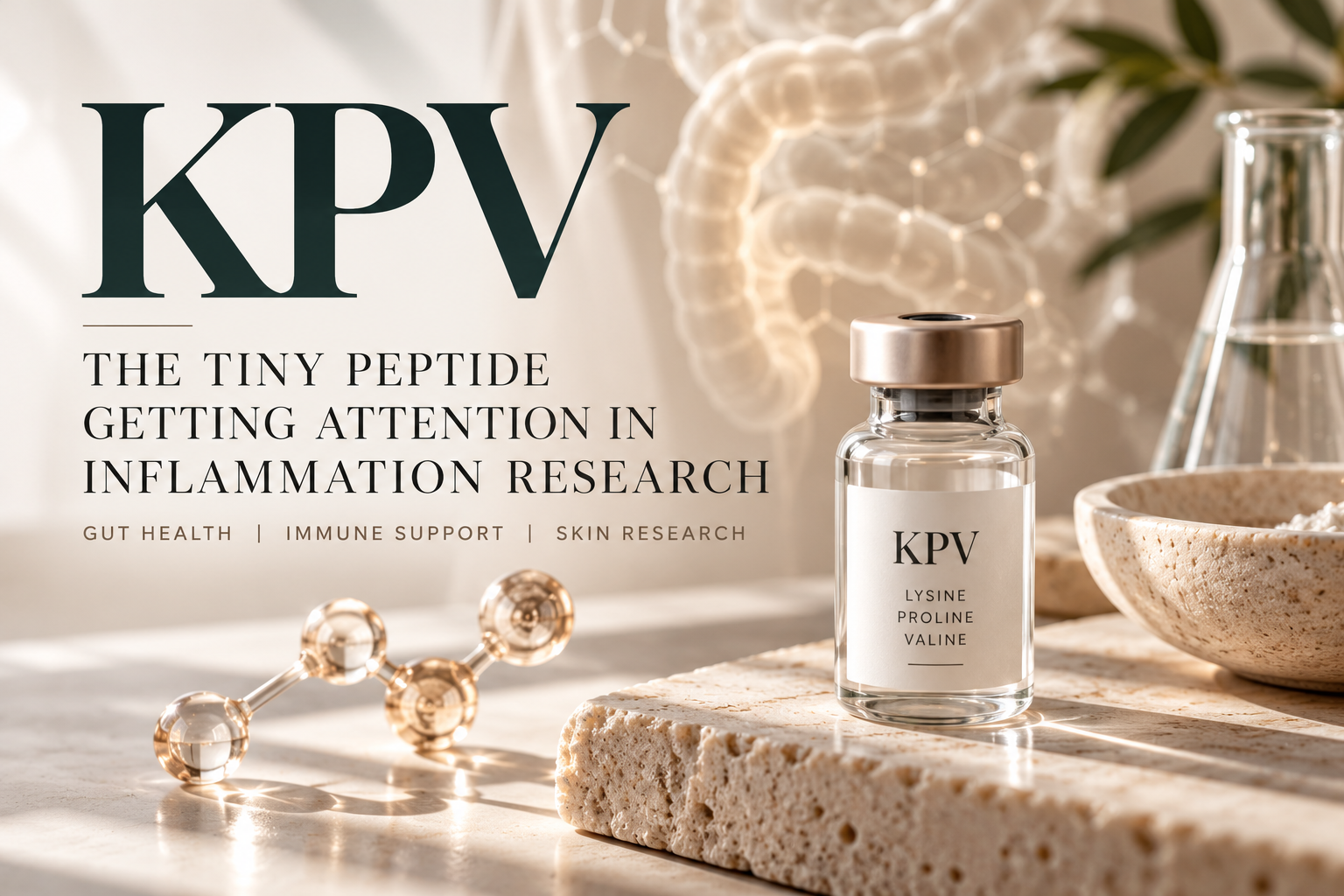
KPV stands for three amino acids:
- K — Lysine
- P — Proline
- V — Valine
That’s it. Three amino acids.
KPV is a small fragment of a naturally occurring hormone called alpha-melanocyte-stimulating hormone, or alpha-MSH.
Although alpha-MSH is often associated with pigmentation, it also participates in immune regulation and inflammatory signaling.
Researchers discovered that the KPV portion of this hormone retains certain anti-inflammatory properties in experimental models.
That discovery opened the door to studying whether this small peptide could influence inflammation without all the biological effects of the full hormone.
Why Inflammation Is Such a Big Deal
Inflammation isn’t automatically a bad thing.
It’s part of how our bodies protect us.
When you get injured, encounter an infection, or experience tissue damage, your immune system activates an inflammatory response.
That response helps your body deal with the problem.
But inflammation can also become persistent or poorly regulated.
Chronic inflammation is involved in numerous medical conditions, including inflammatory bowel disease, certain skin disorders, and autoimmune diseases.
The challenge isn’t simply shutting inflammation off.
It’s understanding how to regulate it appropriately.
And that’s where KPV research becomes interesting.
How Does KPV Work?
One of the most interesting things about KPV is its potential influence on inflammatory signaling.
Our cells communicate using complex networks of chemical signals.
One important pathway is called NF-κB.
Think of NF-κB as part of the cellular alarm system.
When activated, it helps coordinate the production of proteins involved in inflammation and immune responses.
In laboratory studies, KPV has been shown to reduce NF-κB activation and certain inflammatory signals.
Researchers have also investigated its effects on MAP kinase pathways, which participate in how cells respond to stress and inflammation.
In plain English?
KPV appears capable of influencing some of the molecular signals involved in inflammation under experimental conditions.
But there’s an important distinction: changing inflammatory markers in a laboratory does not prove that KPV can safely or effectively treat inflammation in humans.
KPV and Gut Health: One of the Most Interesting Research Areas
If there’s one area where KPV has attracted significant scientific interest, it’s intestinal inflammation.
Researchers have investigated KPV in experimental models of inflammatory bowel disease, including colitis.
In a published study, scientists found that KPV could enter certain intestinal and immune cells through a transporter called PepT1.
Once inside those cells, KPV reduced several inflammatory signals.
The researchers also observed reduced intestinal inflammation in mouse models of colitis.
Another animal study reported improvements in measures of intestinal inflammation and recovery.
These findings are interesting because they suggest that KPV may influence inflammatory processes occurring within intestinal tissue.
However, these were laboratory and animal studies.
They do not establish KPV as a treatment for Crohn’s disease, ulcerative colitis, IBS, or other digestive conditions.
We still need controlled human clinical trials to determine whether these effects translate into meaningful health benefits.
What About KPV and Skin Inflammation?
This is another area that has caught my attention.
We often think about skincare in terms of wrinkles, collagen, and hydration.
But inflammation is also involved in many skin conditions.
Researchers are exploring whether peptides that influence inflammatory pathways could eventually have applications in skin health.
KPV has been investigated in experimental skin-related research, including work involving inflammatory signaling and topical delivery systems.
The idea is intriguing.
Could a small peptide that affects inflammatory pathways eventually become useful in certain dermatological applications?
Possibly.
But research involving cells, laboratory formulations, or animal models is very different from demonstrating that a finished skincare product improves eczema, rosacea, psoriasis, or another skin condition in people.
At this point, KPV should be viewed as an experimental research compound rather than a proven skincare treatment.
Is KPV the Same as BPC-157?
Not at all.
Although both are frequently discussed in peptide communities, they are different compounds.
KPV is a three-amino-acid fragment of alpha-MSH that researchers have investigated primarily for inflammatory signaling and immune-related processes.
BPC-157 is a different experimental peptide that has attracted interest in tissue-repair research.
Their proposed mechanisms and areas of investigation overlap in some ways, but they are not interchangeable.
And neither should be mistaken for an established, FDA-approved treatment for inflammation or tissue healing.
Why Are Researchers Interested in Such a Small Peptide?
This might be my favorite part.
We tend to assume that something needs to be complicated to have an interesting biological effect.
But KPV contains only three amino acids.
Despite its size, researchers have observed measurable effects in certain experimental models.
That makes it useful for studying how small peptide fragments interact with cellular pathways.
Scientists are also investigating different ways to deliver KPV to specific tissues.
Some studies have explored specialized nanoparticles and other delivery systems designed to improve how the peptide reaches its intended target.
These are early research approaches, not established consumer treatments.
What We Still Don’t Know About KPV
This is where the conversation needs to stay realistic.
Despite the interesting laboratory findings, major questions remain.
We don’t yet have reliable clinical evidence establishing:
- Whether KPV improves inflammatory conditions in humans.
- Which conditions, if any, might benefit.
- What doses or administration methods would be safe and effective.
- Whether long-term exposure carries risks.
- How KPV compares with existing treatments.
There is also a difference between KPV studied in specialized laboratory formulations and research-grade products available online.
Results from one formulation cannot automatically be applied to another.
As of this article, KPV does not have an FDA-approved therapeutic use, and established human clinical dosing and safety data are lacking.
My Thoughts on KPV
What interests me most about KPV isn’t the idea of another peptide promising to fix everything.
It’s the possibility that researchers may learn more about how inflammation can be regulated at the cellular level.
I’ve become increasingly interested in the relationship between inflammation and overall wellness.
And the more I read, the more I realize how complicated that relationship really is.
Inflammation isn’t one single process. It involves numerous pathways, tissues, and immune responses.
The fact that scientists are studying such a small peptide for its potential influence on those processes is fascinating to me.
Does that mean KPV is the next breakthrough?
We don’t know.
But does it make the research worth following?
I think so.
Final Thoughts
KPV might be small, but the scientific questions surrounding it are anything but.
From intestinal inflammation to immune signaling and potential skin applications, researchers are exploring several interesting possibilities.
The evidence is still early, and human clinical studies are needed before we can draw conclusions about real-world benefits.
For now, KPV is best understood as an intriguing experimental peptide—not a proven anti-inflammatory treatment.
And that’s exactly why I enjoy following this area of research.
Sometimes the most interesting discoveries begin with the smallest molecules.
Keep Exploring on The Compound Edit
Interested in learning more about peptides, inflammation, and the science behind emerging compounds?
You might also enjoy:
- BPC-157 and TB-500: Exploring the Research Behind Recovery
- GHK-Cu in Skincare: The Copper Peptide That Made Me Rethink My Routine
- NAD+ vs. MOTS-C: Two Different Approaches to Cellular Health
Continue Exploring
At The Compound Edit, we believe understanding the research matters just as much as exploring the possibilities.
If you’re interested in learning more about the compounds discussed throughout our articles, visit Chuk BioWorks.
A Note on Transparency: The Compound Edit has an ownership connection to Chuk BioWorks, a supplier of research-use compounds. Our articles are intended to share education, scientific research, and personal perspectives—not to recommend unapproved medical treatments or human use of research compounds.
Stay curious. Keep learning. Continue exploring.
Disclaimer: This article is intended for educational and informational purposes only and does not constitute medical advice. KPV is an investigational compound without FDA approval for therapeutic use. Its safety and effectiveness in humans have not been established. Do not use research-grade peptides to self-treat medical conditions.
Research references for the article
For credibility, I’d include a small references section at the bottom of the WordPress post, before the disclosure:
- PepT1-mediated tripeptide KPV uptake reduces intestinal inflammation — Gastroenterology, 2008.
- Melanocortin-derived tripeptide KPV has anti-inflammatory potential in murine models of inflammatory bowel disease — Inflammatory Bowel Diseases, 2008.
- Orally targeted delivery of tripeptide KPV via hyaluronic acid-functionalized nanoparticles — Experimental colitis research.