
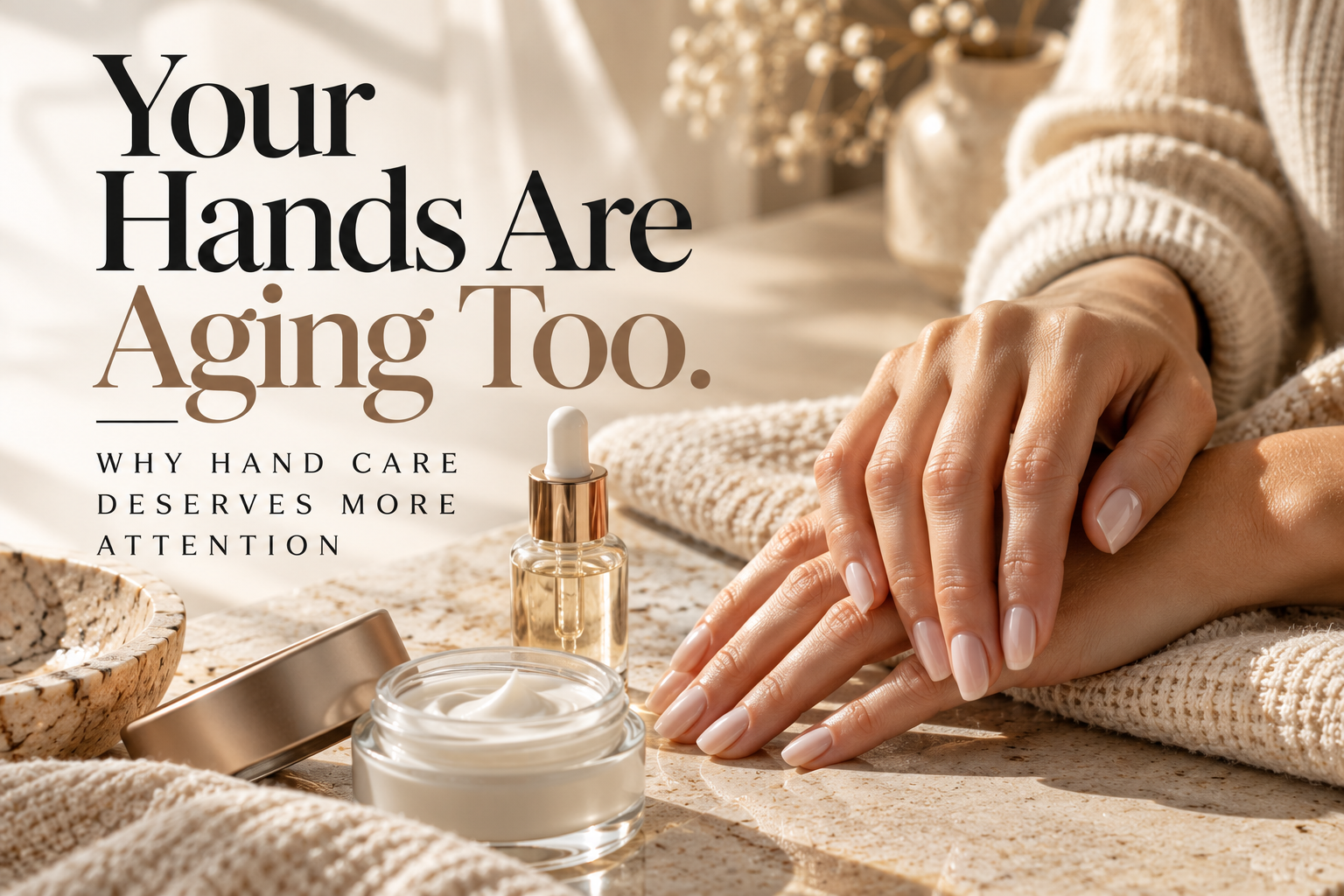
Your Hands Are Aging Too: Why Hand Care Deserves More Attention
We spend so much time taking care of our faces. But what about the part of our body that might be showing our age just as much?
I have a confession.
For years, I paid attention to my face, my hair, and pretty much everything else when it came to skincare.
But my hands?
Not nearly as much.
And lately, I’ve been thinking about how strange that actually is.
We invest in facial serums, moisturizers, anti-aging ingredients, and skincare routines designed to help our skin look its best.
Meanwhile, our hands are exposed to sunlight, soap, cleaning products, weather, and constant use.
Every. Single. Day.
And most of us barely give them a second thought.
After becoming interested in GHK-Cu and experimenting with my facial skincare routine, I started wondering whether I should be paying more attention to the skin on my hands, too.
Because the more I learned, the more I realized something.
Our hands deserve a skincare routine of their own.
Why Our Hands Can Show Signs of Aging
Think about everything your hands go through in a single day.
Washing dishes.
Cleaning.
Driving.
Working.
Washing your hands repeatedly.
Being exposed to cold weather, dry air, and sunlight.
The skin on the backs of our hands is relatively thin, and it can become more fragile as we age.
Over time, several changes can become more noticeable:
- Fine lines and wrinkles
- Dryness and rough texture
- Dark spots and uneven pigmentation
- More visible veins and tendons
- Loss of fullness
Some of these changes are part of natural aging.
Others are influenced by environmental exposure, particularly ultraviolet radiation from the sun.
And here’s something worth remembering:
Your hands are exposed to sunlight far more often than you probably realize.
The Sun Damage We Forget About
Most of us know that sunscreen is important for our faces.
But how often do we remember to apply it to our hands?
Especially before driving?
Ultraviolet radiation contributes to photoaging, which is the premature aging of skin caused by repeated sun exposure.
Over time, this can contribute to wrinkles, uneven pigmentation, and changes in skin texture.
And yes, sunlight can reach your hands while you’re driving.
UVA radiation can pass through ordinary side-window glass to varying degrees, depending on the type of glass and its protective coating.
That means your hands can accumulate sun exposure even when you aren’t spending the day outside.
It’s one of those things that’s obvious once you think about it.
But how many of us actually remember sunscreen on the backs of our hands?
I know it hasn’t always been part of my routine.
Why Moisturizing Matters More Than We Think
Let’s talk about something incredibly simple.
Hand cream.
Not the most exciting skincare product in the world, right?
But it’s one of the most useful.
Every time we wash our hands, we remove some of the natural oils that help protect our skin.
Frequent washing, harsh cleansers, and dry weather can disrupt the skin barrier.
When that happens, skin may feel tight, rough, irritated, or flaky.
A good moisturizer helps reduce water loss and support the skin’s protective barrier.
Ingredients worth looking for include:
Glycerin: A humectant that attracts water and helps keep skin hydrated.
Ceramides: Lipids that help support the skin barrier.
Hyaluronic acid: An ingredient that helps bind water in the skin.
Petrolatum or dimethicone: Ingredients that help reduce moisture loss.
Urea: At appropriate concentrations, it can help hydrate and soften rough skin.
You don’t necessarily need an expensive hand cream.
You need one that works for your skin and that you’ll actually use consistently.
What About Collagen and Skin Elasticity?
Collagen is one of the proteins that gives skin structure and support.
As we age, collagen production and remodeling change.
Sun exposure can accelerate collagen breakdown.
Over time, the skin may appear thinner, less firm, and more wrinkled.
This is part of why hand aging can become so noticeable.
But it’s also why skincare ingredients that support skin health have become such a popular research topic.
Retinoids, certain antioxidants, and other topical ingredients have been studied for their effects on photoaged skin.
The strength of the evidence varies by ingredient and formulation.
And while no cream can completely reverse the structural changes associated with aging, consistent skincare can help improve hydration, texture, and the appearance of some signs of sun damage.
Could Copper Peptides Have a Place in Hand Care?
This is where my interest really started.
I’ve previously shared my experience incorporating GHK-Cu into my facial skincare routine.
And I’ve been genuinely happy with how my skin has looked.
That experience made me curious about other areas of skincare.
Including my hands.
GHK-Cu is a copper-binding peptide that has been studied for its potential involvement in skin-related biological processes.
Laboratory research has explored its relationship with tissue remodeling, extracellular matrix components, and cellular signaling.
Those findings are interesting, especially when you think about skin aging.
But there’s an important difference between promising laboratory research and proven results in people.
We don’t currently have strong clinical evidence showing that topical GHK-Cu reverses aging of the hands.
And research-grade GHK-Cu should not be mixed into hand lotion or applied directly to the skin.
If someone wants to explore copper peptides in skincare, the more appropriate option is a commercially formulated cosmetic product intended for topical use.
Personally, I’m interested in seeing how a consistent hand-care routine might affect the appearance and feel of my skin over time.
But I also know that consistency, moisturizing, and sun protection are likely to make the biggest difference.
The Simple Hand-Care Routine I’m Interested In
One thing I’ve learned about skincare is that complicated doesn’t automatically mean better.
Sometimes the basics are what matter most.
Here’s a practical routine worth considering.
Morning: Protect
Start with a moisturizer if your hands feel dry.
Then apply broad-spectrum SPF 30 or higher sunscreen to the backs of your hands when they’re exposed to daylight.
Reapply after washing your hands and as directed on the sunscreen label, especially during prolonged outdoor exposure.
Throughout the Day: Hydrate
Keep a hand cream somewhere convenient.
Next to the sink.
In your purse.
At your desk.
Apply it after washing your hands, especially when your skin feels dry.
Evening: Restore Moisture
Before bed, apply a richer moisturizer.
If your hands are particularly dry, a fragrance-free cream or ointment can help reduce moisture loss overnight.
If you’re interested in additional cosmetic ingredients, introduce one product at a time and watch for irritation.
That’s it.
Nothing overly complicated.
Just a little more attention to a part of our body that works incredibly hard.
Don’t Forget About Your Nails and Cuticles
Hand care isn’t only about wrinkles.
Your nails and cuticles are part of the picture, too.
Frequent water exposure, harsh cleaning products, and picking at cuticles can contribute to dryness and irritation.
A few small habits can help:
- Moisturize around your nails.
- Wear protective gloves when using cleaning products.
- Avoid cutting or aggressively pushing back cuticles.
- Give irritated skin time to recover.
Healthy-looking hands are about more than one anti-aging ingredient.
They’re about taking care of the entire area.
Can You Actually Make Your Hands Look Younger?
There’s no magic product that can turn back the clock.
But there are ways to improve the appearance and condition of your hands.
Consistent moisturizing can make skin look smoother and feel softer.
Sun protection helps prevent additional UV-related damage.
Certain professionally guided dermatologic treatments can also address pigmentation, texture, and volume changes.
For example, dermatologists may use prescription topical treatments, lasers, or other procedures depending on the concern.
The important thing is having realistic expectations.
Skincare can make a difference.
But prevention and consistency are often more valuable than chasing dramatic results from one product.
My Biggest Takeaway
It’s funny how something so obvious can go unnoticed for so long.
I’ve spent time learning about skincare ingredients, peptides, collagen, and healthy aging.
I’ve paid attention to changes in my facial skin.
And yet, my hands were never really part of the conversation.
Until now.
I’m not expecting a hand cream or serum to perform miracles.
But I am interested in what happens when I start giving my hands the same attention I’ve been giving my face.
Because taking care of your skin shouldn’t stop at your jawline.
And sometimes the simplest changes to your routine are the ones worth making.
Keep Exploring on The Compound Edit
Enjoyed this article? Here are a few more worth reading.
GHK-Cu in Skincare: The Copper Peptide That Made Me Rethink My Routine
GHK-Cu: More Than Just a Skincare Trend
Creatine: Why It’s Not Just for Bodybuilders
In WordPress, highlight each article title and use the chain-link icon to connect it to the published article.
Continue Exploring
At The Compound Edit, we believe understanding the science is just as important as exploring the possibilities.
From skincare and healthy aging to emerging peptide research, there’s always something new to discover.
If you’re interested in learning more about the compounds discussed throughout our articles, you can also explore Chuk BioWorks.
A Note on Transparency: The Compound Edit has an ownership connection to Chuk BioWorks, a supplier of research-use compounds. Our articles are intended to share educational information, research, and personal experiences—not to promote unapproved medical or cosmetic uses. Research-grade compounds are not intended for personal skincare use.
Stay curious. Keep learning. Continue exploring.
Disclaimer: This article is for educational purposes only and is not medical advice. Skincare results vary. Consult a qualified healthcare professional for persistent skin problems or before beginning prescription treatments.