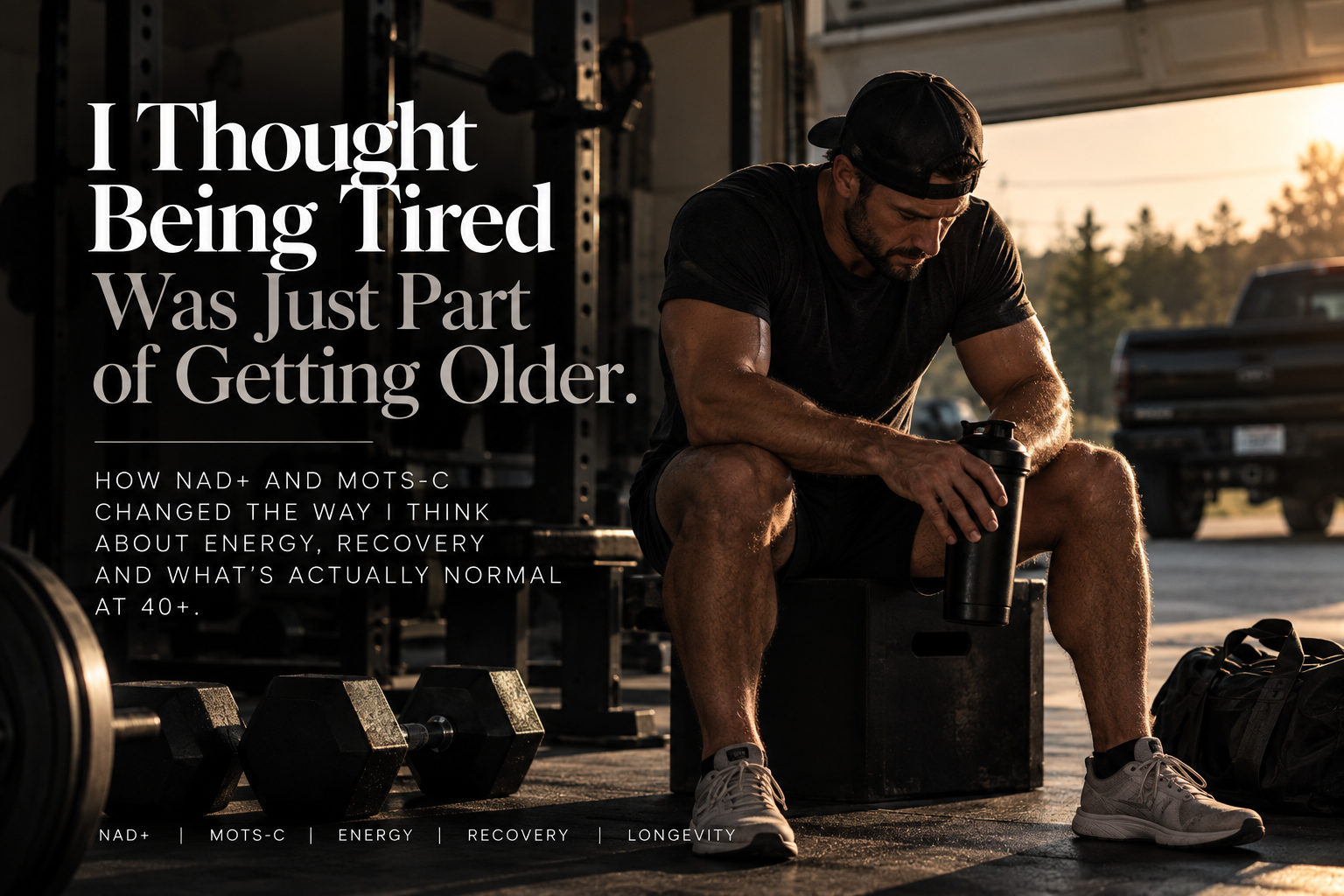
I Thought Being Tired Was Just Part of Getting Older
I wasn’t sick. I wasn’t completely exhausted. I just couldn’t remember the last time I felt like I had a full tank.
This is a composite story inspired by experiences commonly described in peptide and wellness communities. Details have been fictionalized, and the story is not intended to represent one individual’s medical experience.
I’m 43 years old.
I have a wife, three kids, a full-time job and a mortgage.
So when I started feeling tired all the time, I did what I think most guys my age do.
I ignored it.
I wasn’t falling asleep at my desk.
I wasn’t missing work.
I wasn’t lying on the couch unable to function.
I was doing everything I was supposed to do.
I just felt like I was doing all of it at about 70 percent.
And somewhere along the way, I decided that was probably normal.
I Didn’t Think I Had an Energy Problem
If you’d asked me back then whether I had low energy, I probably would have said no.
I still got up at 6.
Still went to work.
Still coached baseball.
Still mowed the lawn.
Still went to the gym.
That’s not what I thought “low energy” looked like.
What I didn’t tell you was that I needed two cups of coffee before I wanted anyone speaking to me.
I’d sit in my truck outside the gym for ten minutes trying to convince myself to go inside.
By 2:30 in the afternoon, I was looking for another coffee or an energy drink.
And after dinner?
Forget it.
If I sat on the couch, the day was over.
My wife would ask if I wanted to do something and my answer was almost always:
“I’m just tired.”
Eventually she started answering:
“You’re always tired.”
That one stuck with me.
Because she was right.
I Figured This Was 40
Nobody warns you that there’s a point where you start blaming your age for everything.
Shoulder hurts?
I’m 40.
Can’t recover from a workout?
I’m 40.
Fall asleep watching a movie at 8:45?
Apparently this is just who I am now.
The weird part is that 43 isn’t actually that old.
I knew guys in their 50s who had more energy than I did.
So I started doing what everyone does when they decide they’re going to “optimize” themselves.
I bought supplements.
A lot of supplements.
My Kitchen Looked Like a Vitamin Store
Multivitamin.
Magnesium.
Vitamin D.
Fish oil.
B complex.
CoQ10.
Some powder somebody on a podcast said would change my life.
I honestly couldn’t tell you what half of it was supposed to do.
Did I feel better?
Maybe.
But if I’m being truthful, the biggest immediate difference still came from coffee.
Then I started hearing about NAD+.
NAD+ Sounded Like Another Wellness Buzzword
The claims were ridiculous.
Energy.
Recovery.
Brain function.
Metabolism.
Longevity.
Anti-aging.
Apparently NAD+ was going to fix my lawn mower too.
So initially, I dismissed it.
But then I learned NAD+ wasn’t some molecule invented by the wellness industry.
It’s already inside us.
Nicotinamide adenine dinucleotide—NAD+—is a coenzyme involved in fundamental cellular processes.
Among other things, it participates in redox reactions that allow cells to extract usable energy from nutrients.
It also acts as a substrate for enzymes involved in cellular signaling and DNA-related processes.
That part was real.
What was much less clear was whether taking or injecting NAD+ would translate into all the benefits being advertised online.
That distinction interested me.
So I Tried It
I wish I could tell you I took NAD+ and immediately felt like I was 22.
I didn’t.
The first time, I mostly sat there waiting for something to happen.
Nothing did.
No rush.
No stimulant feeling.
No sudden desire to reorganize my garage.
Which, looking back, makes sense.
NAD+ isn’t caffeine.
But after I’d been using it for a while, I noticed something small.
I wasn’t reaching for that afternoon energy drink every day.
Not never.
Just…not automatically.
Then I realized I hadn’t been sitting in the parking lot before the gym as often.
That was about it.
It wasn’t:
MORE ENERGY.
It was more like:
less resistance to doing things.
That’s the best way I can describe it.
Then I Found MOTS-c
Once you start reading about cellular energy, the internet inevitably introduces you to mitochondria.
And eventually I came across something called MOTS-c.
That sent me down an entirely different rabbit hole.
MOTS-c is unusual because it’s a mitochondrial-derived peptide.
It’s encoded within mitochondrial DNA rather than the nuclear DNA responsible for most of the proteins and peptides we normally think about.
Researchers have investigated MOTS-c in connection with metabolic regulation, cellular stress responses, glucose metabolism and exercise physiology.
There are also intriguing observations involving exercise itself.
Human research has found that endogenous MOTS-c levels can increase in skeletal muscle and circulation following exercise.
That immediately caught my attention.
Because unlike the vague promise of “more energy,” this was actually connected to the thing I cared about:
How my body handled physical work.
I Made a Terrible Scientific Experiment
Meaning:
I changed several things at once.
I started experimenting with MOTS-c.
I was already using NAD+.
I cleaned up my diet.
I started prioritizing sleep.
And I became much more consistent about going to the gym.
This is exactly what you’re not supposed to do if you’re trying to figure out which variable caused something.
But I wasn’t conducting a clinical trial.
I was a 43-year-old guy who was tired of feeling tired.
The Gym Was Where I Noticed It Most
Again, there wasn’t some explosive change.
I wasn’t suddenly setting personal records every day.
I just stopped dreading the workout.
I’d finish lifting and actually do the cardio I’d told myself I was going to do.
On Saturdays, I’d train in the morning and still have enough motivation to do something with my family afterward.
Before, a hard workout could basically become the day’s major event.
I’d come home, eat and want to sit down.
Now I felt like I had more left.
Was that MOTS-c?
NAD+?
Better sleep?
Eating better?
Improved conditioning because I’d finally been consistent for several months?
Probably some combination.
And that’s where these stories get complicated.
What Does “More Energy” Even Mean?
This became one of the most interesting parts of the whole experience.
People say:
“NAD+ gives you energy.”
Or:
“MOTS-c gives you energy.”
But neither statement really explains what’s happening.
When most of us hear energy, we imagine stimulation.
Coffee.
Pre-workout.
Adderall.
Something you feel.
Cellular energy metabolism is completely different.
Your cells continuously convert nutrients into forms of energy they can actually use, with mitochondria playing a central role in that process.
NAD+ participates in those metabolic reactions.
MOTS-c appears to function as a signaling molecule related to metabolic and cellular stress responses.
That’s biologically fascinating.
But it doesn’t mean injecting either compound is equivalent to pouring more fuel into a gas tank.
The human body is considerably more complicated than that.
NAD+ Has a Marketing Problem
Once I started actually reading the research, I realized the internet often skips several steps.
There’s strong scientific evidence that NAD biology is important.
NAD+ levels and metabolism have been studied extensively in aging, metabolic disease and cellular function.
But:
“NAD+ is essential to human biology”
doesn’t automatically mean:
“Injecting NAD+ has been clinically proven to slow human aging.”
Those are completely different statements.
A lot of longevity marketing quietly slides from the first statement into the second.
Human research into NAD+-related therapies is ongoing, including substantial interest in NAD+ precursors such as nicotinamide riboside and nicotinamide mononucleotide.
But many of the dramatic longevity claims you see online go considerably beyond what clinical evidence has established.
MOTS-c Is Even Earlier
MOTS-c may be one of the coolest molecules I’d never heard of.
But it’s also experimental.
Much of the research surrounding MOTS-c remains preclinical, with a relatively small human evidence base compared with established medications.
Researchers have reported intriguing associations involving aging, metabolic health and exercise.
That makes it worth studying.
It doesn’t make it a proven treatment for fatigue, obesity or aging.
And it definitely doesn’t mean my experience proves anything.
There’s Another Reason I Don’t Tell Guys to Just “Try What I Tried”
Fatigue is a symptom.
And there are a lot of reasons someone can feel exhausted.
Sleep apnea.
Anemia.
Thyroid problems.
Low calorie intake.
Medication side effects.
Depression.
Poor sleep.
Hormonal issues.
Nutrient deficiencies.
And plenty of other medical conditions.
If you’re exhausted all the time, the smartest first move probably isn’t ordering something you saw discussed on the internet.
Looking back, I should have taken that part more seriously before deciding I was simply “getting old.”
The Biggest Change Wasn’t Physical
Here’s the weird part.
I can’t tell you exactly how much of what I felt came from NAD+ or MOTS-c.
But I can tell you what changed afterward.
I stopped accepting feeling mediocre as inevitable.
I started sleeping like it mattered.
I trained consistently.
I ate better.
I stopped treating recovery as something only professional athletes needed.
And I started paying attention to how I actually felt instead of automatically answering:
“I’m fine.”
Maybe experimenting with these compounds contributed.
Maybe they didn’t contribute as much as I think they did.
That’s the limitation of one person’s story.
But something changed.
I Still Drink Coffee
Let’s not get carried away.
I’m not one of those people who’s going to tell you I wake up naturally at 4:45 AM, drink mineral water and watch the sunrise.
I drink coffee.
Sometimes I still need an afternoon one.
Some workouts still suck.
Some nights I sleep terribly because one of my kids wakes me up.
I’m still 43.
The difference is that I no longer think feeling depleted every day is simply the admission price for being an adult.
The Compound Edit Takeaway
NAD+ and MOTS-c are often grouped together under the broad idea of “cellular energy.”
But they’re very different molecules.
NAD+ is a coenzyme essential to fundamental cellular metabolism and numerous signaling processes.
MOTS-c is a mitochondrial-derived peptide being investigated for its role in metabolic regulation, cellular stress responses and exercise physiology.
Both are scientifically interesting.
Neither justifies every anti-aging, performance or energy claim currently circulating online.
And a personal story can’t establish that either compound caused a particular result—especially when sleep, training, diet and multiple interventions changed at the same time.
That’s the difference between an experience and evidence.
I can tell you what I noticed.
Research has to tell us what it actually means.
Continue Exploring
The Compound Edit follows the evolving science around peptides, metabolic health, recovery, performance and longevity—while separating what research actually shows from what’s gaining traction online.
The Compound Edit is affiliated with Chuk BioWorks. You can read more about that connection and how we approach editorial independence here.
EXPLORE CHUK BIOWORKS → www.chukbioworks.com
The Compound Edit is for educational and informational purposes only and does not provide medical advice. MOTS-c is investigational, and discussion of experimental compounds or personal experiences should not be interpreted as a recommendation for human use. Persistent or unexplained fatigue should be discussed with an appropriate healthcare professional.