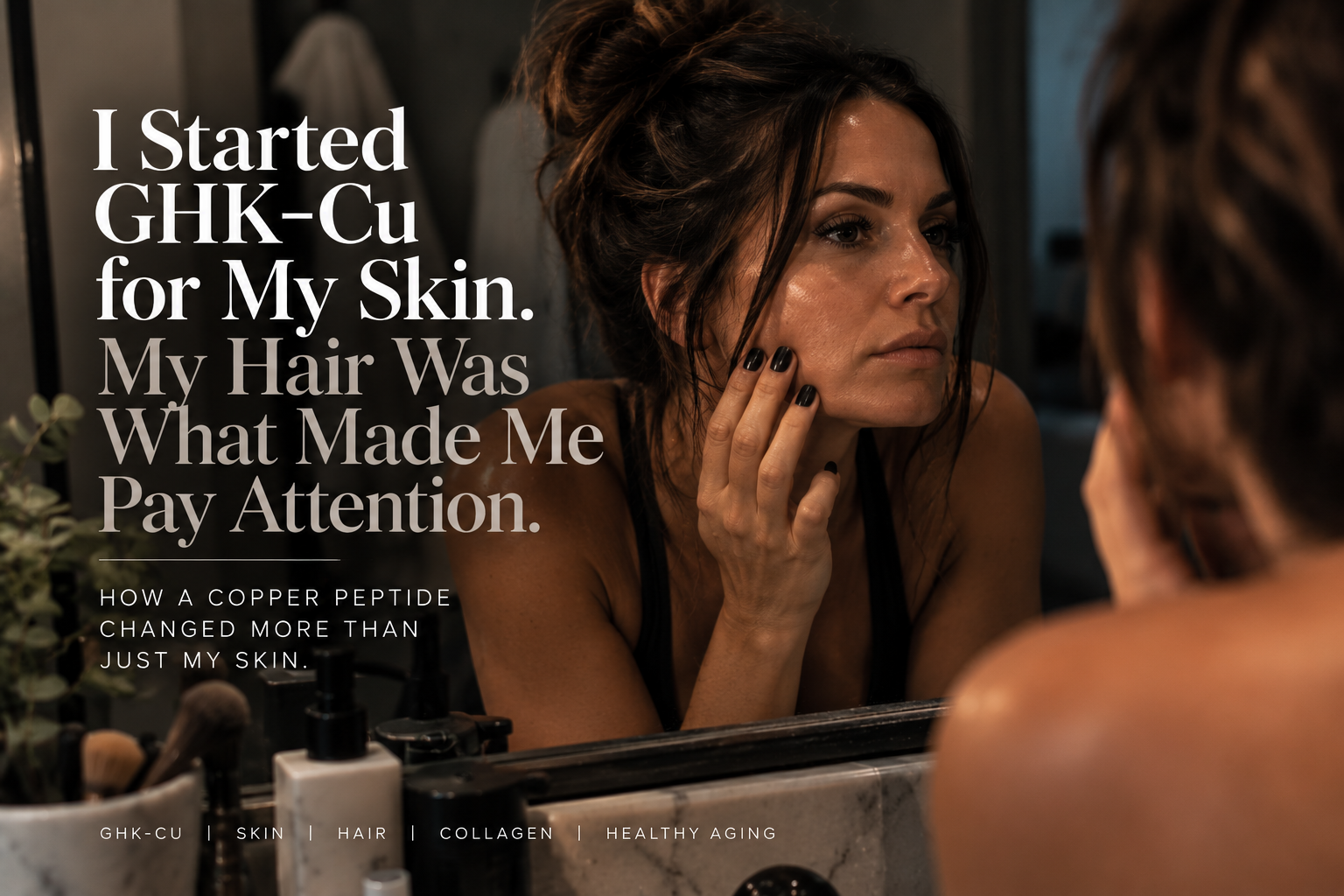
I Started GHK-Cu for My Skin. My Hair Was What Made Me Pay Attention.
I was looking for better skin. A few months later, I was staring at the tiny hairs around my hairline instead.
This is a composite story inspired by experiences commonly described in peptide and wellness communities. Details have been fictionalized, and the story is not intended to represent one individual’s medical experience.
I didn’t wake up one morning and suddenly look old.
It was more annoying than that.
Little things started happening.
Makeup didn’t sit on my skin the way it used to.
The skin under my eyes looked thinner.
I could suddenly see lines around my mouth in pictures that I swore weren’t there six months earlier.
And then there was my neck.
Nobody prepares you for the day you become aware of your neck.
I was 41.
I knew aging was happening.
I just wasn’t particularly interested in helping it along.
So I did what any rational woman would do.
I spent an unreasonable amount of time researching skincare.
I Already Owned Everything
Retinol?
Obviously.
Vitamin C?
Three different kinds.
Hyaluronic acid.
Peptides.
Exfoliating acids.
LED mask.
Sunscreen that cost enough that I expected it to personally apologize whenever I got a wrinkle.
My bathroom counter looked like a small dermatology practice.
Some of it absolutely helped.
But eventually I started reading about something I’d seen listed on skincare products for years without really understanding it:
Copper peptides.
More specifically:
GHK-Cu.
At First, I Thought It Was Just Another Skincare Ingredient
GHK-Cu sounded like something a cosmetics company had invented.
It isn’t.
GHK is a naturally occurring tripeptide composed of three amino acids:
glycine, histidine and lysine.
It has a strong affinity for copper.
When GHK binds copper, we get the complex generally referred to as GHK-Cu.
And researchers have been studying it for decades.
That’s what surprised me.
This wasn’t some new ingredient invented because TikTok needed another skincare trend.
Research involving GHK-Cu has explored things like:
tissue remodeling
collagen
fibroblast activity
wound healing
extracellular matrix
and inflammatory signaling.
Okay.
Now I was interested.
The Collagen Part Got Me
I’m not going to pretend I started researching GHK-Cu because I was fascinated by extracellular matrix biology.
I wanted better skin.
Specifically, I wanted the skin on my face to look a little firmer and less tired.
Collagen is a major structural protein in skin, and changes in collagen production and organization are part of what happens as skin ages.
GHK-Cu has been studied for its potential influence on fibroblasts and processes involved in collagen and extracellular-matrix remodeling.
That’s where much of its reputation as a “skin peptide” comes from.
And compared with some of the things I’d encountered in the peptide world, there was actually a decent amount of biological research behind it.
But there was also a catch.
“Lots of Research” Didn’t Mean What I Thought It Meant
Once I started digging beyond skincare websites, I realized something.
There was a lot of research.
But much of it wasn’t the kind of research consumers assume when they hear:
“Studies show…”
Cell studies count as research.
Animal studies count as research.
Mechanistic studies count as research.
They can tell us incredibly important things.
But they aren’t automatically proof that putting or injecting something into a human produces the same outcome.
Human clinical evidence for many of the claims surrounding GHK-Cu is much smaller than the internet makes it sound.
I kept that in mind.
And then I tried it anyway.
I Took Pictures Because I Didn’t Trust Myself
This is one thing I’m glad I did.
Before I started, I took photos.
Same bathroom.
Same window.
No makeup.
No filter.
Which was humbling.
Because skin changes happen slowly.
If you stare at yourself every morning, you’re probably not going to notice tiny differences.
The first few weeks?
Nothing.
I didn’t wake up with new skin.
My wrinkles didn’t disappear.
Nobody stopped me in the grocery store and demanded to know my anti-aging secret.
It was extremely uneventful.
Around Two Months In, I Thought My Skin Looked Better
The word I’d use is:
healthier.
Not younger.
Not wrinkle-free.
Not transformed.
My skin just looked a little better.
Maybe slightly more even.
Maybe a little less dull.
There was something about the texture that I liked.
But here’s the problem with judging your own face:
I wanted it to work.
I had taken the before pictures.
I was paying attention.
And lighting can make someone look ten years younger or ten years older depending on which direction they’re facing.
So I wasn’t completely convinced.
Then something else happened.
My Hairdresser Said Something
This is the part I remember.
I was getting my hair colored and my stylist started messing around near my forehead.
Then she said:
“You have a ton of new growth up here.”
I immediately looked up.
“What?”
She separated some hair near my temple.
There were all these short little hairs.
I’d noticed them.
I just assumed they were breakage.
She didn’t think so.
They were coming from the scalp.
And suddenly I was paying attention.
I Hadn’t Even Started It for My Hair
My hair had gotten thinner over the previous few years.
Nothing dramatic.
I wasn’t developing bald spots.
My ponytail just wasn’t as thick as it used to be.
My temples looked a little more sparse when my hair was pulled back.
Again, I had filed this under:
Congratulations, you’re 40.
So the possibility of new growth got my attention much more than the subtle changes I’d been analyzing in my skin.
I started taking pictures of my hairline too.
Because apparently I now documented every square inch of my head.
Was GHK-Cu Growing My Hair?
This is where the story gets less satisfying.
I don’t know.
There is scientific interest in GHK-Cu and hair-follicle biology.
Research has explored effects related to follicle activity and tissue remodeling, which helps explain why copper peptides have found their way into hair and scalp products.
But that’s not the same thing as having large clinical trials demonstrating that GHK-Cu reliably regrows hair in women like me.
And I had other variables.
I had started eating more protein.
I was taking better care of my scalp.
My stress level was lower than it had been the year before.
I’d corrected a nutritional issue.
And hair growth operates on a slow cycle.
Something happening to my hair today could reflect changes that started months ago.
That’s important.
Hair Stories Are Especially Tricky
Hair is frustrating because there’s a delay.
Someone can start a supplement today and see new hair three months later.
Naturally, they assume the supplement did it.
Maybe it did.
But hair shedding and growth can be influenced by:
hormonal changes
weight loss
stress
illness
iron status
thyroid function
nutrition
genetics
medications
and the normal hair-growth cycle.
That’s why a before-and-after picture can’t tell you what caused the change.
Mine certainly couldn’t.
Then I Learned Topical and Injectable GHK-Cu Aren’t the Same Thing
This was probably the biggest misconception I had going into it.
I’d seen GHK-Cu in skincare.
I’d seen injectable GHK-Cu discussed in peptide groups.
And mentally, I’d put them in the same category.
Same molecule.
Different delivery method.
Simple.
Except route of administration matters enormously.
Something applied to the skin has to deal with the skin barrier.
Something injected bypasses that barrier and creates a completely different type of exposure.
That changes questions about:
absorption
concentration
sterility
impurities
immune reactions
and overall safety.
The fact that copper peptides have appeared in cosmetic products for years doesn’t establish the safety of injecting GHK-Cu.
Those are separate conversations.
This Is Where Social Media Loses Me
Someone posts:
“GHK-Cu made my skin amazing.”
Then somebody asks:
“How much do you inject?”
We just skipped about fifteen questions.
Was the original person using a serum?
Cream?
Microneedling product?
Injection?
Were they also using tretinoin?
Did they lose weight?
Change their diet?
Have a cosmetic procedure?
How long did they use it?
What exactly improved?
The internet compresses all of that into:
GHK-Cu = better skin.
Biology isn’t usually that simple.
But I Kept Using It
That’s the funny part.
Even after learning all of those limitations, I still liked what I was seeing.
My skin looked good.
My hairline looked fuller to me.
My stylist continued pointing out new growth.
Did I have laboratory proof that GHK-Cu caused it?
Absolutely not.
Would I tell someone:
“GHK-Cu will regrow your hair”?
Also no.
What I can say is:
I started paying attention because of my skin.
My hair is what made the experience interesting enough that I kept reading.
There’s a big difference between those statements and claiming a treatment works.
The Skin Changes Were Almost Too Slow to Notice
A few months later, I compared my original pictures.
That was much more useful than staring at myself every day.
My skin didn’t look twenty years younger.
Thank God, because I’d be suspicious if it did.
But I liked what I saw.
Texture looked better.
My skin looked healthier.
There were small differences that felt meaningful to me.
Could some of that have come from the skincare routine I’d become incredibly consistent with?
Absolutely.
In fact, I’d be shocked if it didn’t.
Consistency is annoyingly effective.
Aging Wasn’t Actually the Enemy
This entire rabbit hole changed something else for me.
At first, I approached skincare like aging was a problem I needed to defeat.
Every line was evidence I was losing.
Every change needed fixing.
Eventually I realized I didn’t actually want to look 25.
I wanted to look good at 41.
Healthy skin.
Healthy hair.
Strong body.
Enough sleep.
Enough food.
Less stress.
Those goals suddenly felt a lot more reasonable than trying to freeze my face at a particular age.
I Still Think GHK-Cu Is Fascinating
Actually, I think it’s more interesting now that I understand the limitations.
It’s easy to get excited about a peptide when someone tells you it:
builds collagen, grows hair, heals wounds and reverses aging.
It’s more interesting to ask:
What has actually been demonstrated?
In cells?
In animals?
In humans?
Through which route of administration?
At what concentration?
For how long?
That’s when “peptide research” stops being marketing and starts becoming science.
The Compound Edit Takeaway
GHK-Cu has legitimate scientific history behind it.
Researchers have investigated its role in tissue remodeling, extracellular-matrix biology, fibroblast activity, collagen and wound repair, among other processes.
There is also biological interest surrounding hair follicles.
But the evidence isn’t equally strong for every claim associated with GHK-Cu.
And an individual story about improved skin or new hair growth cannot establish causation.
That’s especially important when multiple things—nutrition, skincare, stress, hormones and other interventions—may be changing at the same time.
An anecdote can tell you what someone noticed.
It can’t tell you which variable deserves the credit.
For me, the interesting part wasn’t proving that GHK-Cu changed my skin or my hair.
It was that something I originally dismissed as another skincare trend led me into a much bigger question:
What does the research actually show?
And honestly?
That’s a much more interesting rabbit hole.
Continue Exploring
The Compound Edit follows the evolving science around peptides, metabolic health, recovery, performance and longevity—while separating what research actually shows from what’s gaining traction online.
The Compound Edit is affiliated with Chuk BioWorks. You can read more about that connection and how we approach editorial independence here.
EXPLORE CHUK BIOWORKS → www.chukbioworks.com
The Compound Edit is for educational and informational purposes only and does not provide medical advice. GHK-Cu is not FDA-approved as an injectable treatment for skin aging or hair loss. Personal experiences should not be interpreted as evidence of efficacy or a recommendation for human use.

2 Comments
Comments are closed.