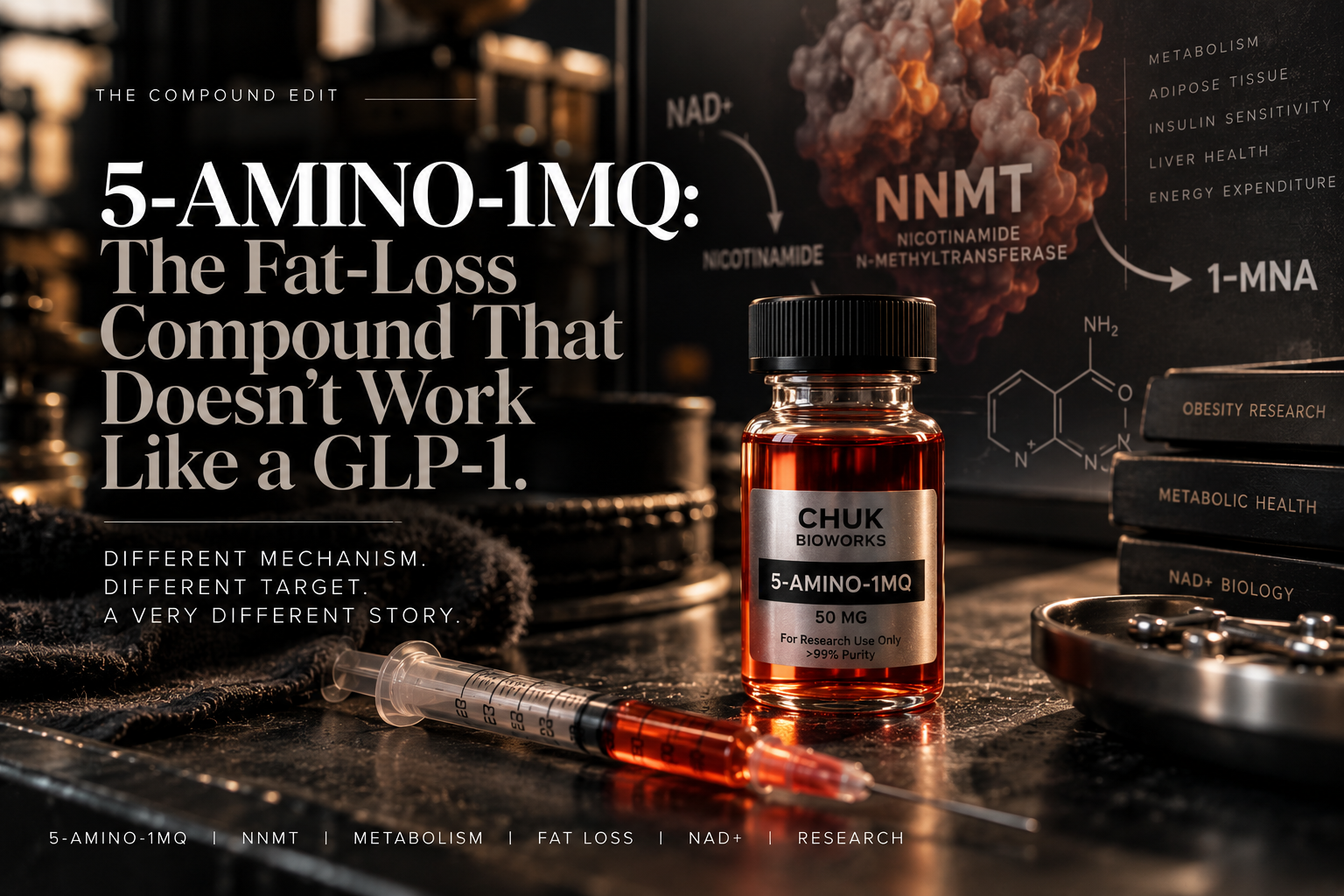
5-Amino-1MQ: The Fat-Loss Compound That Doesn’t Work Like a GLP-1
It doesn’t suppress appetite like semaglutide or retatrutide. So why has 5-Amino-1MQ become so popular in body-composition circles?
If you’ve spent enough time around peptides, metabolic health or bodybuilding communities, you’ve probably seen a strange name appearing more often:
5-Amino-1MQ.
It’s often discussed alongside peptides.
It’s frequently included in “fat-loss stacks.”
And people online describe using it when they’re trying to get leaner, improve body composition or push through the last stubborn stage of fat loss.
Except there’s something worth clearing up immediately.
5-Amino-1MQ isn’t actually a peptide.
And it doesn’t work through GLP-1, GIP or glucagon receptors.
It isn’t designed primarily to make you less hungry.
Instead, almost the entire scientific argument surrounding 5-Amino-1MQ starts with an enzyme most people have never heard of:
NNMT.
And that’s where this compound becomes genuinely interesting.
First: What Is 5-Amino-1MQ?
5-Amino-1MQ is shorthand for 5-amino-1-methylquinolinium, a small-molecule compound developed as an inhibitor of an enzyme called:
nicotinamide N-methyltransferase, or NNMT.
That means calling 5-Amino-1MQ a “peptide” isn’t technically correct.
Peptides are chains of amino acids.
5-Amino-1MQ is a small molecule.
It gets grouped into the peptide world largely because it’s sold and discussed by many of the same communities interested in experimental metabolic compounds.
Scientifically, though, it belongs in a different category.
And understanding its target is much more important than what category an online store puts it under.
Meet NNMT
NNMT is an enzyme involved in nicotinamide metabolism.
Nicotinamide—also called niacinamide—is a form of vitamin B3 and participates in pathways related to NAD+ metabolism.
NNMT transfers a methyl group from a molecule called S-adenosylmethionine, or SAM, to nicotinamide.
That reaction produces:
1-methylnicotinamide (1-MNA).
Why does that matter?
Because researchers have found connections between NNMT activity and metabolic regulation.
In experimental models, NNMT expression has been associated with adipose tissue, liver metabolism, insulin resistance and obesity.
One influential mouse study found that reducing NNMT expression in fat and liver protected mice against diet-induced obesity and affected cellular energy expenditure. Nature
That raised a pretty obvious question:
What if researchers could inhibit NNMT with a drug?
Enter 5-Amino-1MQ.
Where the Fat-Loss Story Started
This is the study that gets referenced constantly in discussions about 5-Amino-1MQ.
Researchers developed several small-molecule NNMT inhibitors and tested them in cells and mice with diet-induced obesity.
5-Amino-1MQ was one of the lead compounds.
In cultured fat cells, NNMT inhibition reduced the NNMT product 1-MNA and affected metabolic pathways involving NAD+ and SAM. Researchers also observed reduced lipid accumulation in developing adipocytes. PubMed
Then they moved into mice.
And that’s when people really started paying attention.
The Mice Lost Weight Without Eating Less
In the original obesity experiment, mice with diet-induced obesity received 5-Amino-1MQ for 11 days.
Researchers reported reductions in:
body weight
white adipose tissue mass
adipocyte size
and total plasma cholesterol.
Here’s the part that helped create 5-Amino-1MQ’s reputation:
The researchers didn’t observe a reduction in total food intake.
The mice weren’t simply eating less.
That suggested NNMT inhibition was affecting metabolism through mechanisms different from appetite suppression. PubMed
And that’s a very different story from GLP-1-based weight-loss drugs.
5-Amino-1MQ vs. GLP-1s
This distinction gets blurred online.
Semaglutide acts primarily through the GLP-1 receptor.
Tirzepatide targets GIP and GLP-1 receptors.
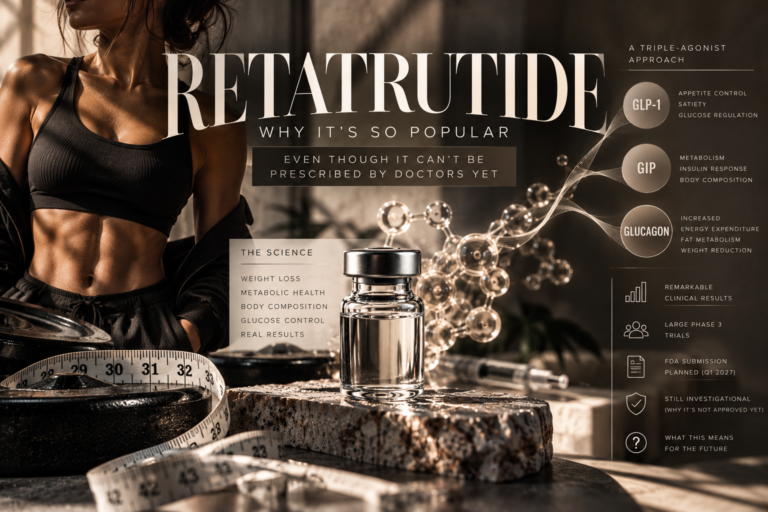
Retatrutide targets GIP, GLP-1 and glucagon receptors.
Those drugs influence several physiological systems, including appetite, satiety and glucose regulation.
5-Amino-1MQ isn’t another version of that idea.
Its experimental target is NNMT.
So when someone says:
“5-Amino is basically another weight-loss peptide.”
That’s misleading in two ways.
It isn’t a peptide.
And its proposed mechanism isn’t the same as the incretin drugs.
What Does NAD+ Have to Do With It?
This is where things get particularly interesting—and particularly easy to exaggerate.
Nicotinamide can be used in pathways that ultimately contribute to NAD+ synthesis.
NNMT moves some nicotinamide into a different metabolic pathway by converting it into 1-MNA.
Researchers therefore became interested in whether inhibiting NNMT could alter the availability of metabolites involved in NAD+ biology.
In the original cellular experiments, treatment with 5-Amino-1MQ was associated with increased intracellular NAD+ and SAM in adipocytes. PubMed
Earlier research involving NNMT knockdown also found changes involving NAD+, SAM, polyamine metabolism and cellular energy expenditure in mouse adipose tissue. Nature
This is where internet explanations often make a giant leap.
You’ll sometimes see:
“5-Amino-1MQ raises NAD+.”
That’s an oversimplification.
What researchers observed in experimental cells and animal models doesn’t establish that a particular dose of 5-Amino-1MQ reliably raises whole-body NAD+ in humans—or that doing so produces a specific clinical benefit.
The pathway is interesting.
The human conclusion isn’t established.
Then Researchers Combined It With Diet
A later study took obese mice and switched them from a Western-style diet to a lower-calorie lean diet.
Some received the diet change alone.
Others received the diet change plus an NNMT inhibitor—5-Amino-1MQ.
The combination produced greater reductions in body weight and fat mass than the diet switch alone.
By the end of the experiment, the treated mice had body-weight and fat-mass measures approaching those of lean control animals. Researchers also reported improvements involving liver fat and metabolic parameters. Nature
Again:
That’s interesting.
But there’s an extremely important word in that paragraph.
Mice.
And the Mouse Research Has Continued
A more recent study published in 2024 examined 5-Amino-1MQ in diet-induced obese mice over 28 days.
Researchers reported that treatment limited body-weight and fat-mass gain in a dose-dependent manner without altering food intake or lean mass.
They also observed improvements in glucose tolerance, insulin sensitivity, hyperinsulinemia and several measures related to fatty liver.
The researchers additionally studied how the compound moved through the animals’ bodies and found distribution into metabolically active tissues including adipose tissue, muscle and liver. PubMed
So 5-Amino-1MQ isn’t based on absolutely nothing.
There is a legitimate preclinical research story here.
But that’s also where we need to draw a very bright line.
What About Humans?
This is the section that tends to be remarkably short on websites selling 5-Amino-1MQ.
Despite the confidence with which it’s discussed online, the evidence supporting 5-Amino-1MQ as a fat-loss intervention comes overwhelmingly from preclinical research.
That’s a completely different evidence base from drugs that have gone through large randomized human obesity trials.
We don’t have the kind of established human clinical evidence that would allow us to confidently answer basic questions like:
How much fat does 5-Amino-1MQ cause humans to lose?
Which people benefit?
What dose provides the best risk-benefit balance?
What happens with prolonged exposure?
What are the uncommon adverse effects?
How does it compare with established obesity treatments?
Those aren’t minor details.
They’re the questions human clinical trials are designed to answer.
“But People Online Say It Works”
They do.
You’ll find people describing:
fat loss
better body composition
more energy
improved workouts
and a “leaner” appearance.
Those experiences can be interesting.
They aren’t useless.
But they’re also incredibly difficult to interpret.
Think about the average person experimenting with 5-Amino-1MQ for body composition.
They’re probably not sitting on the couch eating exactly the same diet they ate beforehand.
They may also be:
tracking calories,
eating more protein,
lifting weights,
doing cardio,
taking creatine,
using a GLP-1 drug,
using other experimental compounds,
or deliberately dieting.
Then six weeks later they look leaner.
Which intervention caused it?
We don’t know.
Why People Combine It With GLP-1s
This is another trend you’ll see in peptide communities.
Someone uses a GLP-1-based drug primarily to help control appetite and body weight.
Then they add something like 5-Amino-1MQ because they’ve heard it targets fat metabolism through an entirely different pathway.
Conceptually, it’s easy to understand why people find that appealing.
Different mechanisms don’t necessarily mean complementary benefits.
There is a big difference between saying:
“These compounds have different biological targets.”
and saying:
“Using them together produces better results.”
The second claim requires evidence on the combination itself.
You can’t simply take the results of two separate experiments, combine the compounds yourself and assume the benefits add together neatly.
The risks might not either.
Is It a Fat Burner?
I’d be careful with that term.
“Fat burner” is mostly a marketing category.
The experimental research suggests that NNMT inhibition can influence pathways involved in adipose metabolism and energy regulation.
In obese mouse models, 5-Amino-1MQ has produced measurable effects on body weight and adiposity. PubMed
That’s considerably more precise than saying:
“It burns fat.”
Because that phrase makes the mechanism sound much simpler—and the human evidence much stronger—than it actually is.
There’s Another Question Nobody Likes Asking
What happens if you inhibit NNMT for a long time?
NNMT exists for a reason.
It’s expressed in multiple tissues and participates in nicotinamide and methyl-group metabolism.
Changing an enzyme’s activity can have downstream consequences that aren’t obvious from a short-term weight-loss experiment.
That’s one of the reasons drug development takes so long.
Researchers don’t only ask:
Does it work?
They also have to ask:
What else does it do?
And:
What happens when thousands of humans use it for months or years?
Mouse studies lasting days or weeks cannot fully answer those questions.
5-Amino-1MQ Is a Perfect Example of the Peptide Internet
Even though it isn’t technically a peptide.
There’s an interesting mechanism.
There are legitimate published studies.
The animal results are intriguing.
Then the internet takes those findings and quietly removes one word:
mouse.
Suddenly:
“NNMT inhibition reduced adiposity in diet-induced obese mice”
becomes:
“5-Amino melts stubborn fat.”
Those aren’t equivalent statements.
And that gap between what a study actually demonstrated and what eventually appears in an Instagram graphic is exactly why The Compound Edit exists.
Does That Mean the Research Doesn’t Matter?
Absolutely not.
Preclinical research is how many important drugs begin.
Scientists identify a biological target.
They manipulate it.
They test compounds.
They study pharmacology.
They investigate safety.
And eventually, promising candidates may move toward human trials.
NNMT is an interesting metabolic target, and multiple research groups have investigated NNMT inhibition in obesity and metabolic disease models. Nature
The mistake isn’t being interested in that research.
The mistake is pretending we’re already at the end of the story.
We’re not.
The Compound Edit Takeaway
5-Amino-1MQ might be one of the better examples of why the phrase “research compound” actually matters.
It isn’t a peptide.
It isn’t a GLP-1 agonist.
And it isn’t simply an appetite suppressant.
It’s a small-molecule inhibitor targeting NNMT, an enzyme involved in nicotinamide and methyl metabolism.
Researchers have produced genuinely interesting results in cells and animal models involving:
adiposity
body weight
glucose metabolism
insulin sensitivity
liver fat
and pathways involving NAD+ and SAM. PubMed
But there’s still a massive difference between:
“This mechanism works in experimental models.”
and
“This is a proven fat-loss treatment for humans.”
Right now, the internet often talks about 5-Amino-1MQ as though we’ve already crossed that bridge.
The research says something more interesting:
NNMT may be a metabolic target worth watching.
Whether 5-Amino-1MQ ultimately becomes a useful human therapy is a question human clinical research—not before-and-after photos—has to answer.
Continue Exploring
The Compound Edit follows the evolving science around peptides, metabolic health, recovery, performance and longevity—while separating what research actually shows from what’s gaining traction online.
The Compound Edit is affiliated with Chuk BioWorks. You can read more about that connection and how we approach editorial independence here.
EXPLORE CHUK BIOWORKS → www.chukbioworks.com
The Compound Edit is for educational and informational purposes only and does not provide medical advice. 5-Amino-1MQ is an experimental small molecule and is not an FDA-approved treatment for obesity or fat loss. Discussion of investigational compounds, mechanisms or research should not be interpreted as a recommendation for human use.