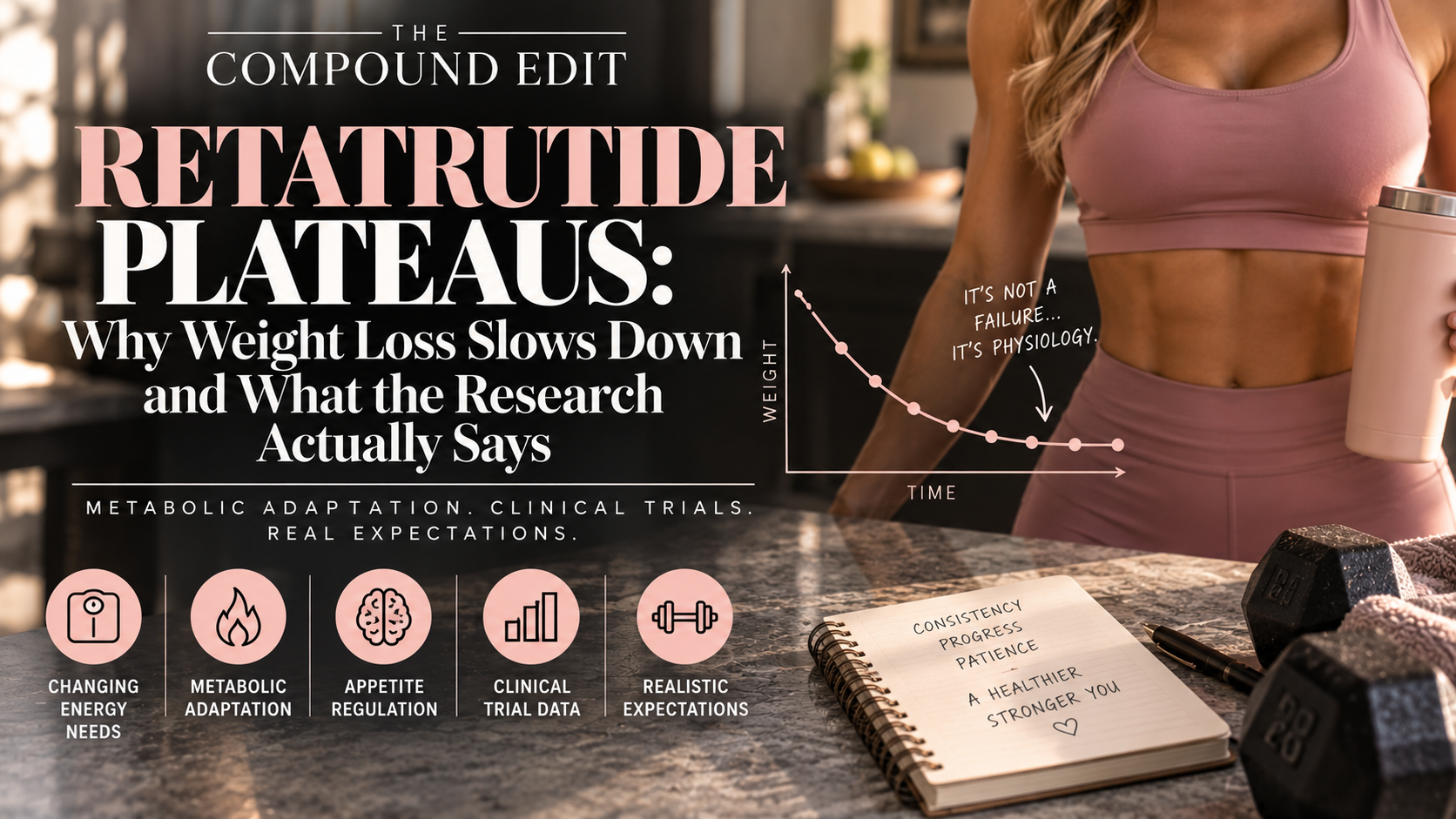
Retatrutide Plateaus: Why Weight Loss Slows Down and What the Research Actually Says
The Compound Edit | Peptides & Metabolic Research
At first, the weight seems to fall off.
Your appetite changes. Your portions get smaller. The scale starts moving in a direction you may have spent years trying to achieve.
Then something happens.
The numbers slow down.
Maybe you’re losing half a pound instead of two pounds.
Maybe the scale hasn’t changed in three weeks.
Or maybe you’ve reached a weight you never thought you’d see, but you still want to lose a little more.
And suddenly, the question becomes:
Has retatrutide stopped working?
It’s one of the most common concerns surrounding weight-loss medications.
But here’s what I think is important to understand:
A slower rate of weight loss does not automatically mean a medication has stopped having a biological effect.
Your body changes as you lose weight.
Your energy needs change.
Your appetite signals change.
And eventually, the relationship between how much energy you’re consuming and how much you’re using begins to shift.
This isn’t necessarily a medication failure.
It’s part of the physiology of weight regulation.
We’ve already talked about why retatrutide can feel like it stopped working. Today, we’re going deeper into the science.
What is metabolic adaptation?
Why do weight-loss curves flatten?
And what can clinical trials actually tell us about retatrutide and plateaus?
Let’s get into it.
First, What Exactly Is a Weight-Loss Plateau?
A weight-loss plateau is a period when body weight stops declining, or declines so slowly that the overall trend becomes relatively stable.
But there isn’t one universal definition.
In clinical research, investigators may define a plateau using changes measured over several weeks or months.
For example, one analysis of tirzepatide trials defined a plateau as less than 5% weight change over a 12-week interval and all subsequent 12-week intervals.
That’s very different from stepping on the scale on Monday and noticing that you weigh the same as you did last Friday.
A few days without weight loss is not evidence of a true physiological plateau.
Even several weeks of stable scale readings can reflect multiple factors.
Before we can understand a plateau, we have to understand what happens to energy balance during weight loss.
Your Body Burns Less Energy as You Become Smaller
This is one of the simplest—and most overlooked—parts of the equation.
A larger body generally requires more energy to maintain than a smaller body, assuming other relevant factors are similar.
When you lose weight, you have less total mass to support and move.
As a result, your energy expenditure often decreases.
Let’s use a hypothetical example.
Imagine someone starts their weight-loss journey at 220 pounds.
At that weight, their daily energy expenditure might be relatively high.
After losing 50 pounds, they’re now maintaining a body that weighs 170 pounds.
Their energy requirements are unlikely to be identical to what they were at 220.
So an eating pattern that initially produced a substantial calorie deficit may eventually produce a much smaller one.
And when that deficit becomes smaller, weight loss slows.
This is a normal consequence of changing body size.
But there’s another layer.
Metabolic Adaptation: What Does It Actually Mean?
You’ve probably heard someone say:
My metabolism adapted.
Or:
My body went into starvation mode.
These phrases often get used interchangeably, but they don’t mean the same thing.
Metabolic adaptation refers to changes in energy expenditure that occur during weight loss, sometimes including reductions beyond what would be predicted from changes in body size and composition alone.
Researchers often call this adaptive thermogenesis.
It is a measurable physiological phenomenon, although its magnitude varies between individuals and studies.
Importantly, not every decrease in calorie expenditure represents adaptive thermogenesis.
Some of the decline is simply because the person weighs less.
Does Metabolic Adaptation Mean Your Metabolism Is Broken?
No.
Your body is responding to changes in energy availability, body composition, and physiological signals.
That doesn’t mean weight loss has become biologically impossible.
It means the conditions that produced weight loss earlier may no longer produce the same result.
And it also doesn’t mean that every plateau can be explained entirely by metabolism.
Changes in appetite, food intake, activity, sleep, medications, and other factors can contribute.
The Other Side of the Equation: Appetite
Energy expenditure is only part of the story.
The body also regulates energy intake through a complex network of signals involving the brain, gastrointestinal tract, pancreas, and other tissues.
As people lose weight, biological signals can encourage increased hunger and food-seeking behavior.
This is one reason maintaining weight loss can be difficult.
And it’s one of the reasons researchers are so interested in medications that influence appetite-regulating pathways.
Retatrutide activates three receptors:
- GLP-1.
- GIP.
- Glucagon.
These pathways are involved in different aspects of glucose regulation, appetite, and metabolism.
But activating those receptors doesn’t eliminate the body’s energy-balance physiology.
Even with substantial medication-associated appetite reduction, weight loss cannot continue at the same rate indefinitely.
Eventually, the body approaches a new balance between energy intake and expenditure.
The Science Behind Why Weight-Loss Curves Flatten
In 2024, researcher Kevin Hall published an analysis examining the physiology of weight-loss plateaus.
The study used a mathematical model to investigate weight trajectories associated with calorie restriction, semaglutide, tirzepatide, and bariatric surgery.
The model considered two important factors:
- How strongly an intervention changes energy intake.
- How the body’s appetite-regulating feedback responds as weight is lost.
The findings suggested that GLP-1-based medications may weaken some of the appetite feedback that normally opposes weight loss.
That could help explain why medication-associated weight loss may continue longer than weight loss from dietary restriction alone.
But the study also reinforced something important.
A plateau is an expected feature of long-term weight regulation, not necessarily evidence that an intervention has failed.
One limitation worth emphasizing: this was a mathematical modeling study, not a clinical trial of retatrutide.
It helps explain the underlying physiology, but it cannot predict precisely when someone using retatrutide will plateau.
What Do Retatrutide’s Clinical Trials Show?
Now let’s look at the medication itself.
Retatrutide is an investigational triple-receptor agonist developed by Eli Lilly.
Its Phase 3 TRIUMPH-1 study evaluated adults with obesity without diabetes over 80 weeks.
The results were published in The New England Journal of Medicine in September 2026.
In the highest-dose group, the average weight reduction at 80 weeks was:
25.0% using the trial’s primary treatment-regimen analysis.
A separate efficacy-oriented analysis reported 28.3%.
Those numbers describe different statistical analyses and shouldn’t be treated as interchangeable.
Both results demonstrate substantial average weight reduction during the study.
But what do they tell us about plateaus?
Did Everyone Keep Losing Weight for 80 Weeks?
No clinical trial average can tell us that every participant followed the same trajectory.
Some participants lose weight more rapidly than others.
Some experience periods of relatively stable weight.
Others may regain some weight.
And a group-average curve can continue declining even while individual participants experience plateaus.
That’s an important distinction.
The TRIUMPH-1 results demonstrate that substantial average weight loss occurred over an extended treatment period.
They do not establish a universal plateau timeline for every person.
What About the 104-Week Extension?
Eli Lilly also reported results from an extension involving a subset of TRIUMPH-1 participants.
In that extension, some groups achieved average weight reductions of approximately 30% at 104 weeks using the reported efficacy analysis.
These findings suggest that substantial additional weight loss was observed in selected participants during longer follow-up.
However, the extension population was a subset of the original trial.
And those results shouldn’t be interpreted as a guarantee that everyone will continue losing weight for two years.
The key takeaway is that weight-loss trajectories can extend over long periods, but individual responses vary.
Does a Plateau Mean You’ve Developed Tolerance?
This is where conversations online can become confusing.
People sometimes describe a plateau as tolerance.
In pharmacology, tolerance generally means a diminished response to a drug after repeated exposure.
But a stable body weight doesn’t prove that drug tolerance has developed.
A medication may continue influencing appetite and glucose-related pathways even after weight stabilizes.
The person may simply have reached a new energy balance.
Weight-loss plateau and pharmacological tolerance are not interchangeable terms.
Researchers would need specific evidence to establish that a loss of receptor responsiveness—or another drug-specific mechanism—is responsible for a plateau.
At present, there isn’t enough evidence to conclude that retatrutide plateaus are generally caused by receptor desensitization.
Why Your Scale Might Stay the Same Even When Your Body Is Changing
Let’s talk about something that matters beyond clinical trial averages.
The scale measures total body weight.
It doesn’t tell you how much of that weight is fat, muscle, water, glycogen, or digestive contents.
And all of those can change.
Water Retention
Changes in sodium intake, exercise, sleep, menstrual cycles, and other factors can influence fluid balance.
You can experience temporary increases in water weight even while your longer-term body-fat trend is moving downward.
Glycogen Changes
Glycogen is the stored form of carbohydrate in muscles and the liver.
When glycogen stores change, associated water storage can change too.
That can affect scale readings without reflecting an equivalent change in body fat.
Resistance Training
If you’re lifting weights while losing weight, your body composition may change in ways the scale doesn’t fully capture.
You may be preserving or gaining some muscle while losing fat.
That doesn’t mean the scale is useless.
It means body weight is only one piece of information.
And when the goal is improving body composition rather than simply getting lighter, other measurements become increasingly valuable.
Why the Last 10 Pounds Can Feel Different From the First 50
This is a conversation I think a lot of people will recognize.
When someone begins at a higher body weight, they may experience substantial early changes.
But after losing a significant amount, the remaining weight can be more difficult to lose.
Part of that may be because their energy needs have decreased.
Part may involve changes in appetite and behavior.
And part may be that they’re approaching a weight their body can maintain under their current circumstances.
But here’s a question worth asking:
Is additional weight loss still the right goal?
Someone who has already achieved a substantial reduction in body weight may benefit more from focusing on strength, muscle preservation, physical function, and long-term maintenance.
The lowest possible scale number isn’t automatically the healthiest or most sustainable outcome.
What Can You Actually Evaluate During a Plateau?
Rather than immediately assuming the medication isn’t working, it’s useful to look at the broader pattern.
1. Look at Trends, Not Individual Weigh-Ins
Daily body weight can fluctuate.
A consistent measurement routine and several weeks of observations can provide more useful information than comparing two isolated readings.
2. Consider Changes in Activity
As body weight decreases, the energy required for many activities decreases too.
People may also move less without consciously noticing, particularly when they’re fatigued or eating too little.
Activity patterns can influence energy balance.
3. Consider Nutritional Adequacy
A reduced appetite can make it difficult to consume adequate protein, fiber, and essential nutrients.
Simply trying to eat less and less is not a reliable solution to a plateau.
Nutritional adequacy matters, especially during substantial weight loss.
4. Pay Attention to Strength and Recovery
If someone is losing weight while resistance training, maintaining muscle and physical function deserves attention.
Declining strength, persistent fatigue, or poor recovery may indicate that the overall approach needs reassessment.
5. Reconsider the Goal
Sometimes the most useful question isn’t how to force the scale lower.
It’s whether the current weight, body composition, and health markers are moving in the right direction.
A stable weight can be a meaningful outcome after major weight loss.
Why Increasing a Dose Isn’t Automatically the Answer
One of the biggest misconceptions surrounding weight-loss plateaus is that every slowdown means someone needs more medication.
But a plateau alone doesn’t establish that a dose is inadequate.
And it doesn’t establish that a higher dose will produce an acceptable balance of benefit and risk.
Higher exposure can increase adverse effects.
Retatrutide remains investigational and does not have an FDA-approved dosing regimen.
The doses studied in clinical trials were administered under research protocols with eligibility screening and safety monitoring.
Clinical trial doses aren’t instructions for self-directed use.
And there’s no evidence-based rule that says a person should increase retatrutide whenever their weight stops changing.
The Difference Between Losing Weight and Maintaining Weight
Here’s something I think deserves much more recognition.
Maintenance isn’t failure.
After substantial weight loss, remaining at a lower weight can represent an important long-term achievement.
In fact, maintaining weight loss is a major challenge in obesity treatment.
Research involving approved weight-loss medications has shown that weight regain commonly occurs after treatment discontinuation.
That tells us weight regulation involves persistent biological processes.
It also reinforces why long-term treatment strategies and sustainable habits matter.
A person whose weight is stable may still be experiencing ongoing benefits from a treatment.
The absence of continued weight loss does not necessarily mean the absence of treatment effect.
What We Still Don’t Know About Retatrutide Plateaus
Despite the impressive Phase 3 results, several questions remain.
We still need more evidence about:
- How plateau timing varies between individuals.
- Whether specific baseline characteristics predict plateau patterns.
- How retatrutide affects long-term energy expenditure.
- The relationship between weight loss, lean mass, and physical function.
- What happens after treatment discontinuation.
- Long-term maintenance outcomes and safety.
And because retatrutide is investigational, the full picture is still developing.
That means claims about resetting receptors, overcoming tolerance, or guaranteeing renewed weight loss should be viewed critically.
Especially when those claims aren’t supported by controlled human research.
The Compound Edit Takeaway
Weight-loss plateaus are not necessarily signs that something has gone wrong.
As body weight decreases, energy requirements change.
Appetite-regulating systems respond.
And eventually, the energy deficit that once produced rapid weight loss may become much smaller.
Retatrutide’s Phase 3 studies demonstrate substantial average weight reductions over extended treatment periods.
But they don’t establish that every person will lose weight continuously—or that a plateau means the medication has stopped working.
A plateau is a change in the weight-loss trajectory, not automatically a failure of the treatment.
And after significant weight loss, the goal may need to evolve.
Less focus on chasing another number.
More focus on preserving muscle, maintaining health, and building a body that feels strong and sustainable.
Because sometimes the next stage of progress isn’t losing more.
It’s learning how to maintain what you’ve achieved.
Keep Exploring on The Compound Edit
If you want to explore this topic further, these previously published articles are a great place to start:
- Why Does Retatrutide Feel Like It Stopped Working?
- The Plateau Isn’t Always the Problem
- From 175 to 115: What My Retatrutide Journey Actually Looked Like
- Why Protein Matters More Than Ever After Weight Loss
Continue Exploring
The Compound Edit is dedicated to exploring the science, research, and real conversations surrounding peptides, hormones, metabolism, performance, and longevity.
The Compound Edit is affiliated with Chuk BioWorks. While the two share an ownership connection, our editorial goal is to explore scientific research with transparency, including limitations, uncertainties, and potential risks.
Research & Sources
- Hall KD. Physiology of the Weight Loss Plateau in Response to Diet Restriction, GLP-1 Receptor Agonism, and Bariatric Surgery. Obesity. 2024. https://doi.org/10.1002/oby.24027
- Time to Weight Plateau With Tirzepatide Treatment in the SURMOUNT-1 and SURMOUNT-4 Clinical Trials. Diabetes, Obesity and Metabolism. 2025. https://pmc.ncbi.nlm.nih.gov/articles/PMC12096058/
- Jastreboff AM, et al. Retatrutide, a Triple Hormone Receptor Agonist, for Treatment of Obesity. New England Journal of Medicine. 2026. https://doi.org/10.1056/NEJMoa2604169
- Eli Lilly and Company. Retatrutide Phase 3 TRIUMPH-1 Results and Extended Follow-Up. May 2026. https://investor.lilly.com/news-releases/news-release-details/lillys-triple-agonist-retatrutide-delivered-powerful-weight-loss
- Hall KD, et al. Mind the Plateau: A Mathematical Modeling Analysis of Long-Term GLP-1 Receptor Agonist Treatment. 2026. https://pubmed.ncbi.nlm.nih.gov/42055215/
Medical Disclaimer
The content published on The Compound Edit is intended for educational and informational purposes only and does not constitute medical advice, diagnosis, or treatment.
Retatrutide remains investigational and is not FDA-approved as of this article’s publication. Clinical trial findings are not instructions for personal use, dose adjustment, or treatment decisions.
Stay curious. Keep learning. Continue exploring.