Cagrilintide vs. Retatrutide: Two Very Different Approaches to Weight Loss
The Compound Edit | Peptides, Metabolism & Weight-Loss Research
If you’ve spent any time following the latest developments in weight-loss medications, you’ve probably noticed something.
The conversation is getting a lot more complicated than Ozempic versus Mounjaro.
Now we’re hearing about retatrutide, cagrilintide, CagriSema, amycretin, and an entirely new generation of treatments being investigated for obesity.
And naturally, everyone wants to know the same thing:
Which one works better?
But before we start comparing percentages on a chart, there’s something much more interesting to understand.
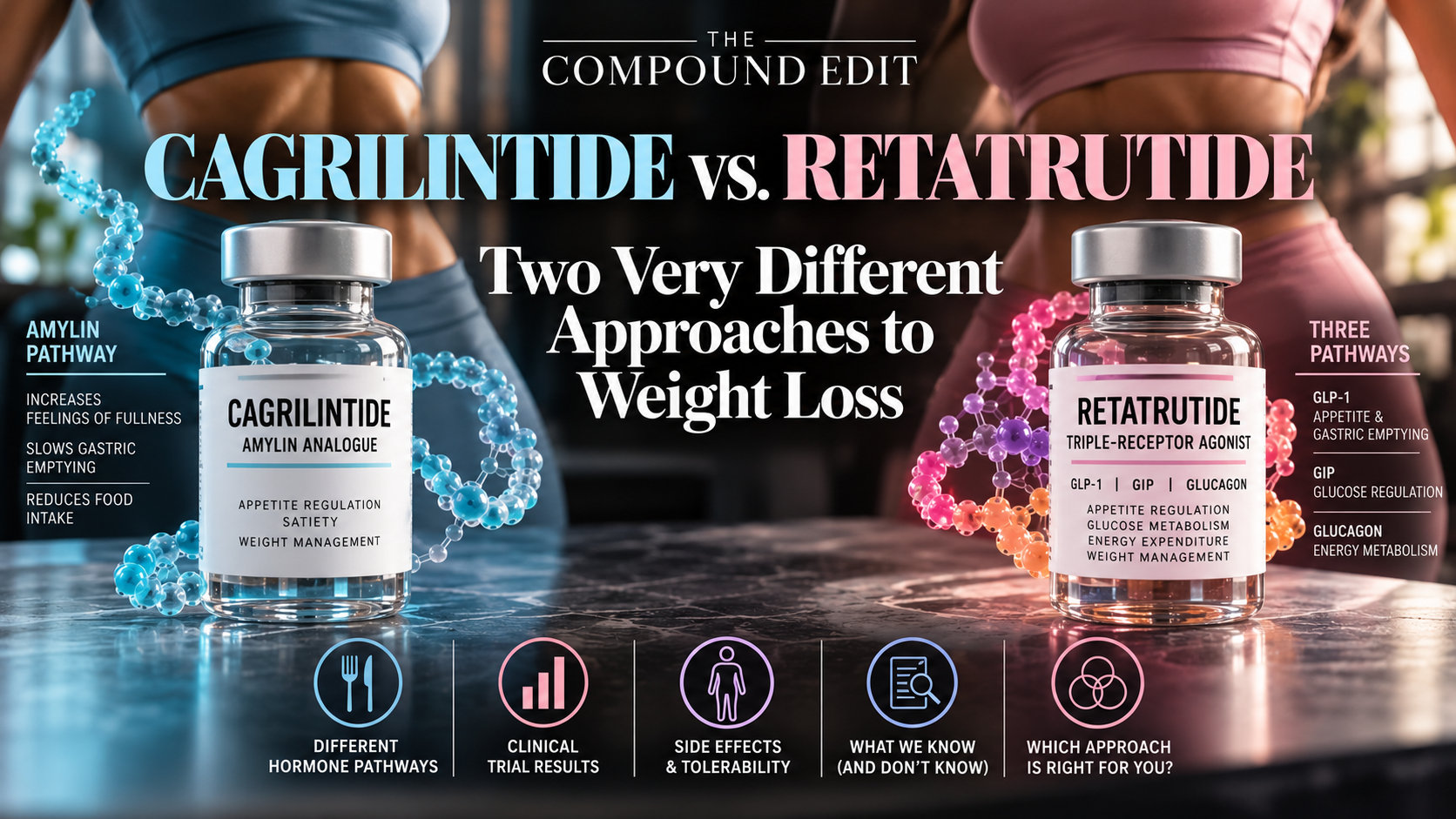
Cagrilintide and retatrutide approach weight regulation through fundamentally different biological pathways.
One focuses on a hormone called amylin.
The other activates three receptors associated with metabolic regulation.
And understanding that difference helps explain why researchers are pursuing both approaches.
Let’s break down what these compounds actually do, what the clinical trials show, and what we still don’t know.
First, What Is Cagrilintide?
Cagrilintide is an investigational, long-acting amylin analogue developed by Novo Nordisk.
To understand why researchers are interested in it, we need to talk about amylin.
Meet Amylin: The Hormone You Probably Haven’t Heard Much About
Amylin is a hormone naturally released by pancreatic beta cells alongside insulin when we eat.
It contributes to the regulation of food intake and glucose levels.
Among its physiological effects, amylin helps signal fullness and can slow gastric emptying.
It also influences glucagon secretion after meals.
In other words, amylin participates in the communication between your digestive system, pancreas, and brain that helps regulate how much you eat.
Cagrilintide was designed to activate amylin-related signaling for a prolonged period.
Researchers are investigating whether that can produce meaningful, sustained reductions in food intake and body weight.
Is Cagrilintide a GLP-1 Medication?
No.
Cagrilintide is an amylin analogue, not a GLP-1 receptor agonist.
That’s an important distinction.
Both pathways can influence appetite and body weight, but they aren’t identical.
And that difference is one reason researchers are interested in combining amylin-based treatments with GLP-1 medications.
More on that shortly.
What Is Retatrutide?
Retatrutide is an investigational medication developed by Eli Lilly.
Unlike cagrilintide, retatrutide activates three different hormone receptors:
- GLP-1 receptors
- GIP receptors
- Glucagon receptors
This makes it a triple-receptor agonist.
Each pathway has distinct physiological functions.
GLP-1 signaling influences appetite, glucose-dependent insulin secretion, and gastric emptying.
GIP signaling participates in glucose regulation and metabolic responses to nutrients.
Glucagon signaling influences hepatic glucose production and energy metabolism.
Researchers are investigating whether combining these activities in one molecule can produce substantial metabolic and weight-related effects.
Why Is the Glucagon Component Interesting?
This is one of the biggest differences between retatrutide and existing GLP-1-based treatments.
Glucagon is commonly associated with raising blood glucose.
But glucagon receptor signaling also has effects on energy metabolism.
Retatrutide’s design attempts to combine those actions with GLP-1 and GIP activity.
That doesn’t mean we can attribute a specific percentage of its weight-loss effect to glucagon alone.
The contribution of each pathway in humans remains an active research question.
But it does help explain why retatrutide represents a different strategy from an amylin analogue.
Cagrilintide vs. Retatrutide: The Key Differences
| Feature | Cagrilintide | Retatrutide |
|---|---|---|
| Developer | Novo Nordisk | Eli Lilly |
| Drug class | Long-acting amylin analogue | Triple-receptor agonist |
| Main receptor pathways | Amylin-related signaling | GLP-1, GIP, glucagon |
| Primary research focus | Appetite, satiety, weight regulation | Weight regulation and broader metabolic effects |
| Studied alone? | Yes | Yes |
| Studied in a combination? | Yes, with semaglutide as CagriSema | Primarily studied as one triple-acting molecule |
| FDA approval status | Investigational | Investigational |
Both approaches are promising.
But they are not interchangeable.
And the available clinical evidence needs to be interpreted carefully.
What Do Clinical Trials Show for Cagrilintide?
Cagrilintide has been studied on its own and in combination with semaglutide.
That distinction matters enormously.
Because when you see a headline reporting more than 20% weight loss with CagriSema, that is not a result for cagrilintide alone.
It’s a result for two active compounds used together.
Cagrilintide on Its Own
Earlier clinical trials demonstrated that cagrilintide monotherapy could produce meaningful weight loss.
For example, a Phase 2 trial published in The Lancet in 2021 evaluated different cagrilintide doses over 26 weeks in adults with overweight or obesity.
The highest-dose cagrilintide group achieved approximately 10.8% mean weight loss, compared with approximately 3.0% for placebo.
These findings helped establish the potential of long-acting amylin analogues as weight-management treatments.
However, this was a shorter, earlier-phase study.
It should not be directly compared with an 80-week Phase 3 retatrutide result.
Different trials can involve different populations, durations, methods, and statistical analyses.
What About CagriSema?
This is where things get particularly interesting.
CagriSema combines:
Cagrilintide + Semaglutide
The goal is to target amylin and GLP-1 pathways together.
Rather than developing one molecule that activates multiple receptors, this strategy combines two separate compounds with complementary mechanisms.
In the Phase 3 REDEFINE 1 trial, published in The New England Journal of Medicine in 2025, CagriSema produced an estimated average weight reduction of 20.4% at 68 weeks, compared with 3.0% for placebo, using the treatment-regimen analysis.
A separate analysis estimating outcomes if participants adhered to treatment reported 22.7% weight loss.
Those are substantial results.
But again, they’re results for CagriSema—not cagrilintide monotherapy.
What Do Retatrutide’s Clinical Trials Show?
Retatrutide has also produced substantial weight-loss results.
Its Phase 2 obesity trial, published in 2023, reported average weight reductions of up to 24.2% at 48 weeks in the highest-dose group studied.
Later Phase 3 findings provided additional evidence.
In the TRIUMPH-1 trial, the highest-dose retatrutide group achieved an average weight reduction of 25.0% at 80 weeks using the primary treatment-regimen analysis.
A separate efficacy analysis reported 28.3%.
These are different statistical approaches, and the results should not be mixed without explanation.
The findings demonstrate considerable weight-loss potential.
But here’s what they do not tell us:
They do not establish that retatrutide is superior to cagrilintide in a direct comparison.
And they do not tell us how an individual person would respond to either treatment.
Can We Compare the Weight-Loss Percentages?
We can describe the findings.
But we need to be careful about what conclusions we draw.
Here’s a simplified overview:
| Treatment | Selected trial | Average weight-loss result |
|---|---|---|
| Cagrilintide alone | Phase 2, 26 weeks | Up to approximately 10.8% |
| CagriSema | REDEFINE 1, 68 weeks | 20.4% |
| Retatrutide | TRIUMPH-1, 80 weeks | 25.0% |
The figures above come from separate studies with different designs, populations, treatment durations, and analysis methods. They are not a head-to-head comparison. The cagrilintide figure is from an earlier-phase study.
Looking at this table, it may be tempting to declare a winner.
But that would be an oversimplification.
A longer trial allows more time for weight loss to occur.
A different study population can produce a different average response.
And combining cagrilintide with semaglutide changes the treatment being evaluated.
The highest percentage on a chart doesn’t automatically identify the best treatment.
Safety, tolerability, durability, health outcomes, and individual response matter too.
What Have We Learned From Newer CagriSema Research?
By 2026, CagriSema’s clinical development program had expanded considerably.
The REIMAGINE trials evaluated the combination in adults with type 2 diabetes.
In June 2026, Novo Nordisk reported Phase 3 findings demonstrating reductions in both A1C and body weight.
And in September 2026, the company announced results from additional studies.
In REIMAGINE 5, a lower-dose CagriSema combination achieved an estimated average weight reduction of 12.4% at 60 weeks, compared with 9.1% for tirzepatide 5 mg.
Importantly, those findings compared specific doses in adults with type 2 diabetes.
They don’t establish that every CagriSema dose is superior to every tirzepatide dose.
In another study, REDEFINE 9, CagriSema 1.0 mg/1.0 mg produced an estimated 21.0% weight reduction at 68 weeks, compared with 2.0% for placebo.
These company-reported topline findings are encouraging, but detailed peer-reviewed results are important for fully evaluating them.
And none of these studies directly compared CagriSema with retatrutide.
Does One Medication Suppress Appetite More Than the Other?
This is a question that comes up frequently.
People want to know which compound makes you feel fuller, reduces food cravings more, or makes it easier to eat less.
But comparing subjective appetite effects across separate trials is difficult.
Both amylin-based and GLP-1-based pathways influence food intake.
Cagrilintide specifically targets amylin-related signaling.
Retatrutide combines GLP-1, GIP, and glucagon receptor activation.
Their biological actions differ, but we don’t have adequate head-to-head evidence to declare that one consistently produces stronger appetite suppression for every person.
And greater appetite suppression isn’t always better.
If a treatment makes it difficult to consume adequate protein, fluids, fiber, or essential nutrients, that can create additional problems.
The goal of obesity treatment isn’t simply to make someone eat as little as possible.
It’s to improve health while maintaining nutritional adequacy and physical function.
What About Side Effects?
Both treatment approaches can produce gastrointestinal adverse effects.
In trials involving cagrilintide, CagriSema, and retatrutide, reported symptoms have included nausea, vomiting, diarrhea, and constipation.
The frequency and severity vary by study, treatment, and dose.
Cagrilintide and CagriSema
In REDEFINE 1, gastrointestinal adverse events occurred in approximately 79.6% of participants receiving CagriSema, compared with 39.9% receiving placebo.
Most reported events were mild to moderate and often temporary.
But some participants discontinued treatment because of adverse events.
Retatrutide
Retatrutide trials have also reported gastrointestinal adverse events, particularly during dose escalation.
Changes in heart rate have been observed as well.
Long-term safety assessment remains important.
Can We Say Which One Has Fewer Side Effects?
Not reliably from separate trial percentages.
Adverse-event reporting can vary with trial design, participant characteristics, doses, and treatment duration.
And tolerability isn’t the same for everyone.
A treatment that is effective on average may still be poorly tolerated by an individual participant.
Why Researchers Are Interested in Amylin
One of the most exciting aspects of cagrilintide research isn’t necessarily the idea of replacing GLP-1 medications.
It’s the possibility of complementary treatment pathways.
For years, much of the public conversation around obesity medication has centered on GLP-1.
Then came dual agonists.
Then triple agonists.
Now amylin-based therapies are becoming a major part of the discussion.
And there’s a reason for that.
Weight regulation is not controlled by one hormone.
It’s influenced by overlapping signals involving appetite, digestion, glucose regulation, energy expenditure, and the central nervous system.
Targeting different pathways may provide additional therapeutic options.
That doesn’t mean more receptor activity is always better.
It means researchers are exploring several scientifically distinct ways to address a complex condition.
What About Muscle Loss During Weight Loss?
This is something I think deserves more attention in every conversation about powerful weight-loss treatments.
When people lose a substantial amount of body weight, the change isn’t necessarily all fat.
Some lean mass may also be lost.
And lean mass is not identical to skeletal muscle—it includes water, organs, and other nonfat tissues.
That’s why it’s important to avoid assuming that every change in lean mass represents lost muscle.
Still, preserving muscle and physical function matters.
Regardless of which medication is being studied, long-term weight-management strategies should consider:
- Adequate protein intake.
- Resistance training.
- Overall nutritional adequacy.
- Physical strength and function.
- The sustainability of the resulting weight loss.
The goal shouldn’t simply be the largest possible percentage of weight reduction.
It should be meaningful, sustainable improvements in health.
Are Cagrilintide and Retatrutide FDA-Approved?
As of October 2026, cagrilintide and retatrutide remain investigational and are not FDA-approved medications.
CagriSema was submitted to the FDA for review in December 2025, but a regulatory submission is not the same as approval.
It’s also important to distinguish a pharmaceutical clinical-trial product from an online vial marketed as a research peptide.
A product sold online under a familiar compound name is not automatically equivalent in quality, purity, formulation, or safety to the investigational product used in clinical trials.
And published trial results do not establish safe self-directed dosing, stacking, or switching protocols.
So Which Approach Is More Promising?
I don’t think the most interesting question is which compound wins a competition on social media.
I think it’s what these different strategies tell us about the future of obesity treatment.
Cagrilintide shows that amylin biology is a meaningful area of research.
CagriSema investigates whether combining amylin and GLP-1 signaling can produce substantial benefits.
Retatrutide explores the potential of activating GLP-1, GIP, and glucagon receptors within a single molecule.
And other investigational medications, including amycretin—also known as zenagamtide—are exploring still more ways to combine hormone pathways.
This isn’t one medication replacing another overnight.
It’s a rapidly developing research field with multiple competing and potentially complementary approaches.
What We Still Need to Know
Despite encouraging results, important questions remain.
We need better evidence about:
- Long-term safety and tolerability.
- Weight maintenance after treatment.
- Effects on body composition and physical function.
- Cardiovascular and other clinical outcomes.
- Differences in response across patient populations.
- How treatments compare in appropriately designed head-to-head studies.
We also need to distinguish peer-reviewed clinical findings from company announcements, preliminary results, and speculation.
Because excitement is not the same thing as evidence.
And when we’re talking about medications that can produce substantial physiological changes, that distinction matters.
The Compound Edit Takeaway
Cagrilintide and retatrutide represent two different approaches to weight-loss research.
Cagrilintide targets amylin-related signaling.
Retatrutide activates GLP-1, GIP, and glucagon receptors.
Both have produced promising clinical results, but their evidence bases are different.
And the substantial weight loss reported with CagriSema reflects a combination of cagrilintide and semaglutide—not cagrilintide alone.
There isn’t enough direct comparative evidence to declare one approach universally better.
What we can say is that obesity research is moving beyond a single hormone pathway.
And that may be one of the most important developments in the field.
Because the future of weight management probably won’t be about finding one perfect medication for everyone.
It will be about understanding which approaches offer meaningful benefits, acceptable risks, and sustainable outcomes for different people.
The real breakthrough isn’t just how much weight a medication can help someone lose. It’s how much we’re learning about the biology of weight regulation itself.
Keep Exploring on The Compound Edit
Interested in learning more about the science behind weight-loss medications?
- GLP-1, GLP-2, GLP-3: What People Really Mean by Semaglutide, Tirzepatide & Retatrutide
- Retatrutide Isn’t Approved Yet, So Why Is Everyone Already Talking About It?
- Why Does Retatrutide Feel Like It Stopped Working?
- Why Protein Matters More Than Ever After Weight Loss
Continue Exploring
The Compound Edit is dedicated to exploring the science, research, and real conversations surrounding peptides, hormones, metabolism, performance, and longevity.
The Compound Edit is affiliated with Chuk BioWorks. While the two share an ownership connection, our editorial goal is to explore scientific research with transparency, including limitations, uncertainties, and potential risks.
Research & Sources
- Lau DCW, et al. Once-Weekly Cagrilintide for Weight Management in People With Overweight and Obesity: A Multicentre, Randomised, Double-Blind, Placebo-Controlled and Active-Controlled, Dose-Finding Phase 2 Trial. The Lancet. 2021. https://doi.org/10.1016/S0140-6736(21)01751-7
- Garvey WT, et al. Coadministered Cagrilintide and Semaglutide in Adults With Overweight or Obesity. New England Journal of Medicine. 2025. https://doi.org/10.1056/NEJMoa2502081
- Jastreboff AM, et al. Triple-Hormone-Receptor Agonist Retatrutide for Obesity — A Phase 2 Trial. New England Journal of Medicine. 2023. https://doi.org/10.1056/NEJMoa2301972
- Eli Lilly and Company. TRIUMPH-1 Phase 3 Retatrutide Results. June 2026. https://lilly.gcs-web.com/news-releases/news-release-details/lillys-triple-agonist-retatrutide-drove-substantial-improvements
- Novo Nordisk. CagriSema REIMAGINE 5 and REDEFINE 9 Trial Results. September 2026. https://www.novonordisk.com/news-and-media/news-and-ir-materials/news-details.html?id=916774
- Novo Nordisk. CagriSema FDA Submission and REDEFINE Trial Findings. December 2025. https://www.novonordisk-us.com/media/press-releases/novo-nordisk-cagrisema-fda-nda-submission.html
Medical Disclaimer
The content published on The Compound Edit is intended for educational and informational purposes only. It does not constitute medical advice, diagnosis, or treatment recommendations.
Cagrilintide, CagriSema, and retatrutide are investigational therapies as discussed in this article. Clinical trial findings do not establish safe personal dosing, combination regimens, or use of products obtained outside regulated clinical or pharmaceutical channels.
Stay curious. Keep learning. Continue exploring.