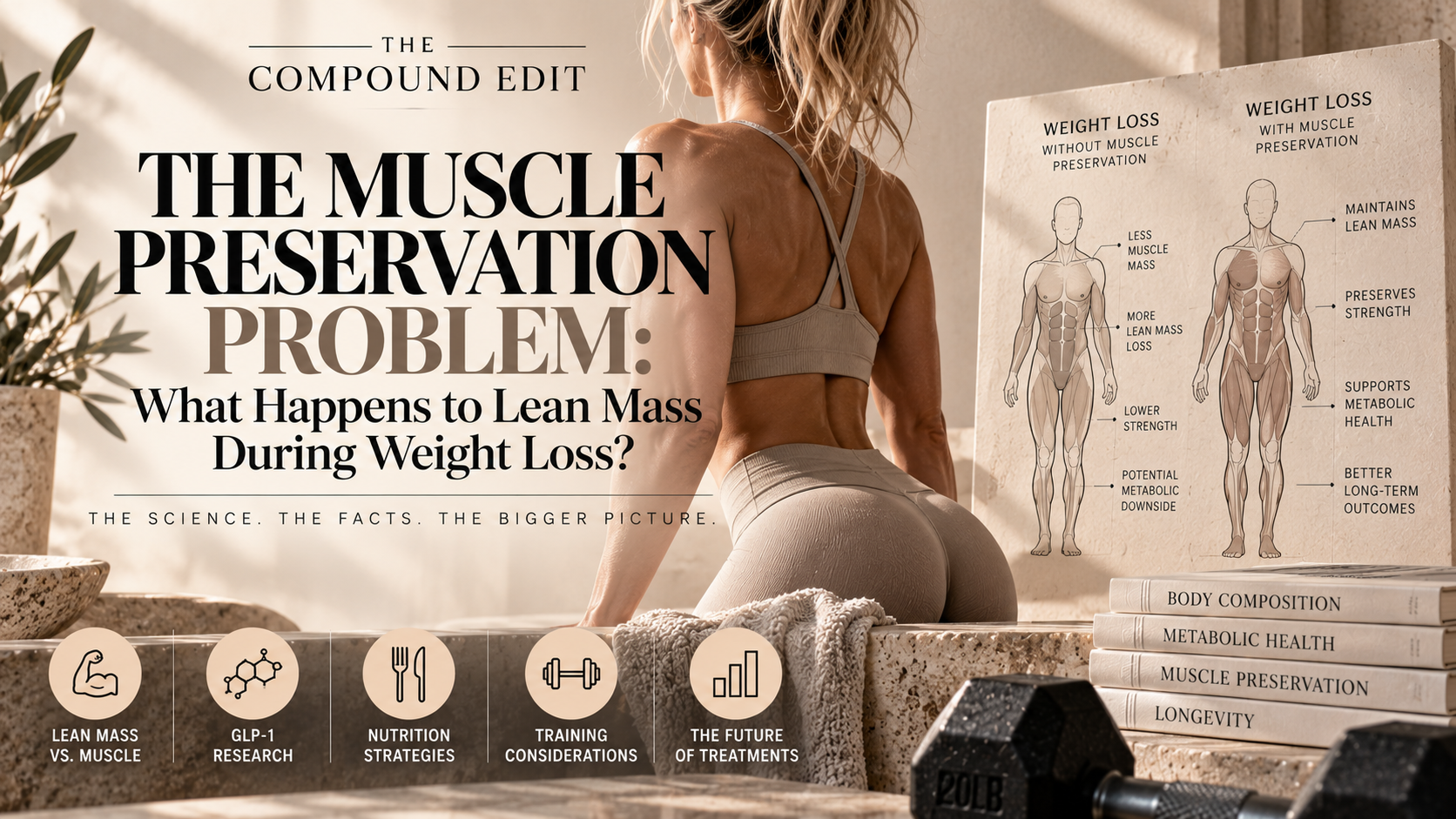
The Muscle Preservation Problem: What Happens to Lean Mass During Weight Loss?
The Compound Edit | Metabolism, Muscle & Body Composition
We’ve spent years talking about how to lose weight.
How to reduce appetite.
How to burn fat.
How to get the scale moving.
And with medications like semaglutide and tirzepatide changing obesity treatment, the conversation has become more focused than ever on how much weight someone can lose.
Twenty pounds.
Fifty pounds.
Twenty percent of their starting body weight.
But there’s a question that deserves just as much attention.
What exactly are we losing?
Because when someone loses a significant amount of weight, that change isn’t necessarily made up entirely of body fat.
Some of it may come from lean tissue.
And while losing fat can improve metabolic health, preserving muscle and physical function is an important part of maintaining those benefits.
This is particularly relevant for people who have lost substantial weight and are now shifting their goals toward strength, body composition, and long-term health.
So let’s talk about what the research actually shows.
Are GLP-1 medications causing muscle loss?
How much lean mass is typically lost during weight reduction?
And can the next generation of metabolic treatments help change that?
First, Lean Mass and Muscle Are Not the Same Thing
This is probably the most important distinction in the entire conversation.
You’ll often see headlines claiming that someone lost a certain percentage of muscle while using a weight-loss medication.
But when you look at the research, the study may actually have measured lean body mass.
And those terms aren’t interchangeable.
What Is Lean Body Mass?
Lean body mass generally refers to everything in the body that isn’t fat.
That includes:
- Skeletal muscle.
- Organs.
- Blood.
- Water.
- Other nonfat tissues.
So when a study reports a reduction in lean mass, it doesn’t necessarily mean every pound lost came from skeletal muscle.
Changes in hydration and glycogen storage can influence lean-mass measurements.
That’s especially relevant during substantial weight loss, when food intake, carbohydrate consumption, and body water may all change.
What Is Skeletal Muscle?
Skeletal muscle is the tissue responsible for voluntary movement.
It’s what helps you lift weights, climb stairs, carry groceries, and maintain physical function.
Muscle also plays an important role in glucose metabolism and overall metabolic health.
Preserving skeletal muscle is a meaningful goal. But measuring it accurately requires more than simply looking at a scale or a basic body-composition estimate.
Why Do People Lose Lean Mass When They Lose Weight?
Weight loss generally occurs when energy intake is lower than energy expenditure over time.
But the body doesn’t draw energy exclusively from fat stores.
During weight loss, changes can occur in fat mass, lean tissue, water, and glycogen.
The proportion of weight lost from different compartments varies.
Several factors can influence that balance.
Starting Body Composition
People with different amounts of body fat and lean tissue may experience different body-composition changes during weight loss.
Size of the Energy Deficit
Large or prolonged energy deficits may make preserving lean tissue more challenging.
Protein Intake
Adequate dietary protein helps support muscle protein synthesis and maintenance.
Resistance Training
Muscle responds to mechanical loading.
Without an adequate training stimulus, the body has less reason to preserve muscle tissue during weight loss.
Age and Health
Older adults and people with certain medical conditions may be especially vulnerable to declines in muscle mass or physical function.
The key point is that lean-mass loss isn’t unique to weight-loss medications.
It can occur with many forms of substantial weight reduction, including dietary interventions and bariatric surgery.
What Do Semaglutide Trials Show About Lean Mass?
One of the most frequently discussed studies comes from the STEP 1 clinical trial program.
A body-composition substudy used dual-energy X-ray absorptiometry, commonly called DXA, to evaluate changes in fat and lean mass.
At 68 weeks, participants receiving semaglutide 2.4 mg experienced substantial reductions in body weight and body-fat mass.
Total lean body mass also decreased.
In the substudy, average lean body mass declined by approximately 9.7% from baseline.
That number sounds concerning when viewed by itself.
But it needs context.
Fat mass decreased proportionally more than lean mass.
As a result, the proportion of body weight represented by lean mass actually increased.
How Can Lean Mass Decrease While Lean-Mass Percentage Increases?
Imagine someone starts with:
- 100 pounds of lean mass.
- 100 pounds of fat mass.
Their total body weight is 200 pounds.
Now imagine they lose 30 pounds of fat and 10 pounds of lean mass.
They would finish with:
- 90 pounds of lean mass.
- 70 pounds of fat mass.
Their total weight would be 160 pounds.
They lost lean mass in absolute terms.
But lean mass now represents a larger percentage of their total body weight.
That’s why researchers look at both absolute changes and relative changes.
And it’s why one body-composition statistic rarely tells the whole story.
What About Tirzepatide?
Tirzepatide activates GLP-1 and GIP receptors.
It has demonstrated substantial weight-loss effects in clinical trials.
A body-composition substudy of SURMOUNT-1 examined changes in fat and lean mass using DXA.
Researchers found that both fat mass and lean mass decreased during treatment.
Approximately 75% of the weight lost was fat mass and 25% was lean mass, based on the substudy’s analysis.
That doesn’t mean 25% of the weight loss was necessarily skeletal muscle.
Remember, DXA-derived lean mass includes more than muscle.
And those percentages describe average findings from a particular study population.
They aren’t a universal rule for every person taking tirzepatide.
Does That Mean Tirzepatide Destroys Muscle?
No.
That conclusion goes beyond what the study demonstrates.
The trial showed substantial fat reduction accompanied by some lean-mass reduction.
It did not establish that tirzepatide directly damages skeletal muscle.
Distinguishing the effects of the medication from the effects of substantial weight loss itself is an important research challenge.
Is Muscle Loss From GLP-1 Medications Worse Than Muscle Loss From Dieting?
This is one of the biggest unanswered questions in the public conversation.
It’s tempting to compare a percentage from a GLP-1 trial with a percentage from a diet study and declare that one approach is worse.
But different studies may involve different participants, measurement methods, intervention durations, and amounts of weight loss.
That makes direct comparisons difficult.
A person losing 60 pounds may experience different absolute body-composition changes from someone losing 15 pounds.
And the proportion of fat versus lean mass lost can vary considerably.
Current evidence does not support the blanket claim that GLP-1 medications uniquely destroy muscle.
But it does support paying attention to muscle preservation during substantial weight loss.
Those are two very different statements.
Why Muscle Preservation Matters Beyond Appearance
When people hear the phrase muscle preservation, they often think about aesthetics.
Maintaining curves.
Keeping their glutes.
Avoiding looking smaller than they intended.
And those can certainly be personal goals.
But muscle preservation matters for reasons that go far beyond appearance.
Strength and Independence
Skeletal muscle supports everyday movement.
Maintaining strength becomes particularly important with age.
Glucose Regulation
Muscle is a major site of glucose uptake and storage.
Healthy muscle tissue contributes to metabolic regulation.
Physical Function
Muscle strength and quality influence balance, mobility, and the ability to perform daily activities.
Long-Term Weight Management
Maintaining muscle may help support physical activity and overall energy expenditure.
However, it’s important not to exaggerate this effect.
Adding a small amount of muscle doesn’t automatically produce a dramatic increase in daily calorie burning.
Healthy Aging
Age-related loss of muscle mass and strength is associated with declines in physical function.
This makes muscle preservation particularly relevant for older adults undergoing substantial weight loss.
The goal isn’t simply to maintain a particular number of pounds of muscle. It’s to preserve the strength and function that muscle provides.
What Happens When Appetite Suppression Makes Eating Difficult?
One of the ways GLP-1-based medications support weight loss is by reducing food intake.
For some people, that can make it easier to maintain a calorie deficit.
But substantial appetite reduction can create nutritional challenges.
Someone may find it difficult to eat enough protein.
They may unintentionally reduce their intake of important vitamins and minerals.
They may also experience nausea, constipation, or other gastrointestinal symptoms that make adequate nutrition more difficult.
And if someone is trying to train consistently while consuming very little energy, recovery may suffer.
This doesn’t mean appetite suppression is inherently harmful.
It means the quality and adequacy of the remaining diet matter.
Eating less isn’t the same thing as eating well.
Can You Preserve Muscle While Losing Weight?
Research suggests that several strategies can help support lean-mass preservation during weight reduction.
But no strategy can guarantee that every pound lost will come from fat.
Resistance Training
Resistance exercise provides a stimulus that helps the body maintain muscle.
Progressive training is especially important.
That doesn’t mean every workout needs to be maximal or exhausting.
It means the muscles need an appropriate challenge over time.
Adequate Protein
Protein provides amino acids needed for muscle protein synthesis.
Protein requirements vary depending on age, body size, health status, and training.
People who exercise regularly may benefit from protein intakes above the general adult recommended dietary allowance.
But consuming extremely high amounts of protein isn’t a substitute for resistance training or adequate overall nutrition.
Avoiding Unnecessarily Severe Restriction
A larger calorie deficit isn’t automatically better.
Aggressive restriction can make it harder to maintain training performance, recovery, and nutritional adequacy.
Recovery
Sleep, rest, and recovery all support physical performance.
And when someone is losing weight, these factors may become even more important.
Why Protein Alone Isn’t Enough
We’ve talked about this before on The Compound Edit.
Protein is essential for muscle maintenance and growth.
But muscle responds to more than amino acids.
It also responds to mechanical loading, energy availability, and recovery.
Someone can consume plenty of protein and still struggle to preserve or build muscle if they’re not training appropriately.
Likewise, someone can train consistently but struggle to recover if they’re chronically under-fueled.
That’s why muscle preservation requires a broader approach.
Not simply drinking more protein shakes.
What About People Who Want to Build Muscle After Weight Loss?
This is where the conversation gets especially interesting.
After significant weight loss, someone’s goals may change.
At first, the priority might have been reducing body fat.
But once they’ve reached a weight they’re comfortable with, they may want to:
- Build their glutes.
- Improve muscle definition.
- Increase strength.
- Maintain their current body weight.
- Improve their overall body composition.
And those goals may require a different nutritional and training strategy from the one that produced weight loss.
Why the Scale Might Stop Being the Best Measure of Progress
If someone is gaining muscle while losing fat, their total body weight may change very little.
Their clothes may fit differently.
Their strength may increase.
Their body measurements may change.
And they may look noticeably different despite a relatively stable scale.
This is commonly called body recomposition.
It’s not always easy, and the rate of change varies.
But it illustrates why weight loss and body composition are not the same goal.
Could the Next Generation of Medications Help Preserve Muscle?
This is one of the most interesting areas of metabolic research.
Researchers are investigating treatments that may influence fat mass and lean mass differently.
One example is bimagrumab.
Bimagrumab is an investigational monoclonal antibody that targets type II activin receptors.
It is not a GLP-1 medication.
And technically, it isn’t a peptide.
But it has attracted attention because of its effects on body composition.
What Does Bimagrumab Research Show?
In a Phase 2 trial published in Nature Medicine in 2026, researchers evaluated bimagrumab and semaglutide, alone and in combination, in adults with obesity.
The trial included 507 participants.
Combination treatment produced substantial reductions in fat mass.
Some treatment groups also demonstrated more favorable lean-mass outcomes than semaglutide alone.
These results are scientifically interesting.
But there are important limitations.
Changes in DXA-derived lean mass don’t automatically demonstrate improvements in strength or physical function.
And Phase 2 findings don’t establish long-term clinical benefits or safety.
Could This Change Obesity Treatment?
Potentially.
If future treatments can reduce excess fat while preserving muscle and physical function, that could represent a meaningful advance.
But the important word is if.
Researchers still need to establish whether favorable body-composition measurements translate into outcomes that matter in daily life.
What About Retatrutide and Muscle Preservation?
Retatrutide is an investigational triple-receptor agonist that activates GLP-1, GIP, and glucagon receptors.
Its clinical trials have demonstrated substantial average weight loss.
But impressive weight-loss percentages don’t automatically tell us how much skeletal muscle was preserved.
To answer that question properly, researchers need detailed body-composition and functional assessments.
And even then, we need to distinguish lean mass from actual muscle tissue and strength.
There isn’t sufficient evidence to conclude that retatrutide uniquely preserves muscle better than other weight-loss medications.
Claims that one investigational compound guarantees pure fat loss should be treated skeptically.
How Do Researchers Actually Measure Body Composition?
Let’s talk about the tools used to evaluate fat and lean tissue.
DXA Scans
DXA estimates fat mass, lean soft tissue, and bone mineral content.
It’s widely used in clinical research.
But DXA doesn’t directly measure every individual muscle.
And changes in hydration can influence lean-mass estimates.
MRI and CT
Imaging methods such as MRI and CT can provide more detailed information about muscle size and distribution.
They may be particularly useful in research focused on skeletal muscle.
Bioelectrical Impedance
Many home body-composition scales use bioelectrical impedance.
These devices estimate body composition based on electrical properties of body tissues.
Results can be influenced by hydration, food intake, exercise, and other factors.
They may be useful for observing broad trends under consistent conditions, but individual readings should not be treated as precise measurements.
Strength and Function Tests
Researchers can also evaluate grip strength, walking speed, chair-rise performance, and other measures of physical function.
These assessments help answer a question that body-composition scans alone cannot.
Is the person actually stronger and functioning better?
Why Muscle Quality Matters Too
Two people can have similar muscle mass and very different physical capabilities.
That’s because muscle function depends on more than size.
Neuromuscular coordination, muscle composition, physical activity, and other factors influence strength.
This is why researchers increasingly distinguish between muscle mass, muscle strength, and muscle quality.
A person can lose some lean mass during weight reduction and still improve mobility or physical performance.
Conversely, someone can maintain a relatively stable lean-mass measurement while experiencing declines in strength.
The relationship is complex.
And that complexity matters when evaluating new treatments.
What About Older Adults?
Older adults deserve special attention in this conversation.
Aging is commonly associated with changes in muscle mass, strength, and physical function.
For someone who already has low muscle reserves, additional lean-mass loss during substantial weight reduction may be particularly concerning.
This doesn’t mean older adults cannot benefit from obesity treatment.
It means treatment outcomes should consider more than body weight alone.
Strength, mobility, nutrition, bone health, and independence all matter.
And preserving physical function may be just as important as reducing excess fat.
The Future: From Weight Loss to Better Body Composition
I think this is where obesity research is heading.
For years, the headline outcome was the percentage of body weight lost.
And that remains an important measure.
But we’re beginning to see a broader conversation emerge.
What percentage of the weight lost was fat?
How much lean tissue was preserved?
Did strength improve?
Did metabolic health improve?
Could the person maintain those changes?
Did their quality of life improve?
These questions may help define the next generation of treatments.
Because losing weight is not the same thing as building a healthier, stronger body.
The Compound Edit Takeaway
Substantial weight loss can involve reductions in both fat mass and lean mass.
That’s true with lifestyle-based weight loss and with medications.
But lean-mass loss is not automatically equivalent to skeletal muscle loss.
And the available research doesn’t support the claim that GLP-1 medications uniquely destroy muscle.
What the evidence does suggest is that muscle preservation deserves attention during significant weight reduction.
Resistance training, adequate nutrition, protein intake, and recovery can all play important roles.
Meanwhile, emerging treatments such as bimagrumab are helping researchers explore whether body composition can be improved more selectively.
But we’re not at the point where any medication can guarantee fat loss without changes in lean tissue.
The bigger lesson?
The goal shouldn’t simply be to weigh less. It should be to preserve the strength, function, and health that make weight loss meaningful.
Because at some point, the number on the scale becomes less important than what your body can actually do.
Keep Exploring on The Compound Edit
- Why Protein Matters More Than Ever After Weight Loss
- Losing Weight Was the Easy Part. Building Muscle Is a Different Story.
- Creatine Isn’t Just for Bodybuilders: What It Actually Does to Muscle, Strength, and the Scale
- The Plateau Isn’t Always the Problem
Continue Exploring
The Compound Edit is dedicated to exploring the science, research, and real conversations surrounding peptides, hormones, metabolism, performance, and longevity.
The Compound Edit is affiliated with Chuk BioWorks. While the two share an ownership connection, our editorial goal is to explore scientific research with transparency, including limitations, uncertainties, and potential risks.
Research & Sources
- Wilding JPH, et al. Once-Weekly Semaglutide in Adults With Overweight or Obesity. New England Journal of Medicine. 2021. https://doi.org/10.1056/NEJMoa2032183
- Wilding JPH, et al. Impact of Semaglutide on Body Composition in Adults With Overweight or Obesity: Exploratory Analysis of the STEP 1 Study. Journal of the Endocrine Society. 2021. https://doi.org/10.1210/jendso/bvab048.1953
- Look M, et al. Body Composition Changes During Weight Reduction With Tirzepatide in the SURMOUNT-1 Study. Diabetes, Obesity and Metabolism. 2025. https://pmc.ncbi.nlm.nih.gov/articles/PMC11965027/
- Heymsfield SB, et al. Bimagrumab Plus Semaglutide Alone or in Combination for the Treatment of Obesity: A Randomized Phase 2 Trial. Nature Medicine. 2026. https://www.nature.com/articles/s41591-026-04204-0
- Cava E, Yeat NC, Mittendorfer B. Preserving Healthy Muscle During Weight Loss. Advances in Nutrition. 2017. https://doi.org/10.3945/an.116.014506
Medical Disclaimer
The information provided by The Compound Edit is intended for educational and informational purposes only and does not constitute medical advice, diagnosis, or treatment recommendations.
Body-composition changes vary between individuals. Clinical trial findings should not be used to determine personal medication regimens or to assume that any treatment can guarantee preservation of skeletal muscle.
Stay curious. Keep learning. Continue exploring.