
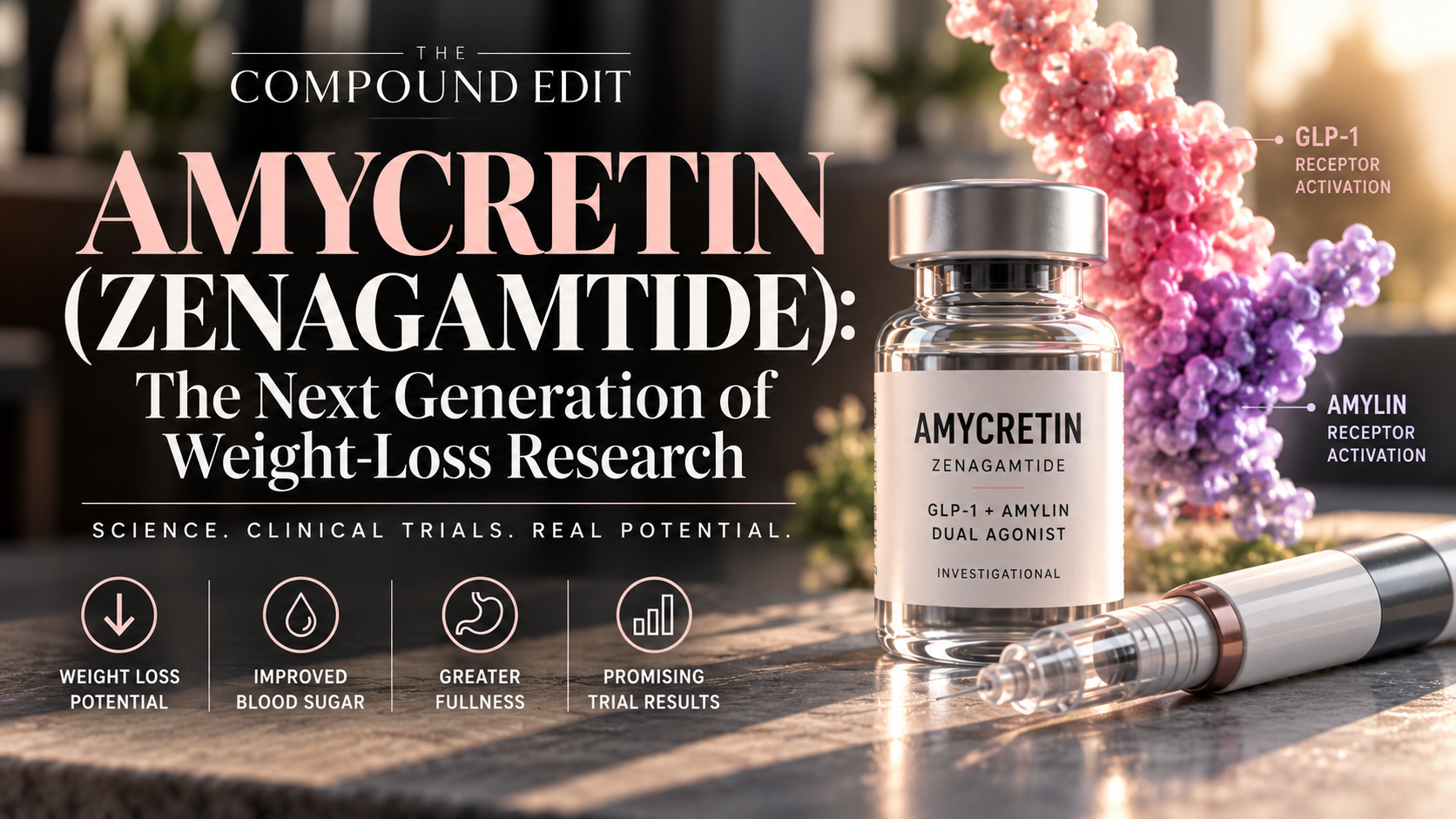
Amycretin (Zenagamtide): The Next Generation of Weight-Loss Research
The Compound Edit | Peptides & Metabolic Research
Just when you think you’ve finally learned the names of all the new weight-loss medications, another one enters the conversation.
Meet amycretin.
Or, as it’s now also called, zenagamtide.
Developed by Novo Nordisk, the company behind Ozempic and Wegovy, amycretin is part of a growing movement in obesity research.
And this time, the focus isn’t simply on activating more GLP-1-related receptors.
It’s on combining two different hormone pathways in one molecule.
GLP-1 and amylin.
That combination has researchers investigating whether they can influence appetite, fullness, blood sugar, and body weight in new ways.
And after some impressive early clinical trial results, amycretin is moving into larger studies.
So what exactly is it?
How is it different from semaglutide, tirzepatide, and retatrutide?
And is the excitement actually supported by research?
Let’s get into it.
First, What Exactly Is Amycretin?
Amycretin, also known as zenagamtide, is an investigational medication being developed by Novo Nordisk.
It is designed to activate two hormone receptors:
- GLP-1 receptors
- Amylin receptors
You probably recognize GLP-1 by now.
It’s the hormone pathway targeted by medications such as semaglutide.
But amylin is a little less familiar.
And that’s where this research gets interesting.
What Is Amylin?
Amylin is a hormone normally released by pancreatic beta cells alongside insulin.
It helps regulate processes involved in eating and glucose control.
Among its physiological effects, amylin can influence:
- Feelings of fullness.
- Gastric emptying.
- Food intake.
- Glucagon secretion after meals.
Essentially, amylin is one of the body’s signals that helps communicate when enough food has been consumed.
But it doesn’t work exactly like GLP-1.
And researchers are interested in whether activating both pathways could produce complementary effects.
One Molecule, Two Receptors
Here’s the detail that makes amycretin different.
It’s described as a unimolecular dual agonist.
That sounds complicated, but the idea is straightforward.
Instead of combining two separate medications, scientists designed one molecule capable of activating both GLP-1 and amylin receptors.
That distinguishes it from approaches involving two individual compounds administered together.
For example, CagriSema combines semaglutide with cagrilintide.
Semaglutide targets GLP-1 receptors.
Cagrilintide is an amylin analogue.
Amycretin is different because its two receptor activities are built into a single molecule.
That doesn’t automatically make it more effective.
But it does represent a different approach to drug design.
Why Are Researchers So Interested in Amylin?
For years, much of the excitement surrounding obesity medications focused on GLP-1.
And for good reason.
GLP-1 receptor agonists demonstrated that targeting appetite and glucose-regulating hormones could produce substantial weight loss.
But the body doesn’t regulate appetite through just one hormone.
It uses a network of signals involving the brain, gastrointestinal tract, pancreas, and other tissues.
Amylin is one part of that network.
Researchers are studying whether combining GLP-1 and amylin receptor activation could provide additional effects on eating behavior and weight regulation.
The idea is biologically plausible.
But the real test is what happens in human clinical trials.
And that’s where amycretin has started attracting attention.
The Early Trial That Got Everyone Talking
In 2025, researchers published results from a Phase 1b/2a study of injectable amycretin in The Lancet.
The study involved 125 adults with overweight or obesity.
Participants received amycretin or placebo in several study groups, with treatment periods ranging up to 36 weeks.
The results were striking.
In one group receiving the highest investigated maintenance dose, the estimated average weight reduction reached:
24.3% after 36 weeks.
The corresponding placebo group experienced approximately 1.1% weight loss.
Another group had an estimated average weight reduction of 22.0% after 36 weeks.
Those results were impressive for an early-stage study.
But here’s the part that matters.
This was not a large Phase 3 trial.
It involved relatively few participants, different study groups, and substantial discontinuation.
The findings are promising, but they shouldn’t be interpreted as a guaranteed outcome for future patients.
They also shouldn’t be used to declare amycretin superior to medications studied in different trials.
What Does 24.3% Weight Loss Actually Look Like?
To put that number into perspective, consider someone starting at 250 pounds.
A 24.3% reduction would equal approximately 61 pounds.
That’s a substantial change.
But the clinical trial percentage represents an estimated group average, not a promise of individual results.
Some participants may lose more.
Others may lose less.
And early trials cannot establish how durable the results will be over several years.
This is why researchers move promising medications into larger, longer studies.
The 2026 Research: Amycretin and Type 2 Diabetes
Amycretin isn’t being studied only for obesity.
Researchers are also investigating its potential effects on type 2 diabetes.
In June 2026, Novo Nordisk announced Phase 2 results involving 262 adults with type 2 diabetes whose blood sugar was not adequately controlled on metformin, with or without an SGLT2 inhibitor.
The trial evaluated once-weekly injectable zenagamtide over 36 weeks.
At the highest investigated dose, researchers reported:
| Outcome | Reported result |
|---|---|
| Average body weight reduction | 14.6% |
| Average A1C reduction | 1.71 percentage points |
| Participants achieving A1C below 7% | Up to 89.1% |
The placebo group experienced approximately 2.1% average weight loss.
These results suggest that amycretin may have meaningful effects on both glucose regulation and body weight.
But notice something interesting.
The weight-loss percentage in this diabetes trial was lower than the highest figure reported in the earlier obesity study.
Does that mean the medication suddenly became less effective?
Not necessarily.
The studies enrolled different populations, used different protocols, and investigated different treatment exposures.
People with type 2 diabetes may also respond differently to weight-loss treatments than people without diabetes.
That’s another reason clinical trial numbers need context.
What About an Oral Version?
This might be one of the most interesting parts of amycretin’s development.
Novo Nordisk has investigated both injectable and oral formulations.
And yes, that means researchers are studying whether amycretin could eventually be available as a pill.
An early Phase 1 study evaluated oral amycretin and reported meaningful short-term weight reductions in some treatment groups.
However, oral and injectable formulations cannot be assumed to have equivalent effectiveness or tolerability.
Their absorption, dosing schedules, and pharmacokinetics may differ.
And neither formulation is currently an FDA-approved amycretin product.
Still, the possibility of different administration options could become important if future trials demonstrate adequate safety and effectiveness.
Amycretin vs. Semaglutide: What’s Different?
Semaglutide activates GLP-1 receptors.
Amycretin activates both GLP-1 and amylin receptors.
That is the fundamental difference.
Both approaches influence metabolic processes involved in appetite and glucose regulation.
But amycretin is designed to incorporate an additional hormone pathway.
Does that mean it will produce more weight loss?
Possibly.
But we need direct comparative evidence before making that conclusion.
Semaglutide already has a substantial body of clinical research, including longer-term studies and cardiovascular outcome evidence in specific populations.
Amycretin is still undergoing clinical development.
Those differences in evidence are just as important as differences in receptor activity.
Amycretin vs. Tirzepatide
Tirzepatide activates:
GLP-1 + GIP
Amycretin activates:
GLP-1 + amylin
So both target two receptors.
But they aren’t targeting the same two receptors.
And that’s important.
GIP and amylin have different physiological roles.
Their effects on appetite, glucose regulation, and metabolism are not interchangeable.
It’s tempting to compare the biggest weight-loss percentages from the two drugs.
But until adequately designed head-to-head trials are available, those comparisons remain uncertain.
Amycretin vs. Retatrutide
This is another comparison that’s bound to generate interest.
Retatrutide activates:
GLP-1 + GIP + glucagon
Amycretin activates:
GLP-1 + amylin
So retatrutide targets three receptors, while amycretin targets two.
But having more receptor targets doesn’t automatically mean a medication will be more effective.
The specific pathways matter.
The strength and balance of receptor activation matter.
And ultimately, the human clinical trial results matter.
Retatrutide’s Phase 3 program has produced substantial weight-loss findings.
Amycretin’s early studies have also shown promising results.
But the evidence is at different stages of development.
Comparing them as though they’re equally established would be misleading.
What About Eloralintide?
Now here’s a comparison I find especially interesting.
We recently covered eloralintide, Eli Lilly’s investigational selective amylin receptor agonist.
Eloralintide targets the amylin pathway.
Amycretin targets both GLP-1 and amylin receptors.
Researchers are also studying combinations of separate amylin-based medications with other metabolic treatments.
So we’re seeing several strategies emerge:
- Target amylin alone.
- Combine an amylin drug with a separate GLP-1 or dual-agonist medication.
- Design a single molecule that activates both GLP-1 and amylin receptors.
These approaches may eventually offer different options.
But we don’t yet know which strategy will provide the best balance of weight loss, tolerability, and long-term health outcomes.
What Are the Side Effects?
Like other medications affecting appetite and gastrointestinal signaling, amycretin has been associated with digestive side effects.
In the published early injectable trial, gastrointestinal adverse events were common.
Reported effects included nausea and vomiting.
Most were described as mild to moderate, but tolerability remains an important research question.
The early trial also had substantial participant discontinuation, including discontinuations for reasons unrelated to treatment-emergent adverse events.
That complicates interpretation of the findings.
The 2026 Phase 2 diabetes study also reported gastrointestinal events as the most common adverse effects.
Larger studies are needed to better understand uncommon adverse events, long-term safety, and how tolerability changes with different treatment regimens.
What About Muscle Preservation?
If you’ve been following The Compound Edit, you know this is a topic I keep coming back to.
Because losing weight and improving body composition aren’t necessarily the same thing.
When someone loses a significant amount of weight, some of that reduction can involve lean tissue.
And when appetite is substantially reduced, it can become more difficult to consume adequate protein and total nutrition.
That’s why research on future obesity treatments should consider more than total body weight.
We also need to understand effects on:
- Lean mass and muscle quality.
- Physical strength.
- Functional performance.
- Nutritional adequacy.
- Long-term weight maintenance.
Amycretin’s early weight-loss results are exciting.
But they don’t yet establish that it preserves muscle better than other medications.
And that distinction matters for anyone interested in both metabolic health and physical performance.
Is Amycretin FDA-Approved?
No.
As of October 2026, amycretin—also called zenagamtide—remains investigational.
It is not FDA-approved for weight management or type 2 diabetes.
Novo Nordisk has initiated its Phase 3 AMAZE obesity program and has outlined plans for Phase 3 development in type 2 diabetes.
Those larger studies are important because they can provide stronger evidence about effectiveness, safety, and longer-term outcomes.
And until those trials are completed and regulators evaluate the evidence, amycretin remains a research medication.
Products advertised online as amycretin are not equivalent to the regulated investigational product used in clinical trials.
So Why Is Amycretin Worth Watching?
Because it represents something bigger than another weight-loss compound.
It shows how researchers are moving beyond a single hormone pathway.
The next generation of metabolic treatments may involve carefully designed combinations of signals that influence appetite, glucose regulation, and energy balance.
Some approaches use multiple separate medications.
Others use single molecules designed to activate multiple receptors.
And some investigate entirely different hormone systems.
Amycretin is part of that broader evolution.
But whether it becomes a successful approved treatment will depend on what the larger clinical trials show.
Not on social media excitement.
Not on the biggest number from an early study.
And not on how many receptors it activates.
The Compound Edit Takeaway
Amycretin, also known as zenagamtide, is an investigational medication designed to activate both GLP-1 and amylin receptors within one molecule.
Early clinical studies have reported substantial weight reductions, including an estimated average reduction of 24.3% in one small injectable trial group after 36 weeks.
A separate 2026 Phase 2 study in adults with type 2 diabetes reported meaningful improvements in A1C and body weight.
Those findings are promising.
But amycretin is still being evaluated, and its long-term effectiveness and safety are not yet established.
The real story isn’t that amycretin has already replaced semaglutide, tirzepatide, or retatrutide.
It’s that researchers are exploring new ways to target the complicated biology of appetite and metabolism.
And the amylin pathway may become an important part of that future.
Keep Exploring on The Compound Edit
Want to learn more about the science behind metabolic medications?
- GLP-1, GLP-2, GLP-3: What People Really Mean by Semaglutide, Tirzepatide & Retatrutide
- Retatrutide Isn’t Approved Yet. So Why Is Everyone Already Talking About It?
- Why Does Retatrutide Feel Like It Stopped Working?
- Why Protein Matters More Than Ever After Weight Loss
Continue Exploring
The Compound Edit is dedicated to exploring the science, research, and real conversations surrounding peptides, hormones, metabolism, performance, and longevity.
The Compound Edit is affiliated with Chuk BioWorks. While the two share an ownership connection, our editorial goal is to explore scientific research with transparency, including limitations, uncertainties, and potential risks.
Research & Sources
- Dahl K, et al. Amycretin, a Novel, Unimolecular GLP-1 and Amylin Receptor Agonist Administered Subcutaneously: Results From a Phase 1b/2a Randomised Controlled Study. The Lancet. 2025. https://doi.org/10.1016/S0140-6736(25)01185-7
- Gasiorek A, et al. Safety, Tolerability, Pharmacokinetics, and Pharmacodynamics of the First-in-Class GLP-1 and Amylin Receptor Agonist, Amycretin. The Lancet. 2025. https://pubmed.ncbi.nlm.nih.gov/40550229/
- Novo Nordisk. Zenagamtide Phase 2 Type 2 Diabetes Results Presented at ADA 2026. June 2026. https://www.novonordisk-us.com/media/press-releases/zenagamtide-phase2-t2d-ada-2026.html
- Novo Nordisk. Second Quarter 2026 Investor Presentation. August 2026. https://www.novonordisk.com/content/dam/nncorp/global/en/investors/pdfs/financial-results/2026/Q2-2026-Full%20presentation.pdf
- The Lancet. GLP-1 Receptor Agonists and Next-Generation Incretin-Based Medications: Metabolic, Cardiovascular, and Renal Benefits. 2026. https://doi.org/10.1016/S0140-6736(25)02105-1
Medical Disclaimer
The content published on The Compound Edit is intended for educational and informational purposes only and does not constitute medical advice, diagnosis, or treatment.
Amycretin (zenagamtide) is investigational and is not FDA-approved as of this article’s publication. Clinical trial doses and outcomes are research information, not instructions for personal use.
Stay curious. Keep learning. Continue exploring.