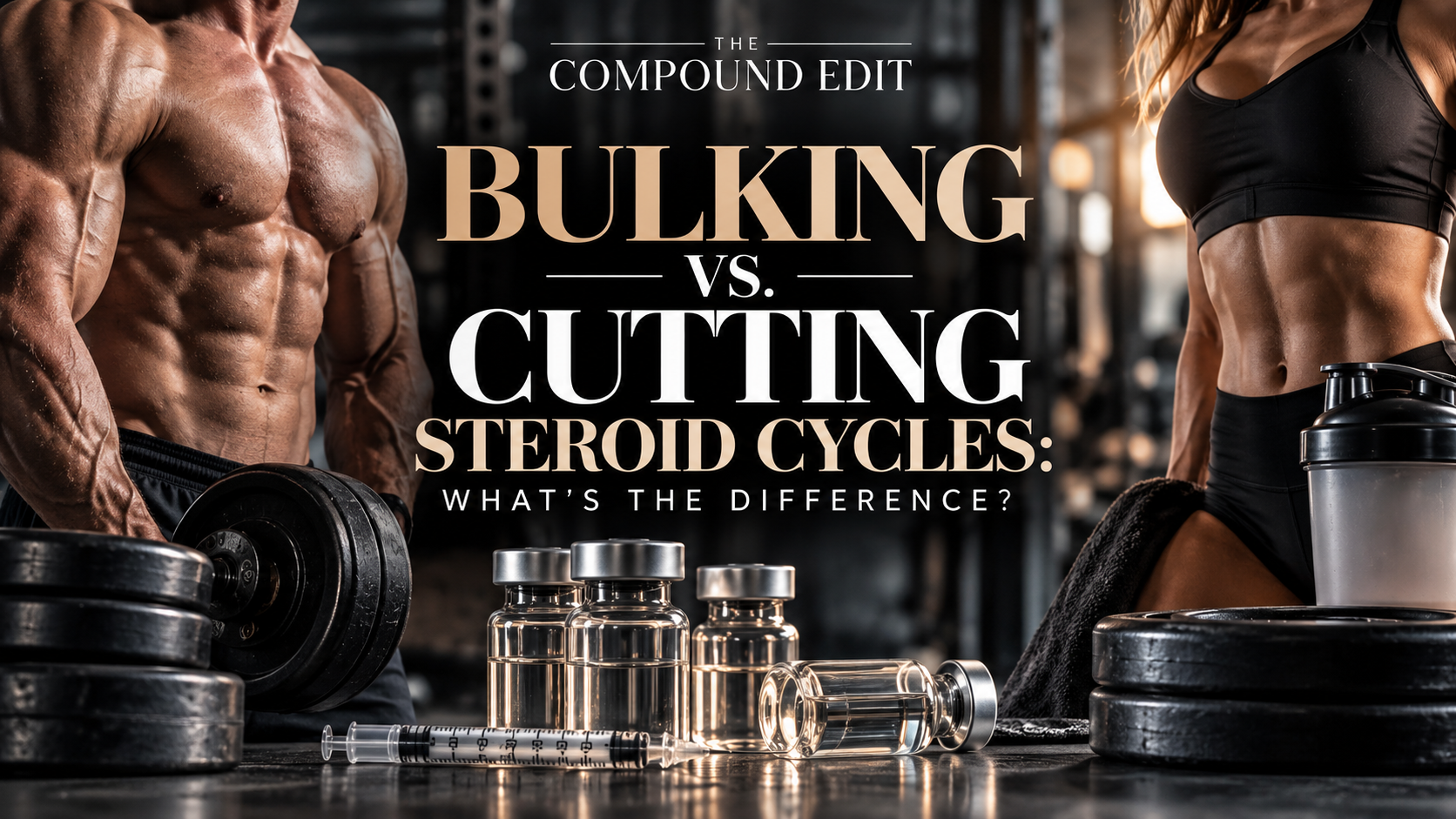
Bulking vs. Cutting Steroid Cycles: What’s the Difference?
The Compound Edit | Hormones & Performance
Spend enough time around bodybuilding, and eventually you’ll hear someone say they’re starting a bulk.
Or they’re cutting.
Or they’re coming off a cycle.
Or they’re planning their next one.
And if you’re new to this world, it can sound like everyone is speaking an entirely different language.
Testosterone. Trenbolone. Deca. Primo. Anavar.
Some compounds have reputations for building serious size. Others are associated with that lean, hard, defined look.
But here’s where things get interesting.
A steroid doesn’t automatically know whether you’re trying to bulk or cut.
Your body doesn’t have a switch that tells testosterone you’re trying to grow your shoulders in January but reveal your abs in June.
So why are certain steroids associated with bulking and others with cutting?
Let’s get into it.
First, What Exactly Is a Steroid Cycle?
In bodybuilding, a steroid cycle generally refers to a period of nonmedical anabolic-androgenic steroid use intended to influence muscle growth, strength, or physical appearance.
Anabolic-androgenic steroids, often shortened to AAS, are synthetic derivatives of testosterone or testosterone itself.
They interact with androgen receptors and influence processes involved in muscle protein synthesis, recovery, and tissue development.
That anabolic activity is why these substances have attracted attention in bodybuilding for decades.
But bodybuilding cycles aren’t the same as medically prescribed testosterone replacement therapy.
TRT is intended to treat a diagnosed hormone deficiency.
Performance-enhancing steroid use often involves exposure above normal physiological levels, sometimes with multiple compounds.
And that difference matters.
What Is a Bulking Cycle?
Bulking is the phase where someone is primarily focused on gaining muscle mass.
The goal is generally to increase body weight, improve strength, and create an environment that supports muscle growth.
That usually means:
- Eating enough calories to support growth.
- Consuming adequate protein.
- Training with progressive overload.
- Recovering between workouts.
- Accepting that some body-fat gain may occur.
In bodybuilding communities, certain anabolic steroids are associated with bulking because of their effects on muscle mass, strength, and sometimes water retention.
Commonly discussed examples include testosterone, nandrolone, and methandrostenolone, better known as Dianabol.
But here’s something people overlook.
A compound’s reputation for producing rapid weight gain doesn’t mean every pound gained is muscle.
Changes in glycogen storage, fluid retention, and fat mass can all influence the number on the scale.
And gaining weight faster doesn’t necessarily mean gaining more quality muscle.
What Is a Cutting Cycle?
Cutting is almost the opposite nutritional environment.
Instead of trying to gain weight, someone is attempting to reduce body fat while preserving as much muscle as possible.
This generally involves a calorie deficit.
And that’s where things get tricky.
When you’re eating less than your body needs to maintain its current weight, muscle retention becomes an important concern.
Bodybuilders sometimes use anabolic steroids during cutting phases because androgens can support lean tissue under certain conditions.
Compounds commonly associated with cutting include oxandrolone (Anavar), methenolone (Primobolan), and trenbolone.
However, the idea that these compounds directly melt fat away is misleading.
A cutting steroid isn’t automatically a fat-burning medication.
Androgenic effects on lean tissue and performance are different from the mechanisms of medications specifically developed to treat obesity.
The calorie deficit, training, nutrition, and starting body composition still matter enormously.
Why Do Certain Steroids Have Different Reputations?
This is where the chemistry becomes interesting.
Not every anabolic steroid behaves exactly like testosterone.
Different compounds can vary in:
- Their interaction with androgen receptors.
- Whether they can be converted into estrogen.
- Their metabolism and duration of action.
- Their effects on fluid retention.
- Their influence on liver enzymes and blood lipids.
- Their androgenic and other hormonal effects.
Testosterone, for example, can be converted into estradiol through aromatase.
Oxandrolone and methenolone do not undergo that same aromatization process.
That helps explain why certain compounds are described as producing a comparatively drier appearance.
But a dry appearance isn’t a direct measurement of muscle growth or fat loss.
And avoiding estrogen conversion doesn’t make a steroid harmless.
Testosterone: Why Is It Discussed in Both Bulking and Cutting?
Testosterone is the primary naturally occurring androgen in men.
It plays important roles in muscle development, reproductive function, bone health, and other physiological processes.
Because of its anabolic activity, testosterone is discussed in both bulking and cutting contexts.
The difference is often the overall goal and nutritional environment rather than testosterone having two entirely different biological functions.
A person eating in a calorie surplus may gain body weight and muscle.
A person eating in a calorie deficit may lose weight while attempting to preserve muscle.
Testosterone doesn’t create those nutritional conditions.
And increasing androgen exposure beyond physiological levels introduces risks that are not equivalent to appropriately prescribed replacement therapy.
Primobolan: Why Is It Associated With a Leaner Look?
Primobolan is the common name for methenolone.
It has developed a reputation in bodybuilding communities as a compound associated with lean tissue and relatively little estrogen-related water retention.
Because it doesn’t aromatize into estrogen, people often describe it as producing cleaner or drier gains.
But those descriptions are largely bodybuilding terminology.
They aren’t standardized clinical measurements.
And the absence of aromatization doesn’t eliminate potential adverse effects on cholesterol, reproductive hormones, or cardiovascular health.
Nandrolone: Why Is It Associated With Bulking?
Nandrolone is another anabolic-androgenic steroid with a long history in medicine and bodybuilding.
Nandrolone decanoate is commonly known as Deca-Durabolin, while nandrolone phenylpropionate is often called NPP.
Both deliver nandrolone but differ in their ester formulation and release characteristics.
Nandrolone has documented anabolic activity and has historically been studied for conditions involving loss of lean tissue.
In bodybuilding circles, it’s frequently associated with gaining muscle and strength.
But nandrolone can also suppress natural hormone production and affect sexual and reproductive function.
And stacking it with testosterone doesn’t make those risks disappear.
Trenbolone: Why Does It Have Such an Extreme Reputation?
Trenbolone is one of the most talked-about anabolic steroids in bodybuilding.
It’s associated with dramatic physique changes and a reputation for potency.
But there’s an important distinction.
Trenbolone is not approved for human medical use in the United States, and controlled human research supporting bodybuilding claims is extremely limited.
Much of its reputation comes from anecdotal reports rather than rigorous clinical trials.
Reported concerns include sleep disturbances, mood changes, cardiovascular effects, and other androgen-related adverse effects.
The lack of robust human safety data makes confident claims about its benefits or comparative safety especially difficult.
What About Stacking Multiple Steroids?
Stacking means using more than one anabolic steroid during the same period.
In bodybuilding communities, the reasoning often involves trying to combine different desired effects.
For example, someone may believe one compound supports size while another improves appearance or strength.
But combining substances also complicates the risk picture.
Multiple compounds may affect blood pressure, cholesterol, red blood cell production, fertility, and other systems simultaneously.
And there is no reliable clinical evidence that bodybuilding-style stacking makes nonmedical steroid use safe.
The Part Nobody Wants to Talk About: Your Heart
When people discuss steroid cycles, the conversation tends to revolve around muscle.
How much size did someone gain?
How much stronger did they get?
Did they maintain their muscle during a cut?
But your cardiovascular system is affected by androgen exposure, too.
A 2026 systematic review and meta-analysis involving 40 studies and 1,906 strength-trained athletes found associations between anabolic steroid use and changes in heart structure and function.
These included increased left ventricular mass and reduced measures of cardiac function.
Longer exposure was associated with certain worse cardiac measurements, although observational research cannot prove that every change was caused by steroid use.
Other documented concerns include adverse cholesterol changes, elevated blood pressure, and increased risk of cardiovascular complications.
A physique can look impressive while important internal health markers are moving in the wrong direction.
What Happens When Someone Stops a Cycle?
This is another part of the discussion that often gets oversimplified.
External androgen exposure can suppress the body’s natural testosterone production.
That suppression occurs because the brain reduces signaling through the hypothalamic-pituitary-gonadal axis.
When steroid exposure stops, natural hormone production may not immediately return to its previous level.
Some people experience low testosterone symptoms, reduced libido, fatigue, mood changes, or fertility problems.
Recovery varies considerably.
Some recover within months. Others experience prolonged suppression or incomplete recovery.
And despite how casually post-cycle therapy is discussed online, there is no universally proven regimen that guarantees recovery after nonmedical anabolic steroid use.
Can You Build Muscle Without Steroids?
Absolutely.
Progressive resistance training, sufficient calories, adequate protein, sleep, and consistency can produce substantial changes in muscle mass and strength.
Creatine is also one of the better-studied legal supplements for supporting high-intensity exercise performance.
Natural muscle growth may be slower than growth under supraphysiological androgen exposure.
But slower doesn’t mean ineffective.
And it avoids the additional drug-related risks associated with anabolic steroid cycles.
The Compound Edit Takeaway
Bulking and cutting aren’t two entirely different types of muscle biology.
They’re primarily different nutritional and body-composition goals.
Anabolic steroids can influence muscle development, strength, and lean tissue retention, but the labels attached to different compounds often reflect bodybuilding culture as much as controlled scientific evidence.
A compound associated with bulking doesn’t automatically produce quality muscle.
A compound associated with cutting doesn’t automatically burn fat.
And neither category is inherently safe.
Understanding the difference means looking beyond the gym terminology and examining what these substances actually do inside the body.
Because building an impressive physique is one thing.
Understanding the biology behind it is another.
Keep Exploring on The Compound Edit
Interested in the science behind hormones, muscle growth, and performance? Explore these articles:
- Anavar Has a Reputation as the “Mild” Steroid. Is It Actually Mild?
- Have You Ever Thought About Starting Your TRT Journey?
- Creatine Isn’t Just for Bodybuilders: What It Actually Does to Muscle, Strength—and the Scale
- “I Thought I Was Just Getting Older”: Shane’s Journey From Peptides to TRT
Continue Exploring
The Compound Edit is dedicated to exploring the science, research, and real conversations surrounding peptides, hormones, metabolism, performance, and longevity.
The Compound Edit is affiliated with Chuk BioWorks. While the two share an ownership connection, our editorial goal is to explore scientific research with transparency, including limitations, uncertainties, and potential risks.
Research & Sources
- Majzoub A, Canguven O. Health consequences of anabolic steroids: a sexual-medicine perspective. International Journal of Impotence Research. 2026.
- Duration-Dependent Cardiac Effects of Anabolic-Androgenic Steroid Use in Strength-Trained Athletes: A Systematic Review and Meta-Analysis. Echocardiography. 2026.
- Anabolic-androgenic steroids at supraphysiological doses: Cardiovascular impacts and pathophysiological mechanisms. Journal of Steroid Biochemistry and Molecular Biology. 2026.
Medical Disclaimer
The content published on The Compound Edit is intended for educational and informational purposes only and does not constitute medical advice, diagnosis, or treatment.
Anabolic-androgenic steroid use without medical supervision carries significant health risks. This article describes terminology and scientific evidence and is not an endorsement or guide to nonmedical steroid use. Consult a qualified healthcare professional regarding medical decisions.
Stay curious. Keep learning. Continue exploring.