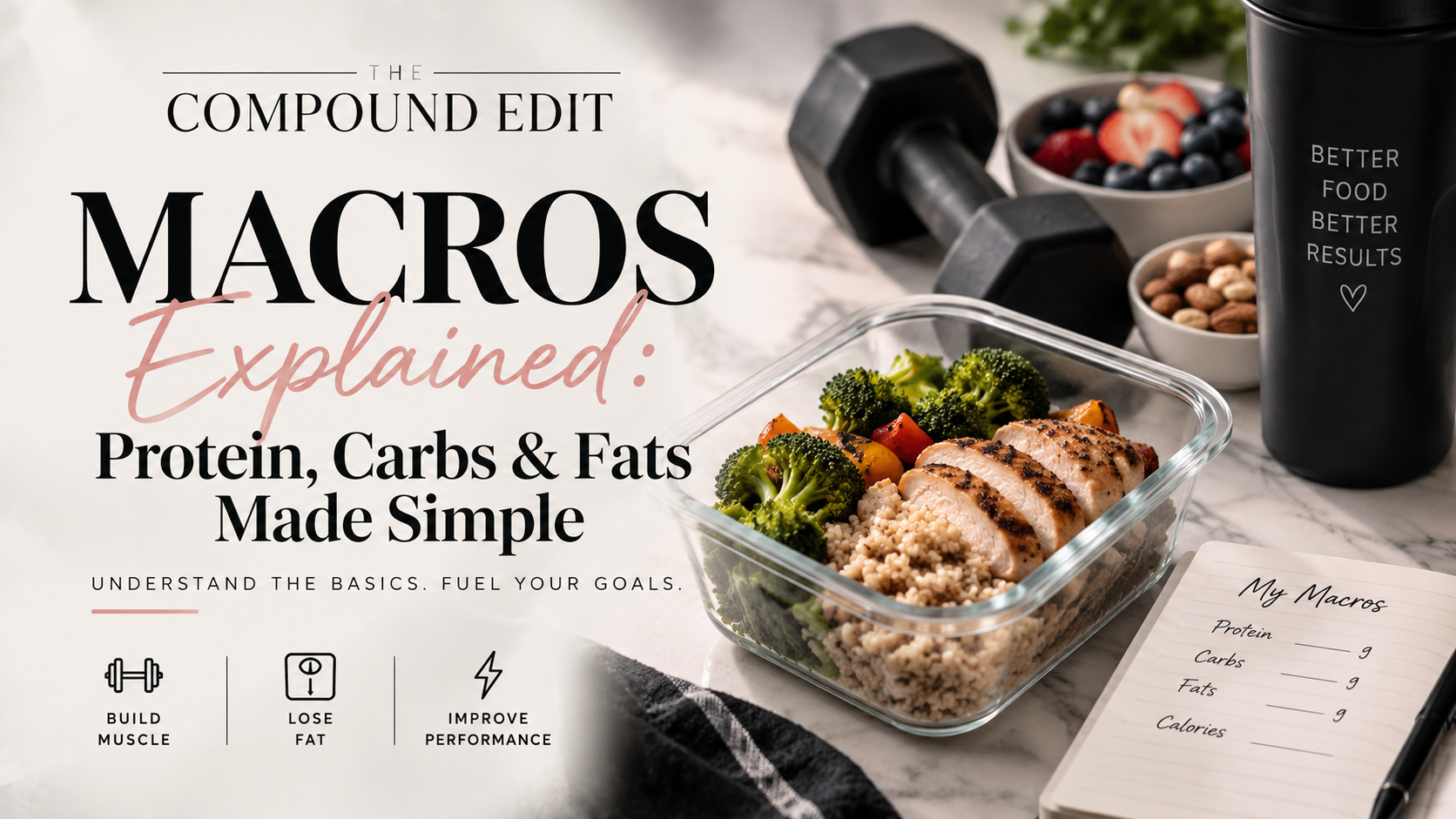
Macros Explained: How Protein, Carbs, and Fats Actually Work
The Compound Edit | Nutrition & Performance
You’ve probably heard someone say they’re tracking their macros.
Maybe they’re trying to lose weight.
Maybe they’re trying to build muscle.
Or maybe they’re the person at the gym who somehow knows exactly how many grams of protein were in their breakfast.
And you’re standing there wondering:
What the hell are macros, and why is everyone counting them?
Here’s the thing.
Understanding macros doesn’t have to be complicated. You don’t need to become a nutritionist, weigh every blueberry, or spend the rest of your life entering food into an app.
But understanding what protein, carbohydrates, and fats actually do can completely change the way you approach nutrition.
Especially if you’re trying to change your body composition.
Let’s break it down.
First, What Are Macros?
Macros is short for macronutrients.
They’re the nutrients your body needs in relatively large amounts to provide energy and support normal physiological functions.
The three we typically track are:
- Protein
- Carbohydrates
- Fat
Each one has a different job.
And each provides a different amount of energy.
| Macronutrient | Calories per gram |
|---|---|
| Protein | 4 |
| Carbohydrates | 4 |
| Fat | 9 |
That means 100 grams of protein provides approximately 400 calories.
One hundred grams of carbohydrates provides another 400.
And 100 grams of fat provides approximately 900.
These are standard nutritional estimates, not exact measurements of how every food is metabolized.
Your daily calorie intake is largely determined by how much of each macronutrient you consume.
But calories and macros aren’t quite the same thing.
Calories describe how much energy you’re eating.
Macros describe where that energy comes from.
And that distinction matters.
Protein: The Building Material
Let’s start with the one everyone at the gym seems obsessed with.
Protein.
And there’s a good reason for that.
Protein is made up of amino acids, which your body uses to build and repair tissues, produce enzymes, and support numerous biological functions.
When you lift weights, you’re creating a stimulus that encourages your muscles to adapt.
Protein supplies amino acids that support muscle protein synthesis.
Think of it like building a house.
Your training is the construction project.
Protein provides some of the building materials.
But just eating a ridiculous amount of protein doesn’t automatically mean you’re going to grow a ridiculous amount of muscle.
You still need an appropriate training stimulus, enough total energy, and recovery.
How Much Protein Do You Actually Need?
For generally healthy adults, the basic recommended dietary allowance is approximately 0.8 grams per kilogram of body weight per day.
But that isn’t necessarily an ideal target for someone training hard to build muscle.
Sports-nutrition research commonly supports around 1.4–2.0 grams per kilogram daily for many exercising individuals, with requirements varying according to training and energy intake.
For example, someone weighing 150 pounds weighs approximately 68 kilograms.
At 1.6–2.0 grams per kilogram, that works out to roughly 109–136 grams of protein daily.
Someone weighing 220 pounds weighs approximately 100 kilograms.
The same range would be approximately 160–200 grams daily.
More isn’t automatically better.
And protein doesn’t have to consume your entire diet.
Where Can You Get Protein?
Chicken, beef, turkey, fish, eggs, Greek yogurt, cottage cheese, tofu, beans, and protein powders are all options.
You don’t have to live on chicken and broccoli.
Promise.
Carbohydrates: The Fuel Everyone Loves to Blame
Oh, carbs.
Possibly the most misunderstood macronutrient in fitness.
Bread makes you fat.
Rice makes you fat.
Pasta makes you fat.
Don’t eat carbs after 6 p.m.
If you’ve spent any time around diet culture, you’ve probably heard some version of these claims.
But carbohydrates aren’t inherently fattening.
And for someone lifting weights regularly, they can be incredibly useful.
What Do Carbs Actually Do?
Carbohydrates are broken down into sugars, including glucose, which your body can use for energy.
Some glucose is stored as glycogen in your muscles and liver.
Muscle glycogen is particularly important during repeated, challenging exercise.
Think about a demanding leg day.
Heavy squats.
Romanian deadlifts.
Hip thrusts.
Walking lunges.
By the time you’re halfway through, your muscles need energy to keep producing force.
Carbohydrate availability can help support training performance, especially when workouts are lengthy, high-volume, or frequent.
That doesn’t mean you can’t lift weights while eating fewer carbs.
It means carbohydrates are a useful tool, not something everyone needs to fear.
Can You Eat Carbs and Still Lose Fat?
Absolutely.
Fat loss primarily depends on maintaining an energy deficit over time.
Someone can eat rice, potatoes, bread, fruit, and pasta while losing body fat.
Someone can also eliminate bread entirely and still gain weight if their overall energy intake exceeds their needs.
Carbs aren’t the enemy. Your overall dietary pattern matters more than demonizing one food group.
Why Do Carbs Sometimes Make the Scale Go Up?
Here’s where people get confused.
When your body stores glycogen, it also stores associated water.
So when you increase carbohydrate intake after eating very little for several days, the scale may increase.
That doesn’t automatically mean you’ve gained body fat.
It may reflect changes in glycogen, water, and food volume.
The opposite can happen when someone drastically reduces carbohydrates.
They lose several pounds quickly and assume it’s all fat.
Often, some of that early change is water.
Understanding that difference can save you a lot of unnecessary frustration.
Dietary Fat: Yes, Your Body Actually Needs It
Dietary fat has a reputation problem, too.
Because fat contains nine calories per gram, it’s more energy-dense than protein or carbohydrates.
But that doesn’t mean it’s bad.
Fat supports important physiological functions, including:
- Absorption of vitamins A, D, E, and K.
- Cell membrane structure.
- Essential fatty acid intake.
- Normal hormone-related processes.
- Overall energy intake and satisfaction from food.
Dietary fat is part of a healthy nutritional pattern.
The key is getting an appropriate amount and considering the types of fat you’re consuming.
Unsaturated fats from foods like olive oil, nuts, seeds, and fish are generally preferred over large amounts of saturated fat.
Does Eating Fat Make You Gain Body Fat?
Not automatically.
Your body can store excess dietary energy as fat, but eating a food containing fat doesn’t mean it immediately becomes body fat.
Overall energy balance matters.
A person can lose weight while eating a moderate-fat diet.
They can also gain weight on a low-fat diet.
The calorie total and long-term eating pattern still matter.
So How Do You Actually Calculate Your Macros?
Now for the part everyone wants to know.
Let’s use an example.
Imagine someone has estimated that they need 2,200 calories per day to support their current goal.
They decide to aim for:
- 150 grams of protein.
- 70 grams of fat.
- The remaining calories from carbohydrates.
Here’s the math.
Protein:
150 grams × 4 calories = 600 calories.
Fat:
70 grams × 9 calories = 630 calories.
That gives us 1,230 calories from protein and fat.
Now subtract that from the daily calorie target.
2,200 − 1,230 = 970 calories remaining.
Since carbohydrates provide approximately four calories per gram:
970 ÷ 4 = 242.5 grams.
So the daily targets would be approximately:
| Macro | Daily target |
|---|---|
| Protein | 150 g |
| Carbohydrates | 243 g |
| Fat | 70 g |
| Total | ~2,200 calories |
And that’s it.
You just calculated a set of macros.
No secret formula.
No magical ratio.
Just an energy target and a distribution of macronutrients.
Of course, 2,200 calories isn’t appropriate for everyone. It’s simply an example.
Macros for Fat Loss vs. Muscle Growth
Here’s where things start getting interesting.
The same person may need a different nutritional strategy depending on their goal.
Goal 1: Fat Loss
For fat loss, the primary nutritional objective is a sustainable calorie deficit.
Adequate protein can help preserve lean mass, especially when combined with resistance training.
Dietary fat should remain sufficient, and carbohydrates can fill the remaining energy needs according to preference and activity.
Goal 2: Maintaining Weight
At maintenance, energy intake is approximately balanced with energy expenditure over time.
Body weight may fluctuate daily because of water, glycogen, digestion, and other factors.
But the longer-term average remains relatively stable.
Someone can sometimes improve body composition at maintenance by gaining muscle while losing fat, particularly if they’re newer to resistance training.
Goal 3: Building Muscle
Muscle growth requires progressive training and adequate nutrition.
A modest calorie surplus can help support muscle gain, although beginners and some returning lifters may gain muscle without one.
Protein remains important.
Carbohydrates can support training performance.
And dietary fat shouldn’t be pushed unnecessarily low.
The goal isn’t simply to eat as much as possible.
It’s to fuel productive training and recovery while managing unnecessary fat gain.
Do You Have to Hit Every Macro Perfectly?
No.
And this is probably my favorite part.
Your body doesn’t reset at midnight and decide your entire day was a failure because you ate 137 grams of protein instead of 140.
Nutrition works over time.
Consistency matters more than perfection.
If you’re tracking macros, it’s often helpful to prioritize:
- An appropriate total calorie intake.
- Enough protein for your goals.
- Adequate dietary fat.
- Carbohydrates based on energy needs and preference.
- Fiber, micronutrients, and overall food quality.
And yes, you can eat dessert.
You can go out to dinner.
You can enjoy a birthday cake.
One meal doesn’t determine your entire body composition.
What About Fiber?
Fiber is a type of carbohydrate, but it’s worth discussing separately because it has important benefits.
Dietary fiber supports digestive health, contributes to fullness, and can help regulate blood glucose and cholesterol.
Whole grains, vegetables, fruit, beans, nuts, and seeds are useful sources.
General adult fiber targets are often around 25–38 grams daily, depending on age, sex, and energy needs.
One thing to remember if you’re increasing protein dramatically:
Don’t forget about fiber.
A diet consisting mostly of protein shakes, meat, and very little plant food can make it harder to meet your fiber needs.
And your digestive system may have some opinions about that.
Do You Need a Macro-Tracking App?
Not necessarily.
Tracking can be useful because it helps you understand what you’re actually eating.
Many people underestimate calorie intake.
Others discover they’re eating significantly less protein than they thought.
And some people who are training hard realize they’re simply not eating enough overall.
A tracking app can help identify those patterns.
But tracking is a tool, not a requirement.
You can also build balanced meals using protein-rich foods, produce, carbohydrates, and healthy fats without counting every gram.
For some people, that approach is more sustainable.
The Biggest Macro Mistake I See
People become so focused on one number that they forget about the bigger picture.
Someone wants to lose fat, so they eliminate carbohydrates.
Someone wants to gain muscle, so they eat enormous amounts of protein.
Someone wants to be healthy, so they avoid all dietary fat.
But your body doesn’t operate on one nutrient alone.
Protein, carbohydrates, and fats work together within an overall dietary pattern.
And none of them can replace consistent training, recovery, sleep, or sufficient micronutrients.
The best macro plan isn’t necessarily the strictest one.
It’s the one that supports your goals and that you can actually maintain.
The Compound Edit Takeaway
Macros don’t have to be intimidating.
Protein helps provide the building blocks your body needs for muscle repair and growth.
Carbohydrates provide energy and support demanding training.
Dietary fats support essential physiological functions.
And calories help determine whether you’re losing, maintaining, or gaining body weight over time.
Understanding how these pieces fit together can help you make more informed decisions about what you eat.
You don’t need to fear carbs.
You don’t need to eat nothing but protein.
And you definitely don’t need to turn every meal into a complicated math equation.
Sometimes the biggest transformation starts with understanding the basics.
Not finding another diet.
Not eliminating another food group.
Just learning how to fuel your body for what you’re actually asking it to do.
Keep Exploring on The Compound Edit
Want to learn more about nutrition, muscle growth, and body composition? These articles are already published:
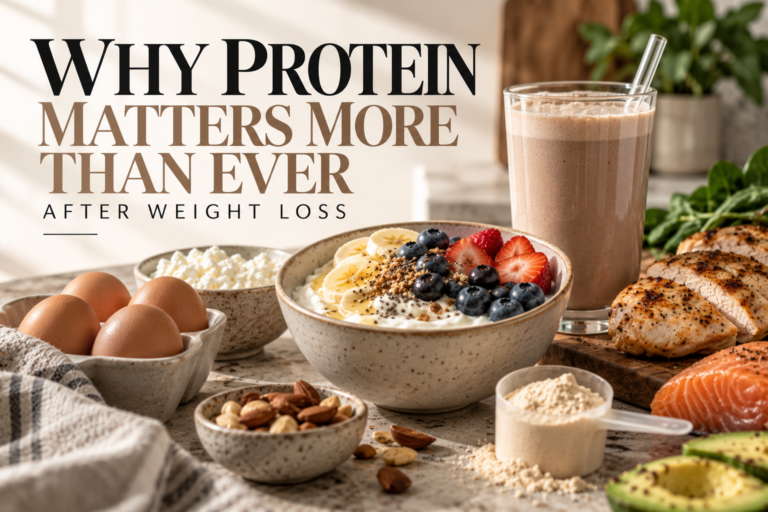
- Why Protein Matters More Than Ever After Weight Loss
- Losing Weight Was the Easy Part. Building Muscle Is a Different Story.
- Creatine Isn’t Just for Bodybuilders: What It Actually Does to Muscle, Strength—and the Scale
- The Plateau Isn’t Always the Problem
Continue Exploring
The Compound Edit is dedicated to exploring the science, research, and real conversations surrounding peptides, hormones, metabolism, performance, and longevity.
The Compound Edit is affiliated with Chuk BioWorks. While the two share an ownership connection, our editorial goal is to explore scientific research with transparency, including limitations, uncertainties, and potential risks.
Research & Sources
- USDA National Agricultural Library, Food and Nutrition Information Center. Macronutrients and Energy Values. https://www.nal.usda.gov/programs/fnic
- Jäger R, et al. International Society of Sports Nutrition Position Stand: Protein and Exercise. Journal of the International Society of Sports Nutrition. 2017;14:20. https://doi.org/10.1186/s12970-017-0177-8
- Thomas DT, Erdman KA, Burke LM. Position of the Academy of Nutrition and Dietetics, Dietitians of Canada, and the American College of Sports Medicine: Nutrition and Athletic Performance. Journal of the Academy of Nutrition and Dietetics. 2016;116(3):501–528. https://doi.org/10.1016/j.jand.2015.12.006
- National Academies of Sciences, Engineering, and Medicine. Dietary Reference Intakes for Energy, Carbohydrate, Fiber, Fat, Fatty Acids, Cholesterol, Protein, and Amino Acids. 2005.
Medical Disclaimer
The content published on The Compound Edit is intended for educational and informational purposes only and does not constitute medical advice, diagnosis, or treatment.
Nutritional needs vary based on age, health status, physical activity, and individual circumstances. The calculations in this article are educational examples, not personalized dietary prescriptions.
Stay curious. Keep learning. Continue exploring.