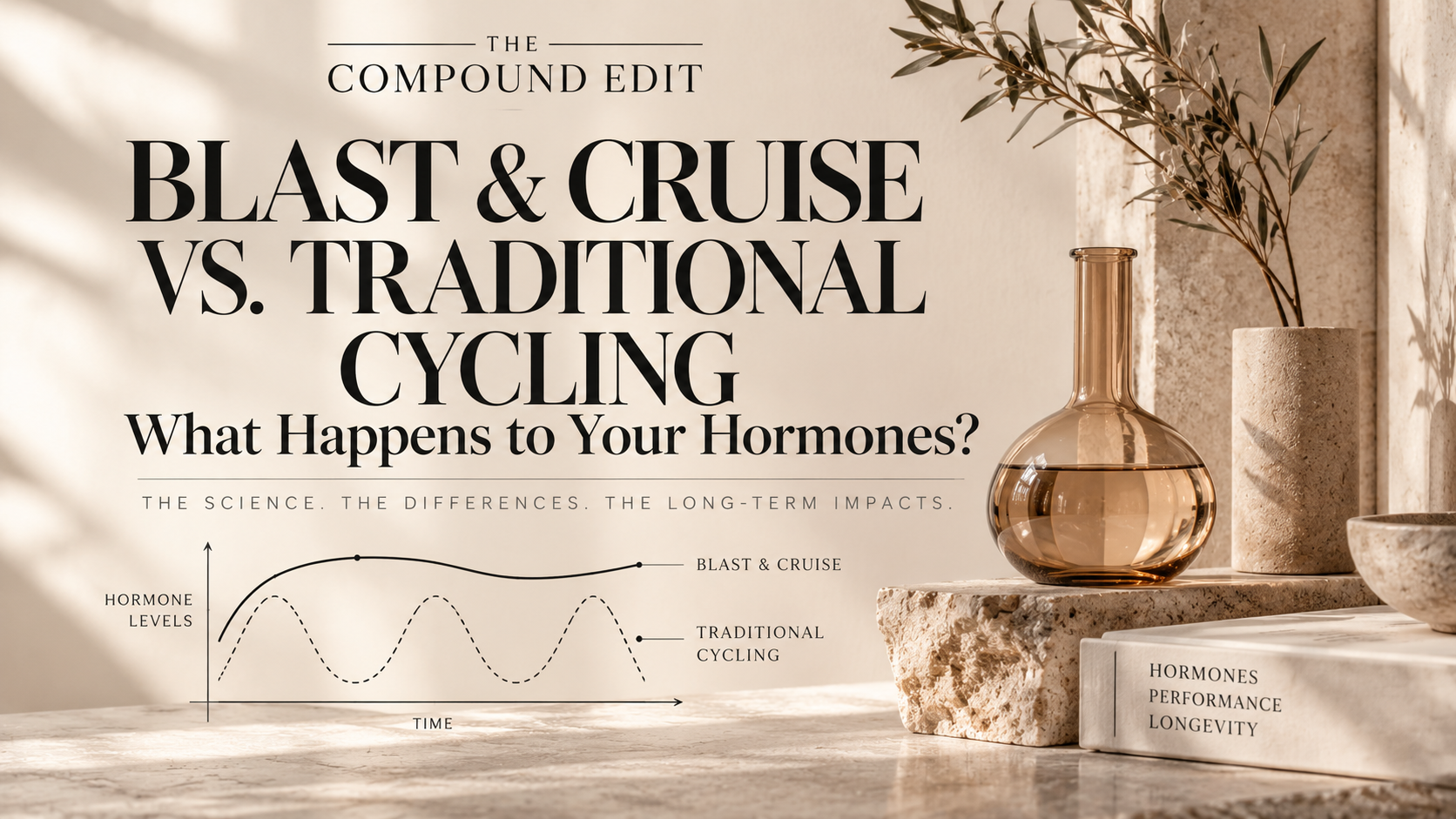
Blast and Cruise vs. Traditional Cycling: What Happens to Your Hormones?
The Compound Edit | Hormones, Testosterone & Performance
If you’ve spent any time researching testosterone or bodybuilding, you’ve probably heard two phrases come up repeatedly:
Blast and cruise.
Traditional cycling.
They’re often discussed as different approaches to anabolic steroid use. And depending on who you ask, one may be described as more convenient, more effective, or easier on the body.
But here’s what gets overlooked in those conversations:
The biggest difference isn’t simply how long someone uses testosterone. It’s what happens to their body’s natural hormone production during and after that exposure.
Because taking testosterone from outside the body doesn’t just increase testosterone levels.
It changes how the brain communicates with the reproductive system.
And those changes can affect estrogen, fertility, testicular function, cholesterol, blood pressure, and long-term cardiovascular health.
Let’s break down what these terms mean, how the endocrine system responds, and what scientific research actually tells us.
First, What Does Blast and Cruise Mean?
In bodybuilding terminology, blast and cruise refers to a pattern of anabolic-androgenic steroid use involving alternating periods of higher and lower androgen exposure.
During a blast, someone uses higher amounts of anabolic steroids, typically with the intention of increasing muscle mass or strength.
During a cruise, they reduce their androgen exposure but continue taking externally supplied testosterone or other androgens rather than stopping completely.
The important distinction is that a cruise generally isn’t a true break from exogenous hormones.
The body is still being exposed to outside androgens.
That means the hormonal feedback mechanisms responsible for natural testosterone production may remain suppressed.
And that’s why the term cruise can be misleading.
It may sound like a recovery period, but it isn’t necessarily a period of endocrine recovery.
What Is Traditional Steroid Cycling?
Traditional cycling generally involves using anabolic steroids for a defined period and then discontinuing them.
The intention is often to spend some time without exogenous anabolic steroids before beginning another cycle.
Some people attempt what is commonly called post-cycle therapy, or PCT, after discontinuation.
The goal is usually to encourage recovery of natural testosterone production.
But there’s an important distinction between the intention and the evidence.
Stopping anabolic steroids gives the body’s hormonal system an opportunity to recover. It does not guarantee that recovery will happen quickly—or completely.
And using medications during PCT doesn’t automatically ensure that the process will be faster or more successful.
We’ll come back to that.
The Hormonal System Behind Testosterone Production
Before comparing these approaches, it helps to understand how testosterone is normally regulated.
In men, testosterone production is controlled primarily by the hypothalamic-pituitary-gonadal axis, commonly called the HPG axis.
It’s essentially a communication system between the brain and the testes.
Here’s the simplified process:
- The hypothalamus releases gonadotropin-releasing hormone, or GnRH.
- GnRH signals the pituitary gland to release luteinizing hormone (LH) and follicle-stimulating hormone (FSH).
- LH stimulates testosterone production in the testes.
- FSH, together with intratesticular testosterone, supports sperm production.
- Testosterone and estradiol provide feedback to the brain, helping regulate the system.
When testosterone levels rise naturally, the brain adjusts its signals accordingly.
But what happens when someone introduces large amounts of testosterone or other anabolic steroids from outside the body?
The feedback system responds.
And that’s where suppression begins.
Why External Testosterone Suppresses Natural Production
The body doesn’t necessarily distinguish between testosterone produced naturally and testosterone introduced through medication when responding to hormonal feedback.
When androgen exposure increases, the hypothalamus and pituitary reduce their signaling.
LH and FSH can fall substantially.
As a result, the testes may produce much less testosterone and fewer sperm.
With sufficiently suppressive exposure, endogenous testosterone production can become profoundly reduced.
This happens even if someone feels energetic, strong, or sexually healthy while using testosterone.
Having high testosterone in your bloodstream does not mean your body is producing high testosterone naturally.
That’s one of the most important concepts in this entire discussion.
And it applies to both blast-and-cruise and traditional cycling.
What Happens During a Blast?
During a period of high androgen exposure, circulating androgen activity can rise well above normal physiological levels.
That can increase anabolic signaling in skeletal muscle.
It can also intensify suppression of the HPG axis.
But muscle growth isn’t the only biological response.
Higher androgen exposure can affect multiple systems, including:
- Red blood cell production and hematocrit.
- Blood pressure.
- Cholesterol and lipoproteins.
- Fluid balance.
- Skin and hair.
- Mood and sleep.
- Reproductive function.
Some anabolic steroids also undergo conversion into other hormones or metabolites.
And the effects vary depending on the compounds involved.
This is why two people using different anabolic steroids may have very different experiences—even when both describe their use as a blast.
What Happens During a Cruise?
This is where things get especially interesting.
During a cruise, androgen exposure is generally reduced compared with a blast.
Someone may feel fewer adverse effects or experience more stable circulating hormone levels.
But that doesn’t necessarily mean the endocrine system has restarted.
If exogenous testosterone is still providing sufficient negative feedback, LH and FSH may remain suppressed.
That means natural testicular testosterone production can remain low.
Sperm production may also remain impaired.
Does Cruising Allow Your Hormones to Recover?
Not in the same way that discontinuing suppressive androgen exposure potentially can.
Reducing an androgen dose may reduce certain exposure-related effects, but continued testosterone administration can still suppress the HPG axis.
So when someone says they’re letting their hormones recover while cruising, it’s worth asking what they actually mean.
They may be referring to changes in symptoms or laboratory markers.
But improved laboratory values are not the same thing as restored natural testosterone production.
And even when a cruise uses a testosterone amount similar to medically prescribed replacement therapy, that doesn’t make an unsupervised blast-and-cruise pattern equivalent to legitimate testosterone replacement treatment.
What Happens When Someone Stops a Traditional Cycle?
After anabolic steroids are discontinued, the body must gradually restore its own hormonal signaling.
But recovery doesn’t happen instantly.
The timing depends on several factors, including previous exposure, the substances used, individual physiology, and whether normal hormonal function existed before steroid use.
During this transition, someone may experience symptoms associated with low testosterone.
These can include:
- Fatigue.
- Reduced libido.
- Erectile difficulties.
- Low mood.
- Reduced motivation.
- Sleep disturbances.
- Difficulty maintaining previous training performance.
Some people recover relatively quickly.
Others experience prolonged symptoms.
And some do not return to their previous hormonal function within the expected timeframe.
This is why stopping a cycle and recovering from a cycle are not necessarily the same event.
What Does Research Say About Hormonal Recovery?
One of the most useful studies on this subject is the HAARLEM study, a prospective observational study involving 100 male amateur athletes who intended to use anabolic-androgenic steroids.
Researchers evaluated hormone levels and reproductive function before, during, and after steroid exposure.
The findings were revealing.
During steroid use, LH and FSH were profoundly suppressed in most participants.
Sperm production also declined substantially.
After discontinuation, testosterone levels returned toward baseline within approximately three months for most participants.
But sperm production took considerably longer to recover.
Researchers estimated that recovery of sperm production could take roughly a year.
And not everyone had fully recovered by the end of follow-up.
In the study, approximately 11% of participants still had below-normal testosterone levels at their final follow-up.
That’s an important reminder that recovery isn’t identical for everyone.
The HAARLEM study was observational and relatively small, so it cannot predict exactly what will happen to every individual.
But it provides valuable evidence that hormonal suppression and reproductive recovery deserve much more attention than they typically receive in casual bodybuilding conversations.
Blast and Cruise vs. Traditional Cycling: The Main Differences
| Factor | Blast and Cruise | Traditional Cycling |
|---|---|---|
| Pattern of use | Alternating higher and lower androgen exposure | Periods of use followed by discontinuation |
| Exogenous hormones between cycles | Usually continued | Generally stopped |
| Natural testosterone production | Often remains suppressed | May recover after discontinuation |
| LH and FSH | May remain suppressed continuously | Can gradually return |
| Fertility | Ongoing suppression may persist | Recovery is possible but variable |
| Hormone fluctuations | Exogenous levels vary with the regimen | Potentially significant changes during withdrawal and recovery |
| Long-term exposure | Generally continuous | Intermittent, depending on cycle history |
| Main concern | Prolonged suppression and cumulative exposure | Repeated suppression, withdrawal, and uncertain recovery |
Neither approach eliminates the health risks associated with nonmedical anabolic steroid use.
And research hasn’t established that one approach is universally safer than the other.
Let’s Talk About Estrogen
Estrogen is often treated like the enemy in bodybuilding discussions.
But that’s an oversimplification.
In men, estradiol plays important roles in bone health, sexual function, and other physiological processes.
Some testosterone is converted into estradiol through an enzyme called aromatase.
When testosterone exposure increases, estradiol may also increase.
But not every anabolic steroid behaves the same way.
Some compounds can be aromatized.
Others cannot.
And certain synthetic androgens have additional effects that make their hormonal profiles more complicated.
What Happens to Estrogen During a Blast?
Estradiol levels may rise, particularly when substantial amounts of aromatizable testosterone are used.
But symptoms alone cannot reliably establish whether estradiol is high or low.
Fluid retention, changes in libido, breast tenderness, and mood changes can have multiple causes.
What Happens During a Cruise?
Estradiol levels may change as testosterone exposure changes.
However, continued exogenous testosterone can still be converted into estradiol.
And estrogen levels aren’t necessarily a reliable indicator of whether natural testosterone production has recovered.
What Happens After Stopping?
Estradiol and testosterone can both change during the recovery period.
This can contribute to an unstable hormonal environment.
The important point is that estrogen isn’t something the body should simply eliminate.
Both excessive and insufficient estradiol can be associated with problems.
What About Fertility?
This is one of the most significant—and often overlooked—issues.
Anabolic steroid use can substantially suppress sperm production.
And someone can have normal-looking or elevated circulating testosterone while their sperm count is severely reduced.
In the HAARLEM study, a large proportion of participants developed significantly impaired sperm production during steroid exposure.
Recovery often took much longer than testosterone normalization.
This distinction matters.
A normal testosterone blood test doesn’t prove fertility has recovered.
And using anabolic steroids is not a reliable method of contraception, because suppression of sperm production is variable.
People who want children in the future should understand that prolonged androgen exposure can complicate reproductive planning.
What About Post-Cycle Therapy?
PCT is widely discussed in bodybuilding communities.
It generally refers to attempts to restore endogenous hormone production after anabolic steroid use, sometimes involving medications that influence estrogen signaling or gonadotropin activity.
But here’s where the research is less reassuring than online discussions might suggest.
In the HAARLEM study, researchers did not identify a clear improvement in measured hormonal or reproductive recovery among participants who reported using PCT.
That doesn’t establish that every medically supervised intervention is ineffective.
It does mean that common internet PCT routines should not be presented as proven solutions for restoring hormonal function or fertility.
Recovery can be complicated, and no single self-directed protocol is guaranteed to work.
The Cardiovascular Risks Don’t Disappear During a Cruise
Now let’s talk about long-term health.
Anabolic-androgenic steroid exposure can affect blood pressure, blood lipids, cardiac structure, and vascular health.
These effects matter because cardiovascular disease is one of the most serious concerns associated with prolonged steroid use.
A large Danish cohort study published in Circulation in 2025 examined cardiovascular outcomes among people identified as anabolic steroid users.
Compared with matched controls, steroid users experienced substantially higher rates of several cardiovascular conditions.
The adjusted hazard ratios included:
- Approximately 3.0 times the hazard of heart attack.
- Approximately 2.3 times the hazard of arrhythmias.
- Approximately 8.9 times the hazard of cardiomyopathy.
- Approximately 3.6 times the hazard of heart failure.
These were observational associations, not proof that every individual will experience these outcomes.
They also don’t establish the risk of a specific dose or compound.
But they are strong reasons to take cumulative androgen exposure seriously.
And switching from a blast to a cruise doesn’t automatically erase the effects of previous exposure.
What About Cholesterol and Blood Pressure?
Anabolic steroids can produce unfavorable changes in cholesterol.
Some compounds may substantially reduce HDL cholesterol, often described as good cholesterol.
Others may increase LDL cholesterol or affect other cardiovascular markers.
Blood pressure can also increase.
These changes may occur without obvious symptoms.
Someone can feel completely fine while developing measurable cardiovascular risk factors.
That’s why judging safety entirely by gym performance, energy levels, or appearance is unreliable.
Is Blast and Cruise the Same as TRT?
No.
And this distinction is especially important.
Testosterone replacement therapy, or TRT, is a medical treatment for appropriately diagnosed testosterone deficiency.
The goal is generally to restore testosterone into an appropriate physiological range while monitoring symptoms, treatment response, and potential adverse effects.
Blast and cruise, by contrast, is a bodybuilding term describing alternating androgen exposure, commonly including supraphysiological doses.
Even if someone refers to a cruise as their TRT dose, that doesn’t automatically make the overall pattern medically indicated or equivalent to supervised replacement therapy.
And TRT itself can suppress sperm production.
That’s particularly relevant for men who want to preserve fertility.
What About Women?
Although blast-and-cruise discussions often focus on men, anabolic steroid exposure can also disrupt hormone function in women.
Potential effects include menstrual irregularities, acne, hair changes, voice deepening, and clitoral enlargement.
Some androgenic changes may be irreversible.
Women’s endocrine responses differ from men’s, so the male-focused recovery findings from the HAARLEM study should not be assumed to apply directly to women.
This is another reason broad claims about supposedly mild or safe anabolic steroid regimens can be misleading.
Why the Long-Term Picture Matters More Than One Cycle
A single laboratory result only captures one moment.
It doesn’t reveal the full history of androgen exposure.
And it doesn’t necessarily tell us whether cardiovascular, reproductive, or endocrine effects have resolved.
The long-term picture includes cumulative exposure, changes in health markers, and the possibility of persistent effects after discontinuation.
This is where the discussion needs to move beyond simply comparing which approach maintains more muscle.
Because the question isn’t only:
What happens while someone is using anabolic steroids?
It’s also:
What happens to the body after months or years of changing its normal hormonal regulation?
That’s the part that deserves more research—and more honest conversations.
The Compound Edit Takeaway
Blast and cruise and traditional cycling are two different patterns of anabolic steroid use.
But both can suppress the body’s natural testosterone production.
The central difference is what happens between periods of higher androgen exposure.
With blast and cruise, exogenous hormones generally continue, meaning natural production may remain suppressed.
With traditional cycling, discontinuation creates the possibility of hormonal recovery—but that recovery can be slow, incomplete, or unpredictable.
Neither approach guarantees normal fertility, cardiovascular health, or long-term endocrine function.
And a lower-dose period isn’t automatically a recovery period.
The most important distinction isn’t simply whether someone is on or off a cycle. It’s whether the body’s natural hormonal system is functioning—and what the cumulative exposure may mean for long-term health.
That’s the science worth understanding.
Keep Exploring on The Compound Edit
Interested in understanding testosterone, anabolic steroids, and the hormones involved?
- Have You Ever Thought About Starting Your TRT Journey?
- Anavar Has a Reputation as the “Mild” Steroid. Is It Actually Mild?
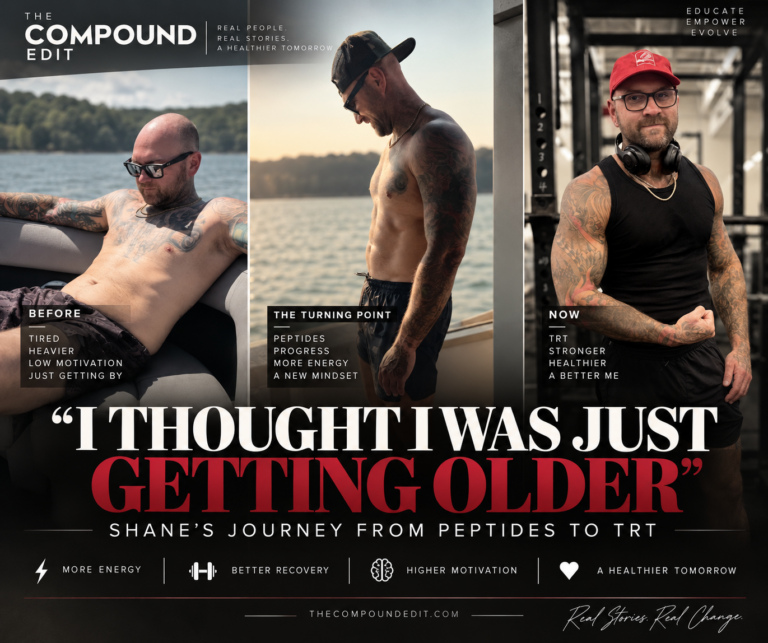
- I Thought I Was Just Getting Older: Shane’s Journey From Peptides to TRT
- Creatine Isn’t Just for Bodybuilders
Continue Exploring
The Compound Edit is affiliated with Chuk BioWorks. While the two share an ownership connection, our editorial goal is to explore scientific research with transparency, including limitations, uncertainties, and potential risks.
Research & Sources
- Smit DL, et al. Disruption and Recovery of Testicular Function During and After Androgen Abuse: The HAARLEM Study. Human Reproduction. 2021. https://doi.org/10.1093/humrep/deaa366
- Smit DL, et al. Positive and Negative Side Effects of Androgen Abuse: The HAARLEM Study. Scandinavian Journal of Medicine & Science in Sports. 2021. https://doi.org/10.1111/sms.13843
- Windfeld-Mathiasen J, et al. Cardiovascular Disease in Anabolic Androgenic Steroid Users. Circulation. 2025. https://doi.org/10.1161/CIRCULATIONAHA.124.071117
- Botman E, Smit DL, de Ronde W. Clinical Question: How to Manage Symptoms of Hypogonadism in Patients After Androgen Abuse? Clinical Endocrinology. 2023. https://doi.org/10.1111/cen.14686
Medical Disclaimer
This article is intended for educational purposes only and does not constitute medical advice or instructions for anabolic steroid use.
Nonmedical anabolic steroid use carries significant cardiovascular, reproductive, endocrine, and other health risks. The terms discussed here describe practices reported in bodybuilding communities, not medically validated or recommended treatment protocols.
Stay curious. Keep learning. Continue exploring.