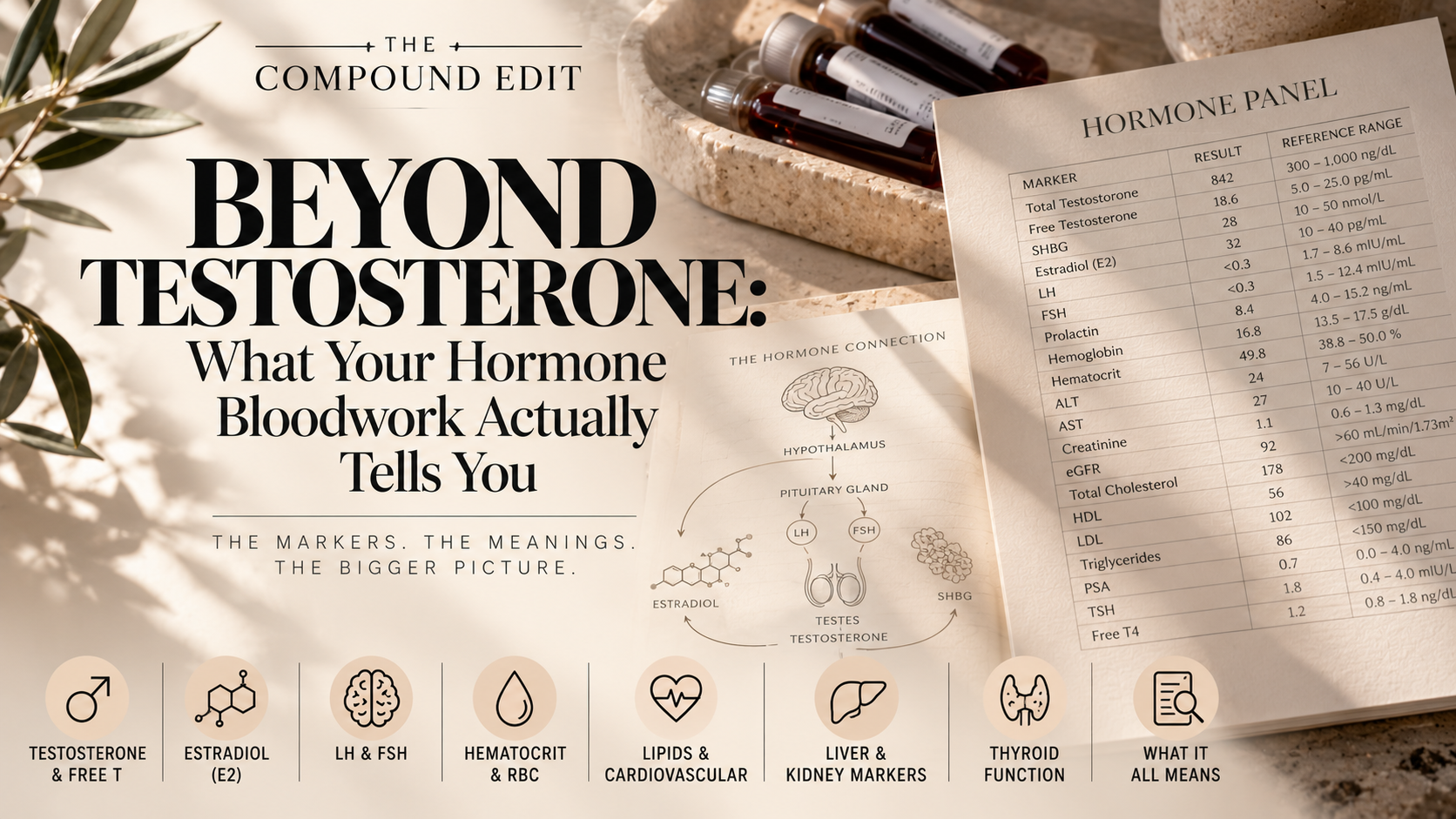
Beyond Testosterone: What Your Hormone Bloodwork Actually Tells You
The Compound Edit | Hormones, Health & Performance
You get your bloodwork back.
You open the results.
And suddenly, you’re staring at a page full of numbers, abbreviations, reference ranges, and little flags telling you what’s high and what’s low.
Maybe your testosterone looks great.
Maybe your estradiol is flagged.
Maybe your hematocrit has crept up.
Or maybe everything falls within the laboratory’s normal range, but you still don’t feel like yourself.
So what do those numbers actually mean?
Hormone bloodwork can tell us a lot about what’s happening inside the body. But individual results rarely tell the whole story.
That’s especially true when we’re talking about testosterone replacement therapy, anabolic steroid exposure, training performance, energy, libido, and recovery.
Because testosterone doesn’t operate independently.
It’s part of an interconnected endocrine system.
And understanding that system requires looking beyond one number.
Let’s break down the markers people commonly discuss, what they measure, and why the context surrounding them matters just as much as the result itself.
First, What Is a Reference Range?
Before we discuss specific hormones, we need to understand something that causes a lot of confusion.
A laboratory reference range is not necessarily the same thing as an individual’s ideal level.
Reference intervals are generally developed using measurements from a defined reference population.
The exact ranges can differ between laboratories because of differences in testing methods, populations, and other factors.
That means a result flagged as slightly high at one laboratory might fall within another laboratory’s reference interval.
And a result within range doesn’t automatically rule out a medical problem.
Normal Doesn’t Always Mean Optimal
You’ve probably seen people online describe their hormone levels as optimal.
But optimal for what?
Sexual function?
Fertility?
Bone health?
Athletic performance?
General well-being?
There isn’t one universal testosterone number that guarantees all of those outcomes.
And there isn’t a scientifically established perfect hormone panel for everyone.
A laboratory value is one piece of clinical information—not a complete description of someone’s health.
1. Total Testosterone: The Number Everyone Talks About
Total testosterone is usually the first number people look for.
And for good reason.
Testosterone is involved in multiple physiological functions, including sexual development, reproductive function, bone health, red blood cell production, and muscle maintenance.
But total testosterone measures more than the hormone that’s immediately available to tissues.
It includes testosterone circulating in different forms.
Some is bound tightly to sex hormone-binding globulin, or SHBG.
Some is bound more loosely to albumin.
And a small portion circulates unbound.
That brings us to our next marker.
2. Free Testosterone: Why Total Testosterone Isn’t the Whole Picture
Free testosterone refers to testosterone that isn’t bound to circulating proteins.
It represents a relatively small fraction of total testosterone.
But it can be clinically relevant, especially when SHBG levels are unusually high or low.
How Can Two People Have Similar Total Testosterone but Different Free Testosterone?
Imagine two people with similar total testosterone levels.
One has relatively high SHBG.
The other has relatively low SHBG.
The amount of testosterone circulating in the unbound fraction may differ substantially.
That’s one reason total testosterone alone may not explain every situation.
However, there’s an important testing issue.
Not all free testosterone tests are equally reliable.
Some direct free testosterone assays have limitations.
Clinical guidelines often favor equilibrium dialysis or appropriately calculated free testosterone using reliable total testosterone and SHBG measurements when free testosterone assessment is needed.
So when someone says their free testosterone is high or low, the method used to measure or calculate it matters.
3. SHBG: The Hormone Marker That Changes the Interpretation
SHBG stands for sex hormone-binding globulin.
It’s a protein produced primarily by the liver.
Its job includes binding circulating sex hormones, particularly testosterone and estradiol.
SHBG affects the distribution of testosterone between bound and unbound forms.
What Can Influence SHBG?
SHBG levels can be influenced by several factors, including:
- Age.
- Thyroid function.
- Liver health.
- Metabolic conditions.
- Certain medications.
- Hormonal exposure.
This is why SHBG can help explain why total testosterone and free testosterone don’t always tell the same story.
But high or low SHBG isn’t automatically a diagnosis.
It’s a marker that needs context.
4. Estradiol: Yes, Men Need Estrogen Too
Estradiol is one of the main forms of estrogen.
And despite what some bodybuilding conversations might suggest, estrogen isn’t exclusively a female hormone.
Men produce estradiol too.
Much of it is formed when testosterone is converted by the enzyme aromatase.
Estradiol plays important roles in bone health and other physiological processes.
Why Does Estradiol Matter During TRT?
When testosterone levels change, estradiol levels may change too.
But the relationship isn’t identical for everyone.
A person receiving testosterone therapy may have higher estradiol than they did before treatment.
That doesn’t automatically mean the level is dangerous or requires suppression.
And symptoms such as fluid retention, mood changes, or libido changes aren’t specific enough to diagnose an estradiol problem on their own.
Can Estradiol Be Too Low?
Yes.
Very low estradiol can negatively affect bone health and may contribute to other symptoms.
This is one reason aggressive attempts to suppress estrogen can create problems.
Estradiol isn’t simply a side effect of testosterone. It’s a hormone with important physiological functions.
Testing methods also matter, particularly when measuring the relatively low estradiol concentrations commonly found in men.
5. LH and FSH: What Is Your Brain Telling Your Testes?
Now we’re getting into one of the most informative parts of hormone bloodwork.
LH stands for luteinizing hormone.
FSH stands for follicle-stimulating hormone.
Both are produced by the pituitary gland.
And both are essential to normal male reproductive function.
LH
LH signals the Leydig cells in the testes to produce testosterone.
FSH
FSH works with intratesticular testosterone and other local signals to support sperm production.
Together, these hormones provide information about how the brain and testes are communicating.
Why Are LH and FSH Important Before TRT?
If someone has consistently low testosterone, LH and FSH can help distinguish different patterns of hypogonadism.
For example:
- Low testosterone with elevated LH may suggest impaired testicular function.
- Low testosterone with low or inappropriately normal LH may suggest a hypothalamic or pituitary component.
These are simplified patterns, not diagnoses by themselves.
Additional testing may be needed depending on the situation.
What Happens to LH and FSH During Testosterone Therapy?
Exogenous testosterone can suppress the body’s normal hormonal feedback system.
As a result, LH and FSH often decrease.
This can happen even when circulating testosterone levels are high.
And it helps explain why testosterone therapy can impair sperm production.
High testosterone on bloodwork doesn’t mean the testes are producing that testosterone naturally.
6. Hemoglobin and Hematocrit: Why Blood Counts Matter
This is one of the most important areas to understand when discussing testosterone therapy.
Testosterone can stimulate red blood cell production.
That means hemoglobin and hematocrit may increase.
What’s the Difference?
Hemoglobin is the oxygen-carrying protein inside red blood cells.
Hematocrit represents the proportion of blood volume occupied by red blood cells.
When hematocrit becomes elevated, it can raise concerns about increased blood viscosity and potential complications.
Testosterone-associated erythrocytosis is a recognized adverse effect of therapy.
Clinical guidelines recommend monitoring hematocrit during testosterone treatment.
Does High Hematocrit Automatically Mean Someone Will Have a Blood Clot?
No.
Risk depends on multiple factors, and the relationship between testosterone-associated erythrocytosis and cardiovascular events is still being studied.
But elevated hematocrit should not be ignored.
It may require evaluation of testosterone exposure, sleep apnea, smoking, dehydration, or other contributing factors.
And a normal hemoglobin or hematocrit doesn’t rule out other cardiovascular risks.
7. Lipid Panels: The Numbers That Don’t Always Get Enough Attention
A lipid panel measures cholesterol and triglycerides.
Common components include:
- Total cholesterol.
- LDL cholesterol.
- HDL cholesterol.
- Triglycerides.
These markers are important because cardiovascular risk isn’t determined by testosterone levels alone.
Why Does This Matter With Anabolic Steroids?
Nonmedical anabolic-androgenic steroid use can negatively affect lipid profiles.
Some anabolic steroids can substantially lower HDL cholesterol and alter LDL cholesterol.
Those changes may occur without noticeable symptoms.
Someone can feel strong, energetic, and physically fit while developing unfavorable cardiovascular markers.
This is why bloodwork should never be interpreted solely through the lens of muscle growth or gym performance.
8. Liver Enzymes: What AST and ALT Can—and Can’t—Tell You
AST and ALT are enzymes commonly included in blood chemistry panels.
Elevations can indicate liver injury.
But here’s something interesting.
AST is also present in skeletal muscle.
And strenuous exercise can sometimes increase AST and ALT levels.
That means an elevated result after intense training doesn’t automatically establish liver disease.
However, it also shouldn’t automatically be dismissed as just from lifting.
The pattern of results, recent activity, medications, supplements, symptoms, and other testing may all matter.
Some oral anabolic steroids are associated with significant liver injury.
And liver damage can occur even when someone feels relatively well.
9. Kidney Markers: Creatinine Isn’t Always Simple in Lifters
Creatinine is a waste product related to muscle metabolism.
It’s commonly used to estimate kidney filtration through calculations such as estimated glomerular filtration rate, or eGFR.
But creatinine can be influenced by muscle mass, diet, and creatine supplementation.
That can complicate interpretation in people with unusually high muscle mass.
Does a High Creatinine Level Mean Your Kidneys Are Failing?
Not necessarily.
But it also doesn’t mean the result should be ignored.
Depending on the circumstances, additional information—such as urine albumin testing or cystatin C—may help clarify kidney function.
The key is to interpret kidney markers in context rather than relying on a single value.
10. PSA: Why Prostate Monitoring Comes Up During TRT
PSA stands for prostate-specific antigen.
It’s a protein produced by prostate tissue.
PSA testing can be relevant when evaluating prostate health, including in some men considering or receiving testosterone therapy.
But PSA isn’t a cancer diagnosis.
Levels can be influenced by several benign and malignant conditions.
Whether PSA testing is appropriate depends on age, individual risk, medical history, and shared decision-making.
And PSA results require careful interpretation rather than treating any single value as definitive.
11. Prolactin: When Another Hormone Enters the Conversation
Prolactin is a hormone produced by the pituitary gland.
It’s best known for its role in lactation, but it also has effects on reproductive hormone regulation.
Elevated prolactin can sometimes contribute to low testosterone, reduced libido, or other reproductive symptoms.
But prolactin can increase temporarily due to stress, sleep, exercise, and other factors.
Certain medications can also raise prolactin.
A single mildly elevated result may not tell the whole story.
Persistent or significant elevations may require further evaluation.
And prolactin testing isn’t automatically necessary for every person simply because they’re interested in testosterone.
12. Thyroid Hormones: When Fatigue Isn’t Just About Testosterone
Fatigue, difficulty concentrating, changes in weight, and reduced exercise tolerance can have many causes.
Thyroid dysfunction is one possibility.
Common thyroid tests include TSH and free T4.
These help evaluate thyroid hormone regulation.
But thyroid testing isn’t a substitute for testosterone testing, and vice versa.
Someone can have normal testosterone and still experience symptoms from an unrelated condition.
This is why focusing exclusively on testosterone can sometimes cause people to overlook other explanations for how they feel.
What Does a Hormone Panel Actually Tell You?
Let’s put everything together.
| Marker | What it helps assess |
|---|---|
| Total testosterone | Overall circulating testosterone |
| Free testosterone | Unbound testosterone, particularly useful in selected situations |
| SHBG | Testosterone-binding dynamics |
| Estradiol | Estrogen status and testosterone conversion |
| LH | Pituitary signaling to testosterone-producing cells |
| FSH | Pituitary signaling involved in sperm production |
| Hemoglobin/hematocrit | Red blood cell status |
| Lipid panel | Cardiovascular risk factors |
| AST/ALT | Possible liver or muscle-related enzyme changes |
| Creatinine/eGFR | Estimated kidney filtration |
| PSA | Prostate-related assessment in appropriate contexts |
| Prolactin | Selected pituitary and reproductive hormone concerns |
| TSH/free T4 | Thyroid function |
Not everyone needs every test.
The most useful laboratory evaluation depends on symptoms, medical history, medications, and the specific question being investigated.
Why Timing Matters
Here’s something that often gets overlooked.
Hormone levels aren’t perfectly constant.
In men who aren’t receiving testosterone therapy, testosterone generally follows a daily rhythm, with higher levels commonly occurring in the morning.
That is one reason guidelines recommend morning testing when evaluating possible testosterone deficiency.
Illness, sleep disruption, and other circumstances can also affect results.
For people receiving injectable testosterone, the timing of a blood draw relative to administration can substantially influence the measured level.
Different testosterone formulations have different pharmacokinetic patterns.
Two results taken at different points in a dosing interval may not be directly comparable.
And when you’re tracking trends over time, consistency in testing conditions can make the information more meaningful.
Why Symptoms Matter Just as Much as Numbers
Imagine someone has a total testosterone result within the laboratory reference range.
But they’re experiencing persistent fatigue.
Does that mean testosterone is definitely the problem?
No.
Does it mean their symptoms aren’t real?
Also no.
It means the evaluation needs to consider more than one number.
Sleep quality, nutrition, psychological stress, medications, thyroid function, anemia, and other conditions may contribute to similar symptoms.
Likewise, someone can have a high testosterone result and still experience health problems unrelated to testosterone deficiency.
Bloodwork should help explain the clinical picture—not replace it.
Why More Testosterone Isn’t Always Better
This is a particularly important point in performance-focused communities.
Testosterone has clear physiological effects on muscle and other tissues.
But that doesn’t mean continuously increasing testosterone produces proportionally greater health benefits.
Higher androgen exposure can also increase adverse effects.
And improvements in strength or muscle size don’t eliminate risks involving fertility, cardiovascular health, red blood cell production, or other organ systems.
A laboratory value above the normal range isn’t automatically evidence of superior health.
In fact, for medically prescribed testosterone replacement, the objective is generally to restore appropriate physiological levels—not to maximize the number on a laboratory report.
What About People Using Anabolic Steroids?
This is where interpretation becomes even more complicated.
Different anabolic steroids can affect laboratory markers in different ways.
And routine testosterone tests don’t necessarily measure the total androgenic activity of every synthetic compound.
Someone may have a testosterone result that looks relatively ordinary while still being exposed to significant androgenic effects from other substances.
Additionally, certain substances can interfere with laboratory assays.
This means a basic hormone panel may not fully describe the physiological effects of a complex anabolic steroid regimen.
It’s another reason that relying on a few supposedly perfect bloodwork numbers can create a false sense of security.
Can Bloodwork Tell You If Your Hormones Have Recovered?
Sometimes it can provide useful evidence.
For example, after discontinuing exogenous testosterone, changes in total testosterone, LH, and FSH can help assess whether the HPG axis is recovering.
But a single test doesn’t establish the entire recovery trajectory.
And testosterone recovery isn’t identical to fertility recovery.
Sperm production can take considerably longer to normalize.
That’s why someone interested in fertility may need a different evaluation from someone whose main concern is testosterone concentration.
The specific question matters.
The Biggest Mistake People Make With Bloodwork
I think the biggest mistake is treating laboratory results like a scorecard.
Higher testosterone equals better.
Lower estrogen equals better.
Lower body fat equals better.
More red blood cells equals better endurance.
But biology doesn’t work that way.
Hormones exist within feedback systems.
And pushing one marker in a particular direction can affect several others.
A healthy endocrine system isn’t defined by maximizing every number. It’s defined by coordinated physiological function.
The goal of testing is to understand what’s happening—not to win a competition against a reference range.
The Compound Edit Takeaway
Hormone bloodwork can be incredibly informative.
But total testosterone is only the beginning.
Free testosterone and SHBG help explain hormone availability.
LH and FSH provide information about reproductive hormone signaling.
Estradiol plays important roles in both men and women.
And markers such as hematocrit, lipids, liver enzymes, and kidney function help reveal aspects of health that testosterone alone cannot capture.
The most important lesson?
One number rarely tells the whole story.
Your symptoms, medical history, medications, timing of testing, and overall health all influence how laboratory results should be interpreted.
And when it comes to hormones, more isn’t automatically better.
Understanding the system is far more valuable than chasing the highest number.
Keep Exploring on The Compound Edit
Want to learn more about the hormones and research behind these conversations?
- Have You Ever Thought About Starting Your TRT Journey?
- I Thought I Was Just Getting Older: Shane’s Journey From Peptides to TRT
- Anavar Has a Reputation as the “Mild” Steroid. Is It Actually Mild?
- Creatine Isn’t Just for Bodybuilders: What It Actually Does to Muscle, Strength, and the Scale
Continue Exploring
The Compound Edit is dedicated to exploring the science, research, and real conversations surrounding peptides, hormones, metabolism, performance, and longevity.
The Compound Edit is affiliated with Chuk BioWorks. While the two share an ownership connection, our editorial goal is to explore scientific research with transparency, including limitations, uncertainties, and potential risks.
Research & Sources
- Bhasin S, et al. Testosterone Therapy in Men With Hypogonadism: An Endocrine Society Clinical Practice Guideline. Journal of Clinical Endocrinology & Metabolism. 2018. https://doi.org/10.1210/jc.2018-00229
- Mulhall JP, et al. Evaluation and Management of Testosterone Deficiency: AUA Guideline. American Urological Association. https://www.auanet.org/guidelines-and-quality/guidelines/testosterone-deficiency-guideline
- Handelsman DJ, et al. Free Testosterone: Pumping Up the Tires or Ending the Free Ride? Endocrine Reviews. 2024. https://doi.org/10.1210/endrev/bnae001
- Smit DL, et al. Disruption and Recovery of Testicular Function During and After Androgen Abuse: The HAARLEM Study. Human Reproduction. 2021. https://doi.org/10.1093/humrep/deaa366
- National Institute of Diabetes and Digestive and Kidney Diseases. Creatinine and Cystatin C. https://www.niddk.nih.gov/health-information/professionals/clinical-tools-patient-management/kidney-disease/laboratory-evaluation/glomerular-filtration-rate/creatinine-cystatin-c
Medical Disclaimer
The content published on The Compound Edit is intended for educational and informational purposes only and does not constitute medical advice, diagnosis, or treatment.
Laboratory results require interpretation in the context of an individual’s health history, symptoms, medications, and testing methods. This article is not intended to provide individualized laboratory targets, testosterone dosing recommendations, or instructions for anabolic steroid use.
Stay curious. Keep learning. Continue exploring.